Technical Specifications
| Brand | Honda |
| Model | FIT |
| Generation | Fit IV (GR1) |
| Type (Engine) | Crosstar 1.3 (98 Hp) CVT |
| Start of production | February, 2020 |
| Powertrain Architecture | Internal Combustion engine |
| Body type | Hatchback |
| Seats | 5 |
| Doors | 5 |
| Fuel consumption at Low speed (WLTP) | 6.2 l/100 km (37.9 US mpg, 45.6 UK mpg, 16.1 km/l) |
| Fuel consumption at Medium speed (WLTP) | 4.9 l/100 km (48 US mpg, 57.6 UK mpg, 20.4 km/l) |
| Fuel consumption at high speed (WLTP) | 4.6 l/100 km (51.1 US mpg, 61.4 UK mpg, 21.7 km/l) |
| Combined fuel consumption (WLTP) | 5.1 l/100 km (46.1 US mpg, 55.4 UK mpg, 19.6 km/l) |
| Fuel consumption (economy) – combined | 4.5 l/100 km (52.3 US mpg, 62.8 UK mpg, 22.2 km/l) |
| Fuel Type | Petrol (Gasoline) |
| Weight-to-power ratio | 11.2 kg/Hp, 89.1 Hp/tonne |
| Weight-to-torque ratio | 9.3 kg/Nm, 107.3 Nm/tonne |
| Power | 98 Hp @ 6000 rpm |
| Power per litre | 74.4 Hp/l |
| Torque | 118 Nm @ 5000 rpm (87.03 lb.-ft. @ 5000 rpm) |
| Engine layout | Front, Transverse |
| Engine Model/Code | L13B |
| Engine displacement | 1317 cm3 (80.37 cu. in.) |
| Number of cylinders | 4 |
| Engine configuration | Inline |
| Cylinder Bore | 73 mm (2.87 in.) |
| Piston Stroke | 78.7 mm (3.1 in.) |
| Compression ratio | 13.5:1 |
| Number of valves per cylinder | 4 |
| Fuel injection system | Direct injection |
| Engine aspiration | Naturally aspirated engine |
| Valvetrain | DOHC |
| Engine oil capacity | 3.3 l (3.49 US qt | 2.9 UK qt) |
| Kerb Weight | 1100 kg (2425.08 lbs.) |
| Fuel tank capacity | 40 l (10.57 US gal | 8.8 UK gal) |
| Length | 4090 mm (161.02 in.) |
| Width | 1725 mm (67.91 in.) |
| Height | 1545 mm (60.83 in.) |
| Wheelbase | 2530 mm (99.61 in.) |
| Front track | 1495 mm (58.86 in.) |
| Rear (Back) track | 1485 mm (58.46 in.) |
| Ride height (ground clearance) | 160 mm (6.3 in.) |
| Minimum turning circle (turning diameter) | 10 m (32.81 ft.) |
| Drivetrain Architecture | The Internal combustion engine (ICE) drives the front wheels of the vehicle. |
| Drive wheel | Front wheel drive |
| Number of gears and type of gearbox | automatic transmission CVT |
| Front suspension | Independent type McPherson |
| Rear suspension | Torsion |
| Front brakes | Ventilated discs |
| Rear brakes | Disc |
| Assisting systems | ABS (Anti-lock braking system) |
| Steering type | Steering rack and pinion |
| Power steering | Electric Steering |
| Tires size | 185/60 R16 86H |
| Wheel rims size | 16 |
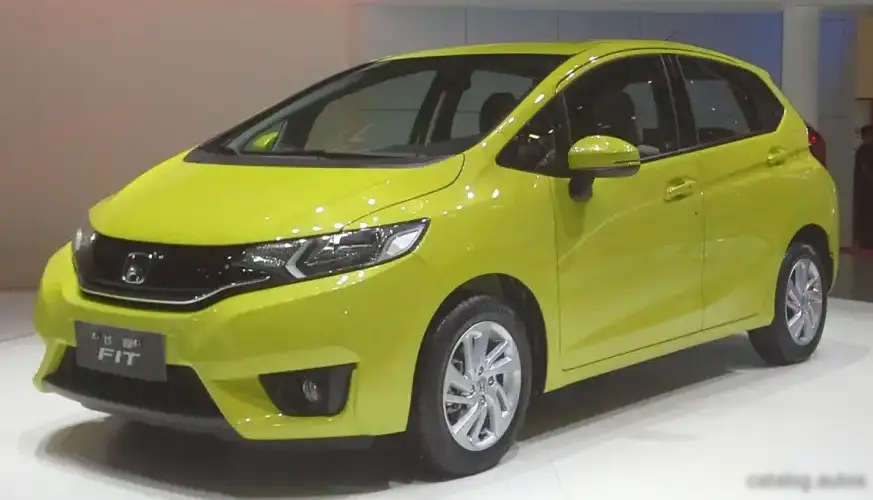
The Honda Fit IV (GR1) Crosstar 1.3 CVT, introduced in February 2020, is a subcompact hatchback variant of the fourth-generation Honda Fit (known as the Jazz in some international markets). The Crosstar distinguishes itself with a more rugged aesthetic, featuring increased ground clearance, distinctive body cladding, and standard roof rails. Powered by a 98-horsepower 1.3-liter engine coupled with a Continuously Variable Transmission (CVT), this model was primarily aimed at European and Japanese consumers seeking a fuel-efficient, versatile, and stylish vehicle for urban and light recreational use. It represents Honda’s ongoing commitment to maximizing interior space and fuel economy within a small vehicle footprint.
Powertrain & Engine Architecture
The Crosstar 1.3 CVT is powered by Honda’s L13B engine, a 1317cc inline-four cylinder gasoline engine. This engine incorporates direct fuel injection, a technology that improves combustion efficiency and reduces emissions. The L13B boasts a double overhead camshaft (DOHC) valvetrain with four valves per cylinder, optimizing airflow for enhanced power output. It produces 98 horsepower at 6000 rpm and 118 Nm (87 lb-ft) of torque at 5000 rpm. A high compression ratio of 13.5:1 further contributes to the engine’s thermal efficiency. The engine is paired with a Continuously Variable Transmission (CVT), designed for smooth and efficient power delivery. Unlike conventional automatic transmissions with fixed gear ratios, the CVT utilizes a belt-and-pulley system to provide a virtually infinite number of gear ratios, allowing the engine to operate at its most efficient speed for any given driving condition. A standard Start & Stop system automatically shuts off the engine when the vehicle is stationary, further improving fuel economy.
Driving Characteristics
The 1.3-liter engine and CVT combination in the Crosstar prioritizes fuel efficiency over outright performance. While sufficient for daily commutes and city driving, the powertrain can feel somewhat underpowered when fully loaded or during overtaking maneuvers. The CVT, while providing smooth acceleration, can sometimes exhibit a “rubber band” effect, where engine speed increases without a proportional increase in vehicle speed. The CVT’s programming emphasizes fuel economy, maintaining lower engine speeds whenever possible. Compared to Fit IV models equipped with the larger 1.5-liter engine, the 1.3L Crosstar offers a more relaxed and economical driving experience. The Crosstar’s increased ride height, while enhancing its rugged appearance, also raises the center of gravity slightly, resulting in a bit more body roll during cornering compared to the standard Fit.
Equipment & Trim Levels
The Crosstar 1.3 CVT typically came standard with a reasonable array of features. Interior appointments included cloth upholstery, a basic infotainment system with a touchscreen display (screen size varied depending on the market), and manual air conditioning. Standard safety features included ABS, electronic stability control, and multiple airbags. Optional extras often included Honda’s Sensing suite of advanced driver-assistance systems (ADAS), which encompassed adaptive cruise control, lane keeping assist, and collision mitigation braking. Higher trim levels within the Crosstar range offered upgrades such as automatic climate control, enhanced audio systems, and alloy wheels. The interior design prioritized maximizing space and practicality, featuring Honda’s innovative “Magic Seats” which provide versatile seating configurations.
Chassis & Braking
The Crosstar 1.3 utilizes a McPherson strut front suspension and a torsion beam rear suspension. This configuration provides a comfortable ride quality suitable for everyday driving conditions. The front brakes are ventilated discs, while the rear brakes are solid discs. The Crosstar’s increased ride height, approximately 160mm (6.3 inches), provides improved ground clearance compared to the standard Fit, enhancing its ability to navigate uneven road surfaces. The steering system is an electric power steering (EPS) rack and pinion, offering light and responsive steering feel. The standard tire size is 185/60 R16, striking a balance between ride comfort and handling.
Market Reception & Comparison
The Honda Fit IV Crosstar 1.3 CVT was generally well-received by automotive critics for its fuel efficiency, spacious interior, and practical features. However, the engine’s limited power output was a common point of criticism. Compared to other trims in the Fit lineup, such as those equipped with the 1.5-liter engine, the 1.3L Crosstar offered a more affordable entry point but at the expense of performance. In terms of fuel economy, the 1.3L CVT consistently outperformed the higher-output variants, making it an appealing option for budget-conscious buyers. Reliability was generally considered excellent, consistent with Honda’s reputation for building durable and dependable vehicles.
Legacy
The Honda Fit IV Crosstar 1.3 CVT has proven to be a reliable and economical vehicle in the used car market. The L13B engine and CVT transmission are generally considered durable and require minimal maintenance. The vehicle’s spacious interior and versatile seating configurations continue to appeal to buyers seeking a practical and efficient subcompact hatchback. While not designed for high-performance driving, the Crosstar 1.3 CVT remains a popular choice for those prioritizing fuel economy, reliability, and everyday usability. Its blend of practicality and efficiency ensures its continued relevance in the used car market for years to come.