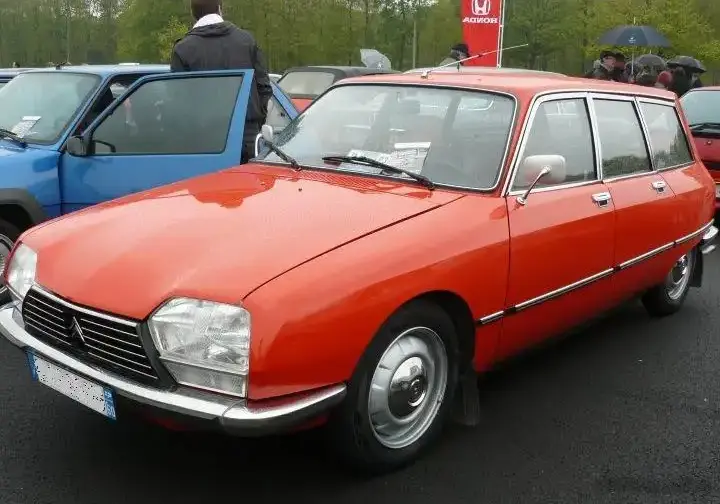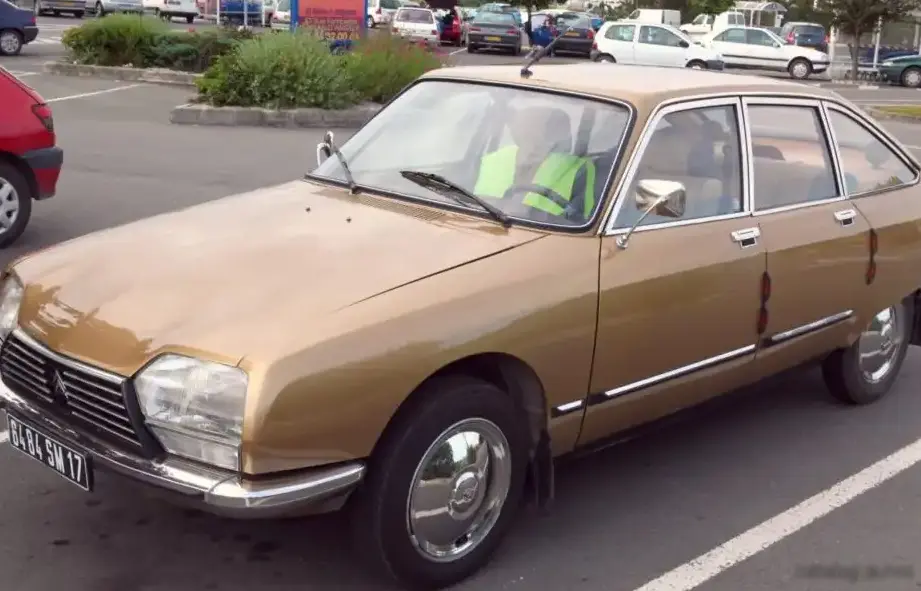
The Citroën GS 1.0, produced between 1970 and 1977, represents the entry point into Citroën’s innovative GS range. This model, powered by a modest 1.0-liter engine producing 56 horsepower, served as the foundation for a car that would become renowned for its advanced hydropneumatic suspension and aerodynamic design. Positioned as the most affordable variant of the GS, it aimed to bring Citroën’s forward-thinking technology to a wider audience. The GS itself was a significant vehicle for Citroën, representing a departure from their traditionally curvaceous designs and embracing a more modern, angular aesthetic. It was built on a new platform, intended to offer a blend of comfort, performance, and practicality.
Technical Specifications
| Brand | Citroen |
| Model | GS |
| Generation | GS |
| Type (Engine) | 1.0 (56 Hp) |
| Start of production | 1970 |
| End of production | 1977 |
| Powertrain Architecture | Internal Combustion engine |
| Body type | Hatchback |
| Seats | 5 |
| Doors | 4 |
| Fuel consumption (combined) | 9.3 l/100 km |
| Fuel consumption (US mpg) | 25.3 US mpg |
| Fuel consumption (UK mpg) | 30.4 UK mpg |
| Fuel consumption (km/l) | 10.8 km/l |
| Fuel Type | Petrol (Gasoline) |
| Acceleration 0 – 100 km/h | 18.3 sec |
| Acceleration 0 – 62 mph | 18.3 sec |
| Acceleration 0 – 60 mph | 17.4 sec |
| Maximum speed | 148 km/h |
| Maximum speed (mph) | 91.96 mph |
| Weight-to-power ratio | 15.5 kg/Hp |
| Power | 56 Hp @ 6250 rpm |
| Power per litre | 55.2 Hp/l |
| Maximum engine speed | 6500 rpm |
| Engine layout | Front, Longitudinal |
| Engine Model/Code | G10/612 |
| Engine displacement | 1015 cm3 |
| Engine displacement (cu. in.) | 61.94 cu. in. |
| Number of cylinders | 4 |
| Engine configuration | Boxer |
| Cylinder Bore | 74 mm |
| Cylinder Bore (in.) | 2.91 in. |
| Piston Stroke | 59 mm |
| Piston Stroke (in.) | 2.32 in. |
| Compression ratio | 9:1 |
| Fuel injection system | Carburettor |
| Engine aspiration | Naturally aspirated engine |
| Engine oil capacity | 4.2 l |
| Engine oil capacity (US qt) | 4.44 US qt |
| Engine oil capacity (UK qt) | 3.7 UK qt |
| Kerb Weight | 867 kg |
| Kerb Weight (lbs) | 1911.41 lbs |
| Max. weight | 1295 kg |
| Max. weight (lbs) | 2854.99 lbs |
| Max load | 428 kg |
| Max load (lbs) | 943.58 lbs |
| Trunk (boot) space – minimum | 465 l |
| Trunk (boot) space – minimum (cu. ft.) | 16.42 cu. ft. |
| Fuel tank capacity | 43 l |
| Fuel tank capacity (US gal) | 11.36 US gal |
| Fuel tank capacity (UK gal) | 9.46 UK gal |
| Length | 4120 mm |
| Length (in.) | 162.2 in. |
| Width | 1608 mm |
| Width (in.) | 63.31 in. |
| Height | 1349 mm |
| Height (in.) | 53.11 in. |
| Wheelbase | 2550 mm |
| Wheelbase (in.) | 100.39 in. |
| Front track | 1378 mm |
| Front track (in.) | 54.25 in. |
| Rear (Back) track | 1328 mm |
| Rear (Back) track (in.) | 52.28 in. |
| Front overhang | 818 mm |
| Front overhang (in.) | 32.2 in. |
| Rear overhang | 752 mm |
| Rear overhang (in.) | 29.61 in. |
| Minimum turning circle | 10.2 m |
| Minimum turning circle (ft) | 33.46 ft |
| Drivetrain Architecture | The Internal combustion engine (ICE) drives the front wheels of the vehicle. |
| Drive wheel | Front wheel drive |
| Number of gears | 4 |
| Gearbox type | manual transmission |
| Front suspension | Hydro-pneumatic element, Double wishbone |
| Rear suspension | Hydro-pneumatic element, Trailing arm |
| Front brakes | Disc, 270 mm |
| Rear brakes | Disc, 176 mm |
| Steering type | Steering rack and pinion |
| Wheel rims size | 4.5J x 15 |
Powertrain & Engine Architecture
The Citroën GS 1.0 was powered by the G10/612 engine, a 1015cc, naturally aspirated, four-cylinder boxer engine. This engine, while relatively small, was a key component of the GS’s innovative design. The boxer configuration, with horizontally opposed cylinders, contributed to a lower center of gravity, enhancing stability and handling. The engine utilized a single carburetor for fuel delivery, a common practice for engines of this era. The valvetrain employed an overhead camshaft, a relatively advanced feature for a car in this price bracket. The 56 horsepower output was modest, but the engine’s smooth operation and relatively high-revving nature were appreciated. The GS 1.0 was exclusively offered with a four-speed manual transmission, designed to make the most of the engine’s power band. The longitudinal engine placement, coupled with front-wheel drive, was a defining characteristic of the GS platform.
Driving Characteristics
The driving experience in the GS 1.0 was defined by its unique suspension. The hydropneumatic system, also found in Citroën’s flagship DS and ID models, provided an exceptionally smooth and comfortable ride, absorbing bumps and imperfections in the road with remarkable ease. However, the 56 horsepower engine and four-speed manual transmission meant that performance was not a strong suit. Acceleration was leisurely, and overtaking required careful planning. Compared to the later GS 1.6 and GS 1.9 models, the 1.0 felt significantly underpowered. The gear ratios were optimized for fuel economy and relaxed cruising rather than outright speed. While the manual transmission offered a more engaging driving experience than the later automatics, it couldn’t fully compensate for the engine’s limitations. The steering, aided by power assistance, was light and precise, contributing to the car’s surprisingly nimble handling.
Equipment & Trim Levels
The GS 1.0 was positioned as the entry-level model, and its equipment level reflected this. Standard features included cloth upholstery, basic instrumentation, and a heater. The interior was functional and well-designed, but lacked the luxurious appointments found in higher-spec GS models. Optional extras included a radio, upgraded upholstery, and a sunroof. The dashboard layout was typically Citroën – unconventional and focused on ergonomics. The GS 1.0 generally featured simpler exterior trim compared to its more powerful siblings, with less chrome detailing and smaller wheels. The focus was on providing a comfortable and practical car at an affordable price point.
Chassis & Braking
The GS featured a monocoque chassis, providing a strong and rigid platform. The front suspension utilized a double wishbone configuration combined with the hydropneumatic elements, while the rear suspension employed a trailing arm design, also incorporating the hydropneumatic system. This setup provided exceptional ride quality and handling. The GS 1.0 was equipped with disc brakes on all four wheels, a relatively advanced feature for a car of its size and price in the early 1970s. The brakes provided adequate stopping power, although they could feel somewhat lacking when pushed hard. The steering was a rack and pinion system, offering precise and responsive control. The 15-inch wheels were typically fitted with 165-series tires.
Market Reception & Comparison
The Citroën GS 1.0 received mixed reviews upon its launch. Critics praised the car’s innovative suspension and comfortable ride, but many found the engine to be underpowered. Compared to rivals like the Renault 16 and Peugeot 504, the GS 1.0 offered a more sophisticated driving experience but lacked the outright performance of some competitors. Fuel economy was reasonable for the time, averaging around 25.3 US mpg. Reliability was generally good, although the hydropneumatic suspension required periodic maintenance. The GS 1.0 appealed to buyers who prioritized comfort and innovation over performance, and it found a niche market among those seeking a unique and technologically advanced car.
Legacy
The Citroën GS 1.0, while not the most powerful or fastest variant of the GS range, played a crucial role in establishing the model as a technological leader. The hydropneumatic suspension and aerodynamic design were groundbreaking features that set the GS apart from its competitors. Today, the GS 1.0 is a sought-after classic car, appreciated by enthusiasts for its unique character and innovative engineering. The 1.0-liter engine, while modest in output, has proven to be relatively durable, and well-maintained examples are still on the road. Parts availability can be a challenge, but a dedicated community of owners and specialists ensures that the GS continues to be cherished and preserved. The GS 1.0 represents a fascinating chapter in Citroën’s history, showcasing the company’s commitment to innovation and its willingness to challenge conventional automotive design.