Technical Specifications
| Brand | Volkswagen |
| Model | Golf |
| Generation | Golf VII (5-door, facelift 2017) |
| Type (Engine) | GTI 2.0 TSI (230 Hp) |
| Start of production | February, 2017 |
| End of production | May, 2018 |
| Powertrain Architecture | Internal Combustion engine |
| Body type | Hatchback |
| Seats | 5 |
| Doors | 5 |
| Fuel consumption (economy) – urban (NEDC) | 7.8 l/100 km (30.2 US mpg, 36.2 UK mpg, 12.8 km/l) |
| Fuel consumption (economy) – extra urban (NEDC) | 5.5 l/100 km (42.8 US mpg, 51.4 UK mpg, 18.2 km/l) |
| Fuel consumption (economy) – combined (NEDC) | 6.4 l/100 km (36.8 US mpg, 44.1 UK mpg, 15.6 km/l) |
| CO2 emissions (NEDC) | 148 g/km |
| Fuel Type | Petrol (Gasoline) |
| Acceleration 0 – 100 km/h | 6.4 sec |
| Acceleration 0 – 62 mph | 6.4 sec |
| Acceleration 0 – 60 mph | 6.1 sec |
| Maximum speed | 250 km/h (155.34 mph), Electronically limited |
| Emission standard | Euro 6 |
| Weight-to-power ratio | 5.7 kg/Hp, 174.4 Hp/tonne |
| Weight-to-torque ratio | 3.8 kg/Nm, 265.4 Nm/tonne |
| Power | 230 Hp @ 4700-6200 rpm |
| Power per litre | 115.9 Hp/l |
| Torque | 350 Nm @ 1500-4600 rpm (258.15 lb.-ft. @ 1500-4600 rpm) |
| Engine layout | Front, Transverse |
| Engine Model/Code | EA888 / CHHA, CXDB |
| Engine displacement | 1984 cm3 (121.07 cu. in.) |
| Number of cylinders | 4 |
| Engine configuration | Inline |
| Cylinder Bore | 82.5 mm (3.25 in.) |
| Piston Stroke | 92.8 mm (3.65 in.) |
| Compression ratio | 9.6:1 |
| Number of valves per cylinder | 4 |
| Fuel injection system | Direct injection and Multi-port manifold injection |
| Engine aspiration | Turbocharger, Intercooler |
| Valvetrain | DOHC |
| Engine oil capacity | 5.7 l (6.02 US qt | 5.02 UK qt) |
| Kerb Weight | 1319 kg (2907.9 lbs.) |
| Max. weight | 1850 kg (4078.55 lbs.) |
| Max load | 531 kg (1170.65 lbs.) |
| Trunk (boot) space – minimum | 380 l (13.42 cu. ft.) |
| Trunk (boot) space – maximum | 1270 l (44.85 cu. ft.) |
| Fuel tank capacity | 50 l (13.21 US gal | 11 UK gal) |
| Max. roof load | 75 kg (165.35 lbs.) |
| Permitted trailer load with brakes (8%) | 1800 kg (3968.32 lbs.) |
| Permitted trailer load with brakes (12%) | 1600 kg (3527.4 lbs.) |
| Permitted trailer load without brakes | 680 kg (1499.14 lbs.) |
| Permitted towbar download | 80 kg (176.37 lbs.) |
| Length | 4268 mm (168.03 in.) |
| Width | 1799 mm (70.83 in.) |
| Width including mirrors | 2027 mm (79.8 in.) |
| Height | 1482 mm (58.35 in.) |
| Wheelbase | 2626 mm (103.39 in.) |
| Front track | 1527-1550 mm (60.12 – 61.02 in.) |
| Rear (Back) track | 1503-1521 mm (59.17 – 59.88 in.) |
| Ride height (ground clearance) | 133 mm (5.24 in.) |
| Minimum turning circle (turning diameter) | 10.9 m (35.76 ft.) |
| Drivetrain Architecture | The Internal combustion engine (ICE) drives the front wheels of the vehicle. |
| Drive wheel | Front wheel drive |
| Number of gears and type of gearbox | 6 gears, manual transmission |
| Front suspension | Independent, type McPherson with coil spring and anti-roll bar |
| Rear suspension | Independent multi-link spring suspension with stabilizer |
| Front brakes | Ventilated discs |
| Rear brakes | Disc |
| Assisting systems | ABS (Anti-lock braking system) |
| Steering type | Steering rack and pinion |
| Power steering | Electric Steering |
| Tires size | 225/45 R17; 225/40 R18; 225/35 R19 |
| Wheel rims size | 7.5J x 17; 7.5J x 18; 7.5J x 19 |
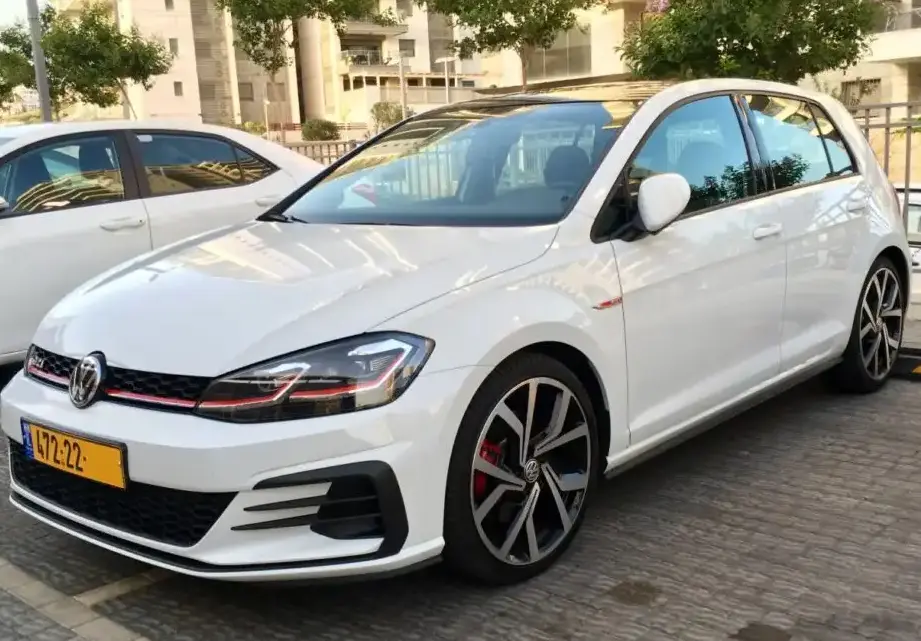
The 2017-2018 Volkswagen Golf VII GTI 2.0 TSI (230 Hp) is a front-wheel-drive, five-door hatchback that represents a mid-cycle refresh of the highly successful seventh-generation Golf. Positioned as a performance-oriented variant, the GTI offered a significant step up in driving engagement compared to the standard Golf models. This particular iteration, with its 230 horsepower output, served as a popular choice for enthusiasts seeking a balance between spirited performance and everyday practicality. It was built on the Volkswagen Group’s MQB platform (A7 iteration), known for its modularity and efficiency. The facelift brought revised front and rear styling, updated infotainment systems, and improvements to the engine for enhanced efficiency and power delivery.
Powertrain & Engine Architecture
At the heart of the Golf VII GTI 2.0 TSI lies the EA888 engine, specifically the CHHA or CXDB code depending on the market. This is a 1.984-liter (121.07 cubic inches) turbocharged and direct-injected inline-four cylinder engine. The engine utilizes a combination of direct injection and multi-port fuel injection, optimizing both power and fuel efficiency. The turbocharger, typically a BorgWarner unit, provides significant boost, contributing to the engine’s 230 horsepower at 4700-6200 rpm and 350 Nm (258.15 lb-ft) of torque between 1500-4600 rpm. The engine features a dual overhead camshaft (DOHC) valvetrain with four valves per cylinder. The 230 hp version typically employed a slightly larger turbocharger and revised engine mapping compared to earlier GTI variants. The engine was paired with a 6-speed manual transmission as standard, offering precise gear changes and a direct connection to the drivetrain. A 7-speed dual-clutch transmission (DSG) was also available as an option, providing quicker shifts and a more automated driving experience.
Driving Characteristics
The Golf VII GTI 2.0 TSI (230 Hp) delivers a responsive and engaging driving experience. The 230 horsepower output provides ample power for both city driving and highway cruising, with a 0-60 mph acceleration time of around 6.1 seconds. The turbocharger provides a noticeable surge of power, but the broad torque curve ensures strong acceleration throughout the rev range. The manual transmission offers a satisfyingly mechanical feel, while the optional DSG provides seamless and rapid gear changes. Compared to the higher-output GTI Performance model, the 230 hp version feels slightly less aggressive, but it remains a highly capable and enjoyable hot hatch. The suspension is well-tuned, providing a comfortable ride while maintaining good body control in corners. The steering is precise and well-weighted, offering good feedback to the driver.
Equipment & Trim Levels
The GTI 2.0 TSI came standard with a comprehensive list of features, including sport seats upholstered in the classic “Clark” plaid fabric, a leather-wrapped steering wheel, and stainless steel pedal caps. Infotainment was typically handled by Volkswagen’s Composition Media or Discover Pro system, featuring a touchscreen display, Bluetooth connectivity, and Apple CarPlay/Android Auto integration. Optional extras included adaptive dampers (DCC), a panoramic sunroof, and a premium sound system. Exterior features included unique GTI styling cues, such as a honeycomb grille, red brake calipers, and a rear spoiler. The interior trim was typically finished in black with red accents, further emphasizing the GTI’s sporty character.
Chassis & Braking
The Golf VII GTI utilizes an independent suspension setup, with a McPherson strut front suspension and a multi-link rear suspension. This configuration provides a good balance between ride comfort and handling performance. The GTI also features a stabilizer bar on both the front and rear axles to reduce body roll during cornering. Braking duties are handled by ventilated disc brakes on all four wheels, providing ample stopping power. ABS (Anti-lock Braking System) is standard, enhancing safety and control. The GTI typically featured slightly larger brake rotors compared to the standard Golf models.
Market Reception & Comparison
The Golf VII GTI 2.0 TSI (230 Hp) was widely praised by automotive critics for its blend of performance, practicality, and refinement. It was consistently ranked among the best hot hatches on the market. Compared to the 1.8L TSI models, the GTI offered a significant performance upgrade, while remaining more affordable than the GTI Performance. Fuel economy was respectable, averaging around 36.8 US mpg in combined driving. Reliability was generally good, although some owners reported minor issues with the turbocharger and DSG transmission. The GTI’s reputation for quality and durability contributed to its strong resale value.
Legacy
The Golf VII GTI 2.0 TSI (230 Hp) continues to be a popular choice in the used car market. Its combination of performance, practicality, and reliability makes it an attractive option for enthusiasts seeking a well-rounded hot hatch. The EA888 engine is known for its durability and tunability, making it a favorite among aftermarket modifiers. The Golf VII GTI cemented the GTI’s position as a benchmark in the hot hatch segment, and its legacy continues to influence the design and engineering of modern performance cars.