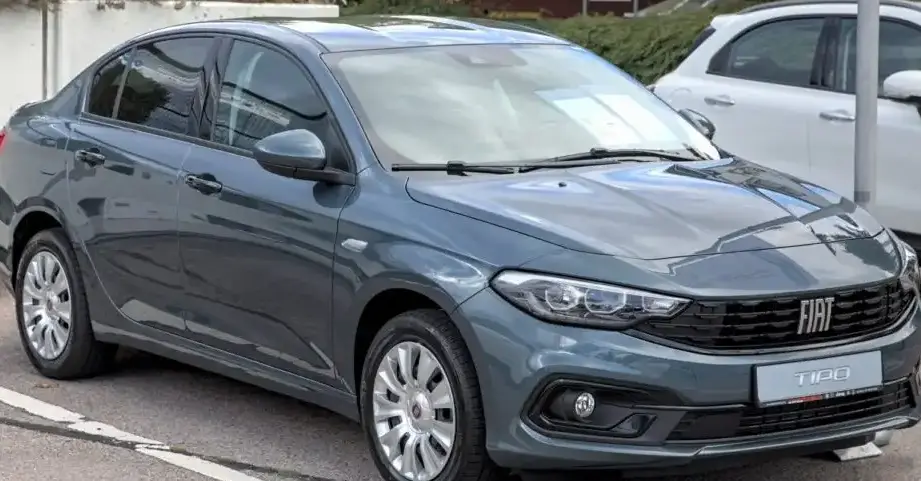
The Fiat Tipo (356) facelift, introduced in October 2020, represented a mid-cycle refresh of the Tipo compact sedan. Among the engine options available, the 1.4-liter gasoline engine producing 95 horsepower (Hp) offered a balance of affordability and practicality. This variant occupied the entry to mid-level position within the Tipo lineup, appealing to buyers prioritizing fuel efficiency and lower running costs over outright performance. It was primarily marketed in Europe and other regions where smaller displacement engines were favored, offering a competitive option in the crowded compact car segment.
Technical Specifications
| Brand | Fiat |
| Model | Tipo |
| Generation | Tipo (356, facelift 2020) |
| Type (Engine) | 1.4 (95 Hp) |
| Start of production | October, 2020 |
| Powertrain Architecture | Internal Combustion engine |
| Body type | Sedan |
| Seats | 5 |
| Doors | 4 |
| Fuel consumption (urban) | 7.7 l/100 km (30.5 US mpg) |
| Fuel consumption (extra urban) | 4.5 l/100 km (52.3 US mpg) |
| Fuel consumption (combined) | 5.7 l/100 km (41.3 US mpg) |
| CO2 emissions | 141 g/km |
| Fuel Type | Petrol (Gasoline) |
| Acceleration 0 – 100 km/h | 11.5 sec |
| Acceleration 0 – 62 mph | 11.5 sec |
| Acceleration 0 – 60 mph | 10.9 sec |
| Maximum speed | 185 km/h (114.95 mph) |
| Emission standard | Euro 4 |
| Weight-to-power ratio | 12.1 kg/Hp |
| Weight-to-torque ratio | 9.1 kg/Nm |
| Power | 95 Hp @ 6000 rpm |
| Torque | 127 Nm @ 4500 rpm (93.67 lb.-ft. @ 4500 rpm) |
| Engine layout | Front, Transverse |
| Engine Model/Code | 843A1000 |
| Engine displacement | 1368 cm3 (83.48 cu. in.) |
| Number of cylinders | 4 |
| Engine configuration | Inline |
| Cylinder Bore | 72 mm (2.83 in.) |
| Piston Stroke | 84 mm (3.31 in.) |
| Compression ratio | 11:1 |
| Number of valves per cylinder | 4 |
| Fuel injection system | Multi-port manifold injection |
| Engine aspiration | Naturally aspirated engine |
| Valvetrain | DOHC |
| Engine oil capacity | 2.95 l (3.12 US qt | 2.6 UK qt) |
| Coolant | 5 l (5.28 US qt | 4.4 UK qt) |
| Kerb Weight | 1150 kg (2535.32 lbs.) |
| Max. weight | 1650 kg (3637.63 lbs.) |
| Max load | 500 kg (1102.31 lbs.) |
| Trunk (boot) space – minimum | 520 l (18.36 cu. ft.) |
| Fuel tank capacity | 45 l (11.89 US gal | 9.9 UK gal) |
| Max. roof load | 45 kg (99.21 lbs.) |
| Permitted trailer load with brakes (12%) | 1200 kg (2645.55 lbs.) |
| Permitted trailer load without brakes | 500 kg (1102.31 lbs.) |
| Permitted towbar download | 60 kg (132.28 lbs.) |
| Length | 4532 mm (178.43 in.) |
| Width | 1792 mm (70.55 in.) |
| Width including mirrors | 2002 mm (78.82 in.) |
| Height | 1497 mm (58.94 in.) |
| Wheelbase | 2636 mm (103.78 in.) |
| Front track | 1542 mm (60.71 in.) |
| Rear (Back) track | 1543 mm (60.75 in.) |
| Front overhang | 893 mm (35.16 in.) |
| Rear overhang | 1003 mm (39.49 in.) |
| Minimum turning circle | 10.93 m (35.86 ft.) |
| Drivetrain Architecture | Front wheel drive |
| Drive wheel | Front wheel drive |
| Number of gears and type of gearbox | 6 gears, manual transmission |
| Front suspension | Independent, type McPherson with coil spring and anti-roll bar |
| Rear suspension | Coil spring, Torsion |
| Front brakes | Disc, 284×22 mm |
| Rear brakes | Drum, 228×40 mm |
| Assisting systems | ABS (Anti-lock braking system) |
| Steering type | Steering rack and pinion |
| Power steering | Electric Steering |
| Tires size | 195/65 R15; 205/55 R16; 225/45 R17 |
| Wheel rims size | 6J x 15; 6.5J x 16; 7J x 17 |
Powertrain & Engine Architecture
The heart of this Tipo variant is the 843A1000 1.4-liter inline-four cylinder gasoline engine. This engine is a naturally aspirated unit, meaning it doesn’t rely on turbocharging or supercharging for increased power. It utilizes a multi-point fuel injection system, delivering fuel directly into the intake ports. The engine features a double overhead camshaft (DOHC) valvetrain, operating four valves per cylinder, which aids in efficient combustion and improved breathing. The 1.4-liter engine produces 95 horsepower at 6000 rpm and 127 Nm (93.67 lb-ft) of torque at 4500 rpm. The engine is transversely mounted at the front of the vehicle, driving the front wheels. The standard transmission for this variant was a 6-speed manual gearbox, although an automatic transmission was also offered as an option, albeit less common.
Driving Characteristics
The 1.4-liter 95 Hp Tipo offered a comfortable, rather than sporty, driving experience. Acceleration from 0-100 km/h (0-62 mph) took around 11.5 seconds, making it adequate for everyday commuting and highway cruising. The 6-speed manual transmission provided reasonable control, but the engine lacked the low-end torque of larger displacement or turbocharged engines, requiring frequent downshifts for overtaking maneuvers. The automatic transmission, when equipped, further dulled the performance, prioritizing smooth shifts over responsiveness. Compared to the more powerful 1.6-liter engine options, the 1.4 felt noticeably less energetic, but it offered a more refined and fuel-efficient driving experience.
Equipment & Trim Levels
The 1.4-liter Tipo typically came equipped with a respectable level of standard features. These included air conditioning, power windows, central locking, and a basic audio system with USB connectivity. Safety features such as ABS brakes, electronic stability control, and multiple airbags were also standard. Higher trim levels offered upgrades such as alloy wheels, a touchscreen infotainment system with Apple CarPlay and Android Auto compatibility, rear parking sensors, and cruise control. Interior upholstery was typically cloth, with options for upgraded materials on higher trims. The dashboard layout was functional and straightforward, prioritizing usability over aesthetic flair.
Chassis & Braking
The Tipo’s chassis featured an independent McPherson strut suspension at the front and a torsion beam suspension at the rear. This setup provided a comfortable ride quality, absorbing bumps and imperfections in the road surface effectively. The front brakes were ventilated discs, while the rear brakes were drum brakes – a cost-saving measure common in this segment. The steering was electrically assisted, providing light and easy maneuverability. Stabilizer bars were fitted to both the front and rear axles to reduce body roll during cornering.
Market Reception & Comparison
The Fiat Tipo 1.4 (95 Hp) was generally well-received as a practical and affordable family car. Critics praised its spacious interior, comfortable ride, and competitive fuel economy. However, some reviewers noted its lack of outright performance and somewhat uninspired styling. Compared to rivals like the Volkswagen Golf, Ford Focus, and Peugeot 308, the Tipo offered a more budget-friendly option, but it lacked the refinement and driving dynamics of those more established competitors. The 1.4-liter engine offered better fuel economy than the larger 1.6-liter engine, but at the expense of performance. The diesel variants, such as the 1.3 MultiJet, provided even better fuel economy but were more expensive to purchase.
Legacy
The 1.4-liter engine in the Tipo proved to be a relatively reliable unit, with few widespread mechanical issues reported. The engine’s simplicity and lack of complex technologies contributed to its durability. On the used car market, the 1.4-liter Tipo represents a good value proposition for buyers seeking an affordable and practical family car. Maintenance costs are generally reasonable, and parts availability is good. While it may not be the most exciting car to drive, the Tipo 1.4 offers a dependable and economical transportation solution.