Technical Specifications
| Brand | Opel |
| Model | Astra |
| Generation | Astra H Caravan |
| Type (Engine) | 1.7 CDTI (80 Hp) |
| Start of production | March, 2004 |
| End of production | June, 2005 |
| Powertrain Architecture | Internal Combustion engine |
| Body type | Station wagon (estate) |
| Seats | 5 |
| Doors | 5 |
| Fuel consumption (urban) | 6.3 l/100 km (37.3 US mpg, 44.8 UK mpg, 15.9 km/l) |
| Fuel consumption (extra urban) | 4.1 l/100 km (57.4 US mpg, 68.9 UK mpg, 24.4 km/l) |
| Fuel consumption (combined) | 4.9 l/100 km (48 US mpg, 57.6 UK mpg, 20.4 km/l) |
| CO2 emissions | 132 g/km |
| Fuel Type | Diesel |
| Acceleration 0 – 100 km/h | 15.4 sec |
| Acceleration 0 – 62 mph | 15.4 sec |
| Acceleration 0 – 60 mph | 14.6 sec |
| Maximum speed | 168 km/h (104.39 mph) |
| Weight-to-power ratio | 16 kg/Hp, 62.5 Hp/tonne |
| Weight-to-torque ratio | 7.5 kg/Nm, 132.8 Nm/tonne |
| Power | 80 Hp @ 4400 rpm |
| Power per litre | 47.4 Hp/l |
| Torque | 170 Nm @ 1800 rpm (125.39 lb.-ft. @ 1800 rpm) |
| Engine layout | Front, Transverse |
| Engine Model/Code | Z17DTL |
| Engine displacement | 1686 cm3 (102.89 cu. in.) |
| Number of cylinders | 4 |
| Engine configuration | Inline |
| Cylinder Bore | 79 mm (3.11 in.) |
| Piston Stroke | 86 mm (3.39 in.) |
| Compression ratio | 18.4:1 |
| Number of valves per cylinder | 4 |
| Fuel injection system | Diesel Commonrail |
| Engine aspiration | Turbocharger, Intercooler |
| Valvetrain | DOHC |
| Engine oil capacity | 4.5 l (4.76 US qt | 3.96 UK qt) |
| Coolant | 6.8 l (7.19 US qt | 5.98 UK qt) |
| Kerb Weight | 1280 kg (2821.92 lbs.) |
| Max. weight | 1905 kg (4199.81 lbs.) |
| Max load | 625 kg (1377.89 lbs.) |
| Trunk (boot) space – minimum | 540 l (19.07 cu. ft.) |
| Trunk (boot) space – maximum | 1590 l (56.15 cu. ft.) |
| Fuel tank capacity | 52 l (13.74 US gal | 11.44 UK gal) |
| Length | 4515 mm (177.76 in.) |
| Width | 1794 mm (70.63 in.) |
| Height | 1500 mm (59.06 in.) |
| Wheelbase | 2703 mm (106.42 in.) |
| Front track | 1488 mm (58.58 in.) |
| Rear (Back) track | 1488 mm (58.58 in.) |
| Front overhang | 871 mm (34.29 in.) |
| Rear overhang | 941 mm (37.05 in.) |
| Ride height (ground clearance) | 160 mm (6.3 in.) |
| Drag coefficient (Cd) | 0.31 |
| Drivetrain Architecture | ICE, Front wheel drive |
| Drive wheel | Front wheel drive |
| Number of gears and type of gearbox | 5 gears, manual transmission |
| Front suspension | Spring Strut |
| Rear suspension | Spring Strut |
| Front brakes | Ventilated discs |
| Rear brakes | Disc |
| Assisting systems | ABS (Anti-lock braking system) |
| Steering type | Steering rack and pinion |
| Tires size | 195/65 R15 |
| Wheel rims size | 6.5J X 15 |
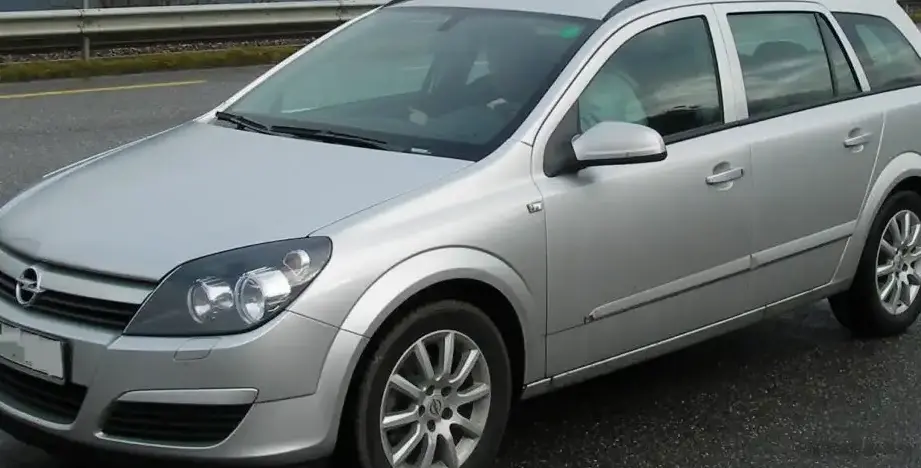
The Opel Astra H Caravan 1.7 CDTI, a station wagon variant, was produced between March 2004 and June 2005. It was a key part of the Astra H series (2004-2009), marking the second generation of the Astra developed under General Motors ownership following their acquisition of Opel in 1999. Positioned as an entry-level diesel option within the Caravan (estate) body style, it aimed to deliver fuel efficiency and practicality for families and those needing substantial cargo space. The Astra H generation, built on the GM Delta platform, represented a significant advancement for Opel in terms of design, safety features, and overall technology.
Powertrain & Engine Architecture
The Astra H Caravan 1.7 CDTI was powered by the Z17DTL engine, a 1.7-liter inline-four cylinder diesel. This engine belonged to Opel/Vauxhall’s family of common-rail diesel engines, known for their relatively quiet operation and fuel economy. The Z17DTL incorporated a turbocharger with an intercooler to enhance power output. A Bosch-supplied common-rail direct injection system delivered fuel directly into the cylinders at very high pressure, optimizing combustion efficiency. The engine featured a Double Overhead Camshaft (DOHC) valvetrain with four valves per cylinder, improving airflow and contributing to performance. Producing 80 horsepower and 170 Nm (125 lb-ft) of torque, it was adequate for everyday driving. The engine was exclusively paired with a five-speed manual transmission for this specific configuration; an automatic transmission was not offered with the 1.7 CDTI.
Driving Characteristics
The 1.7 CDTI, equipped with the five-speed manual transmission, provided a practical, though not particularly sporty, driving experience. Acceleration was modest, requiring approximately 15.4 seconds to reach 62 mph (100 km/h). The engine’s torque peak at 1800 rpm offered reasonable pulling power for overtaking and tackling inclines, but often necessitated downshifting for more assertive driving. The gear ratios were optimized for fuel economy rather than outright performance. Compared to the more powerful 1.9 CDTI variants, the 1.7 CDTI felt noticeably slower. However, it delivered a smoother and more refined driving experience than the smaller 1.3 CDTI engine. The suspension was tuned for comfort, providing a reasonably compliant ride, although it could feel somewhat unsettled on uneven road surfaces.
Equipment & Trim Levels
The 1.7 CDTI Caravan typically came with a base level of standard equipment, prioritizing practicality and value. Standard features generally included power steering, central locking, electric front windows, and an adjustable steering column. Safety features included ABS brakes, front airbags, and seatbelt pretensioners. Interior upholstery was typically cloth, and the dashboard featured a functional, if somewhat basic, design. Optional extras included air conditioning, alloy wheels, a CD stereo, and rear electric windows. Trim levels varied slightly depending on the market, but the 1.7 CDTI generally represented the entry point into the Astra H Caravan range.
Chassis & Braking
The Astra H Caravan utilized a MacPherson strut front suspension and a torsion beam rear suspension. This setup offered a good compromise between ride comfort and handling. The front brakes were ventilated discs, while the rear brakes were solid discs. The braking system was adequate for the vehicle’s weight and performance, with ABS enhancing stopping power and stability. The steering was a rack and pinion system, providing precise and responsive control. 1.7 CDTI models typically came equipped with 15-inch steel wheels with wheel covers, although alloy wheels were available as an option.
Market Reception & Comparison
The Opel Astra H Caravan 1.7 CDTI was generally well-received as a practical and fuel-efficient estate car. Critics praised its spacious interior, generous cargo capacity, and comfortable ride. However, the engine’s limited power output was frequently mentioned as a drawback. Compared to the 1.9 CDTI variants, the 1.7 CDTI offered significantly lower performance but also lower running costs. The 1.7 CDTI competed with other compact estate cars, such as the Ford Focus Estate and the Volkswagen Golf Estate. It presented a compelling combination of practicality, fuel efficiency, and affordability.
Legacy
The Z17DTL engine, while not known for high performance, proved to be relatively reliable. Common issues included turbocharger failure and injector problems, but these were not widespread occurrences. Today, the Astra H Caravan 1.7 CDTI can be found on the used car market at very affordable prices. It remains a practical and economical choice for those seeking a spacious estate car. Its fuel efficiency and relatively low maintenance costs make it an attractive option for budget-conscious buyers. However, potential buyers should be aware of the engine’s limited power output and the possibility of age-related issues.