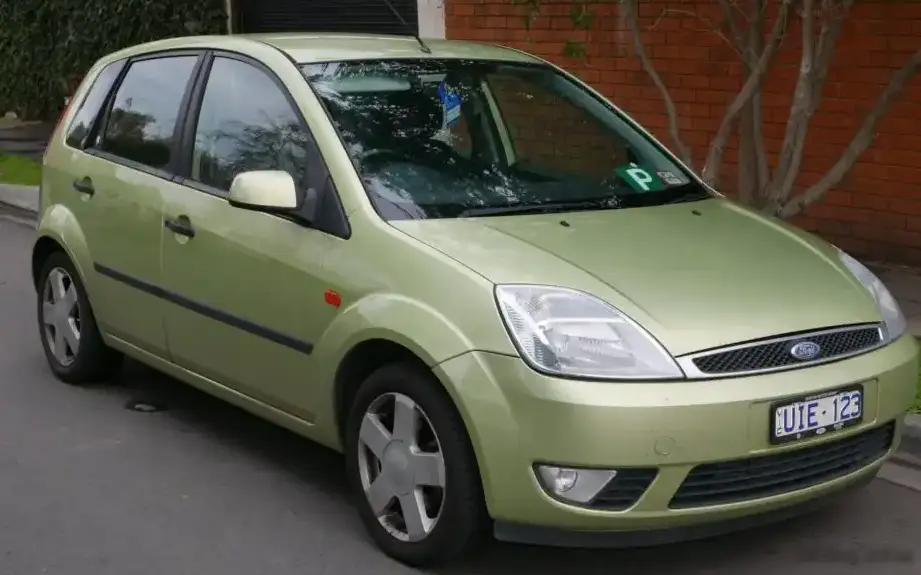
The Ford Fiesta Mk6, produced from 2001 to 2005, represented a significant step forward for Ford’s supermini. Among the various engine and transmission combinations offered, the 1.4 TDCi 68 horsepower variant paired with the Durashift EST automatic transmission occupied a specific niche. This model aimed to provide economical and convenient transportation, appealing to buyers prioritizing ease of use over outright performance. It was positioned as an entry-level to mid-range option within the Mk6 Fiesta lineup, sitting below the more powerful petrol and diesel variants, and above the base 1.25L petrol model.
Technical Specifications
| Brand | Ford |
| Model | Fiesta |
| Generation | Fiesta VI (Mk6) 5 door |
| Type (Engine) | 1.4 TDCi (68 Hp) Durashift EST |
| Start of production | 2001 |
| End of production | 2005 |
| Powertrain Architecture | Internal Combustion engine |
| Body type | Hatchback |
| Seats | 5 |
| Doors | 5 |
| Fuel consumption (urban) | 5.3 l/100 km (44.4 US mpg, 53.3 UK mpg, 18.9 km/l) |
| Fuel consumption (extra urban) | 3.7 l/100 km (63.6 US mpg, 76.3 UK mpg, 27 km/l) |
| Fuel consumption (combined) | 4.3 l/100 km (54.7 US mpg, 65.7 UK mpg, 23.3 km/l) |
| Fuel Type | Diesel |
| Acceleration 0 – 100 km/h | 16 sec |
| Acceleration 0 – 62 mph | 16 sec |
| Acceleration 0 – 60 mph | 15.2 sec |
| Maximum speed | 164 km/h (101.9 mph) |
| Emission standard | Euro 3 |
| Weight-to-power ratio | 17.1 kg/Hp, 58.4 Hp/tonne |
| Weight-to-torque ratio | 7.3 kg/Nm, 137.3 Nm/tonne |
| Power | 68 Hp @ 4000 rpm |
| Power per litre | 48.6 Hp/l |
| Torque | 160 Nm @ 2000 rpm (118.01 lb.-ft. @ 2000 rpm) |
| Engine layout | Front, Transverse |
| Engine Model/Code | F6JA |
| Engine displacement | 1399 cm3 (85.37 cu. in.) |
| Number of cylinders | 4 |
| Engine configuration | Inline |
| Cylinder Bore | 73.7 mm (2.9 in.) |
| Piston Stroke | 82 mm (3.23 in.) |
| Compression ratio | 17.9:1 |
| Number of valves per cylinder | 2 |
| Fuel injection system | Diesel Commonrail |
| Engine aspiration | Turbocharger, Intercooler |
| Engine oil capacity | 3.8 l (4.02 US qt | 3.34 UK qt) |
| Coolant | 5.5 l (5.81 US qt | 4.84 UK qt) |
| Kerb Weight | 1165 kg (2568.39 lbs.) |
| Max. weight | 1560 kg (3439.21 lbs.) |
| Max load | 395 kg (870.83 lbs.) |
| Trunk (boot) space – minimum | 284 l (10.03 cu. ft.) |
| Trunk (boot) space – maximum | 947 l (33.44 cu. ft.) |
| Fuel tank capacity | 45 l (11.89 US gal | 9.9 UK gal) |
| Length | 3917 mm (154.21 in.) |
| Width | 1683 mm (66.26 in.) |
| Height | 1417 mm (55.79 in.) |
| Wheelbase | 2486 mm (97.87 in.) |
| Front track | 1477 mm (58.15 in.) |
| Rear (Back) track | 1444 mm (56.85 in.) |
| Drivetrain Architecture | Front wheel drive |
| Number of gears | 5 |
| Type of gearbox | automatic transmission |
| Front suspension | Independent type McPherson |
| Rear suspension | Torsion |
| Front brakes | Ventilated discs |
| Rear brakes | Drum |
| Assisting systems | ABS (Anti-lock braking system) |
| Steering type | Steering rack and pinion |
| Power steering | Hydraulic Steering |
| Tires size | 175/65 R14 |
| Wheel rims size | 14 |
INTRODUCTION
The Fiesta Mk6, launched in 2001, was a crucial model for Ford in Europe, representing a significant improvement in build quality, interior design, and driving dynamics compared to its predecessor. The 1.4 TDCi with the Durashift EST automatic transmission was introduced as a fuel-efficient option for buyers who preferred the convenience of an automatic gearbox. This variant was particularly popular in markets where manual transmissions were less common or where urban driving conditions demanded frequent gear changes. The Durashift EST transmission, a four-speed automatic, was designed to offer smooth shifts and contribute to the Fiesta’s overall refinement.
Powertrain & Engine Architecture
The 1.4 TDCi engine, identified by the F6JA engine code, was a common-rail direct injection diesel engine. This engine utilized a turbocharger with an intercooler to boost power and efficiency. The common-rail system allowed for precise control of fuel injection timing and pressure, resulting in improved combustion and reduced emissions. The engine featured a two-valve-per-cylinder configuration and a relatively high compression ratio of 17.9:1, typical for diesel engines. The Durashift EST automatic transmission was a conventional hydraulic automatic, offering four forward gears and a torque converter. It wasn’t known for its sportiness, prioritizing smooth operation and fuel economy over rapid gear changes.
Driving Characteristics
The 1.4 TDCi automatic Fiesta offered a comfortable, if not particularly exciting, driving experience. With 68 horsepower and 160 Nm (118 lb-ft) of torque, acceleration was modest, taking around 16 seconds to reach 62 mph. The automatic transmission, while smooth, could feel somewhat sluggish, especially when attempting to overtake or climb hills. The gear ratios were optimized for fuel efficiency rather than performance. Compared to the 1.6L petrol versions, the 1.4 TDCi automatic was noticeably slower, but it offered significantly better fuel economy. Against other diesel variants, like the later 1.6 TDCi, it lacked the outright power and refinement, but it remained a viable option for budget-conscious buyers.
Equipment & Trim Levels
The 1.4 TDCi automatic typically came equipped with basic features such as power steering, central locking, and an immobilizer. Air conditioning was often an optional extra. Interior trim was generally functional and durable, with cloth upholstery and a simple dashboard layout. Higher trim levels, such as Zetec, added features like alloy wheels, electric windows, and a better audio system. The specific equipment level varied depending on the market and the options selected by the original purchaser.
Chassis & Braking
The Fiesta Mk6 utilized a McPherson strut front suspension and a torsion beam rear suspension. This setup provided a reasonable balance between ride comfort and handling. The front brakes were ventilated discs, while the rear brakes were drums, a cost-saving measure common in this class of vehicle. ABS (Anti-lock Braking System) was standard, enhancing safety. The suspension was tuned for comfort, resulting in a slightly softer ride compared to the sportier Fiesta models.
Market Reception & Comparison
The 1.4 TDCi automatic Fiesta was generally well-received as a practical and economical city car. Critics praised its fuel efficiency and comfortable ride, but noted its lack of performance. Compared to the petrol-powered Fiestas, the diesel offered superior fuel economy, making it a popular choice for high-mileage drivers. However, the automatic transmission was sometimes criticized for its slow response and lack of driver engagement. In terms of reliability, the 1.4 TDCi engine proved to be generally robust, although common rail systems can be prone to issues if not properly maintained.
Legacy
The Fiesta Mk6 1.4 TDCi automatic remains a relatively common sight on used car markets. Its reputation for fuel efficiency and reliability has helped it maintain a loyal following. While not a performance car, it offers a practical and affordable transportation solution. The Durashift EST transmission, while not the most advanced, has proven to be reasonably durable with proper servicing. Today, these Fiestas are often sought after as inexpensive runabouts or first cars, offering a blend of practicality and economy.