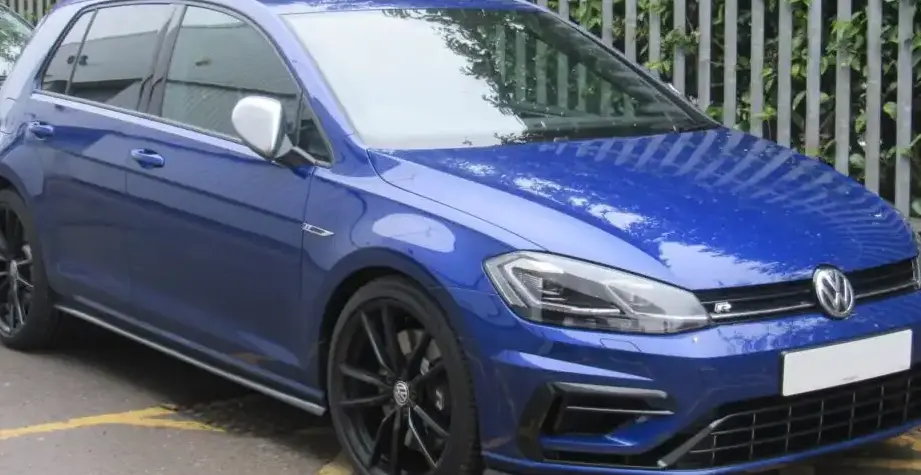
The Volkswagen Golf VII R, specifically the 2.0 TSI 292 Hp 4MOTION variant produced from November 2017 to September 2018, represents the performance pinnacle of the seventh-generation Golf lineup. This facelifted model, distinguished by subtle exterior revisions and enhanced interior technology, built upon the success of the previous Golf R, offering a compelling blend of everyday usability and exhilarating performance. Positioned as the flagship model, it catered to enthusiasts seeking a potent hot hatch with all-weather capability. The “R” designation historically signified Volkswagen’s highest-performance models, and this iteration continued that tradition.
Technical Specifications
| Brand | Volkswagen |
| Model | Golf |
| Generation | Golf VII (5-door, facelift 2017) |
| Type (Engine) | R 2.0 TSI (292 Hp) 4MOTION |
| Start of production | November, 2017 |
| End of production | September, 2018 |
| Powertrain Architecture | Internal Combustion engine |
| Body type | Hatchback |
| Seats | 5 |
| Doors | 5 |
| Fuel consumption (economy) – urban (EPA) | 11.2 l/100 km (21 US mpg, 25.2 UK mpg, 8.9 km/l) |
| Fuel consumption (economy) – extra urban (EPA) | 8.1 l/100 km (29 US mpg, 34.9 UK mpg, 12.3 km/l) |
| Fuel consumption (economy) – combined (EPA) | 9.8 l/100 km (24 US mpg, 28.8 UK mpg, 10.2 km/l) |
| Fuel Type | Petrol (Gasoline) |
| Weight-to-power ratio | 5.1 kg/Hp, 195.1 Hp/tonne |
| Weight-to-torque ratio | 3.9 kg/Nm, 253.8 Nm/tonne |
| Power | 292 Hp @ 5400-6200 rpm |
| Power per litre | 147.2 Hp/l |
| Torque | 380 Nm @ 1800-5500 rpm (280.27 lb.-ft. @ 1800-5500 rpm) |
| Engine layout | Front, Transverse |
| Engine Model/Code | EA888 / DJJA |
| Engine displacement | 1984 cm3 (121.07 cu. in.) |
| Number of cylinders | 4 |
| Engine configuration | Inline |
| Cylinder Bore | 82.5 mm (3.25 in.) |
| Piston Stroke | 92.8 mm (3.65 in.) |
| Compression ratio | 9.6:1 |
| Number of valves per cylinder | 4 |
| Fuel injection system | Direct injection |
| Engine aspiration | Turbocharger, Intercooler |
| Valvetrain | DOHC |
| Engine oil capacity | 5.7 l (6.02 US qt | 5.02 UK qt) |
| Coolant | 10 l (10.57 US qt | 8.8 UK qt) |
| Kerb Weight | 1497 kg (3300.32 lbs.) |
| Max. weight | 1980 kg (4365.15 lbs.) |
| Max load | 483 kg (1064.83 lbs.) |
| Trunk (boot) space – minimum | 343 l (12.11 cu. ft.) |
| Trunk (boot) space – maximum | 1233 l (43.54 cu. ft.) |
| Fuel tank capacity | 55 l (14.53 US gal | 12.1 UK gal) |
| Length | 4276 mm (168.35 in.) |
| Width | 1799 mm (70.83 in.) |
| Width including mirrors | 2027 mm (79.8 in.) |
| Height | 1436 mm (56.54 in.) |
| Wheelbase | 2630 mm (103.54 in.) |
| Front track | 1541 mm (60.67 in.) |
| Rear (Back) track | 1515 mm (59.65 in.) |
| Ride height (ground clearance) | 122 mm (4.8 in.) |
| Drag coefficient (Cd) | 0.32 |
| Minimum turning circle (turning diameter) | 10.9 m (35.76 ft.) |
| Drivetrain Architecture | The Internal combustion engine (ICE) drives the front wheels permanently, and the rear wheels are driven through an electrically or mechanically operated clutch if necessary. |
| Drive wheel | All wheel drive (4×4) |
| Number of gears and type of gearbox | 6 gears, manual transmission |
| Front suspension | Independent, type McPherson with coil spring and anti-roll bar |
| Rear suspension | Independent multi-link spring suspension with stabilizer |
| Front brakes | Ventilated discs, 340×30 mm |
| Rear brakes | Ventilated discs, 310×23 mm |
| Assisting systems | ABS (Anti-lock braking system) |
| Steering type | Steering rack and pinion |
| Power steering | Electric Steering |
| Tires size | 225/40 R18; 235/35 R19 |
| Wheel rims size | 7.5J x 18; 8J x 19 |
Powertrain & Engine Architecture
At the heart of the Golf VII R lies the EA888 2.0-liter turbocharged inline-four cylinder engine, specifically the DJJA engine code. This engine is a sophisticated design featuring direct fuel injection, a dual-mass flywheel, and variable valve timing on both the intake and exhaust sides (DOHC). The turbocharger, an integral part of the performance equation, provides significant boost, contributing to the engine’s high specific output. The engine’s control unit (ECU) is meticulously calibrated to deliver a broad torque curve, peaking at 380 Nm (280.27 lb-ft) between 1800 and 5500 rpm. The 6-speed manual transmission was standard, offering precise shifts and engaging driver control. The 4MOTION all-wheel-drive system utilizes a Haldex multi-plate clutch to distribute torque between the front and rear axles as needed, enhancing traction and stability, particularly in adverse weather conditions.
Driving Characteristics
The Golf R’s driving experience is characterized by its responsiveness and agility. The 292 horsepower and 380 Nm of torque provide brisk acceleration, allowing for a 0-60 mph time of around 4.6 seconds. The 6-speed manual transmission, while requiring more driver involvement than a dual-clutch alternative, offers a satisfyingly mechanical feel. The 4MOTION system effectively mitigates understeer, allowing the car to maintain composure through corners. Compared to lower-powered Golf variants, such as the 1.8 TSI, the R delivers a significantly more potent and engaging driving experience. While the 1.8 TSI prioritized fuel economy and comfort, the R focused on performance and driver enjoyment. The manual transmission, while offering more control, meant slightly slower acceleration times compared to the optional DSG (Dual Shift Gearbox) equipped models.
Equipment & Trim Levels
The Golf R came generously equipped as standard. Key features included sport seats upholstered in cloth and Alcantara, a leather-wrapped steering wheel, stainless steel pedal caps, and ambient lighting. The infotainment system featured a touchscreen display with navigation, Apple CarPlay, and Android Auto compatibility. Optional extras included adaptive dampers (DCC), a panoramic sunroof, and a premium sound system. The interior trim was generally dark-toned, with subtle “R” badging throughout. The exterior styling was also enhanced with unique bumpers, side skirts, and a rear spoiler, differentiating it from other Golf models.
Chassis & Braking
The Golf R’s chassis was specifically tuned to handle the increased power output. It featured a sport-tuned suspension with stiffer springs and dampers compared to standard Golf models. The front suspension utilized a McPherson strut design, while the rear employed a multi-link setup. Larger ventilated disc brakes were fitted at all four corners (340x30mm front, 310x23mm rear) to provide ample stopping power. The electronic stability control (ESC) system was calibrated to allow for a degree of wheel slip in Sport mode, enhancing driving enjoyment. The steering was precise and well-weighted, providing good feedback to the driver.
Market Reception & Comparison
The Golf VII R was widely praised by automotive critics for its performance, handling, and practicality. It was often lauded as one of the best all-around hot hatches on the market. Fuel economy, while not a primary focus, was respectable for a car of its performance caliber, averaging around 24 US mpg in combined driving. Compared to other high-performance hatchbacks, such as the Ford Focus RS and the Honda Civic Type R, the Golf R offered a more refined and mature driving experience. While the Focus RS prioritized raw power and a more aggressive character, the Golf R emphasized balance and usability. Reliability was generally good, although some owners reported minor issues with the turbocharger and the Haldex all-wheel-drive system.
Legacy
The Golf VII R has established itself as a highly desirable used car. Its combination of performance, practicality, and build quality has ensured strong residual values. The EA888 engine, while known to require regular maintenance, is generally considered robust and reliable when properly cared for. The 4MOTION system, while potentially requiring occasional servicing, provides excellent all-weather capability. Today, the Golf VII R remains a popular choice for enthusiasts seeking a capable and rewarding hot hatch, representing a sweet spot in the Golf lineage.