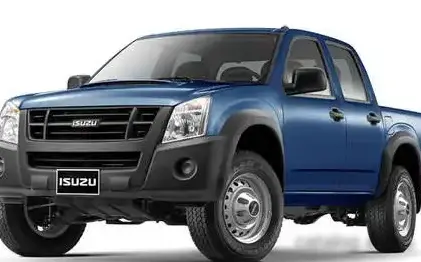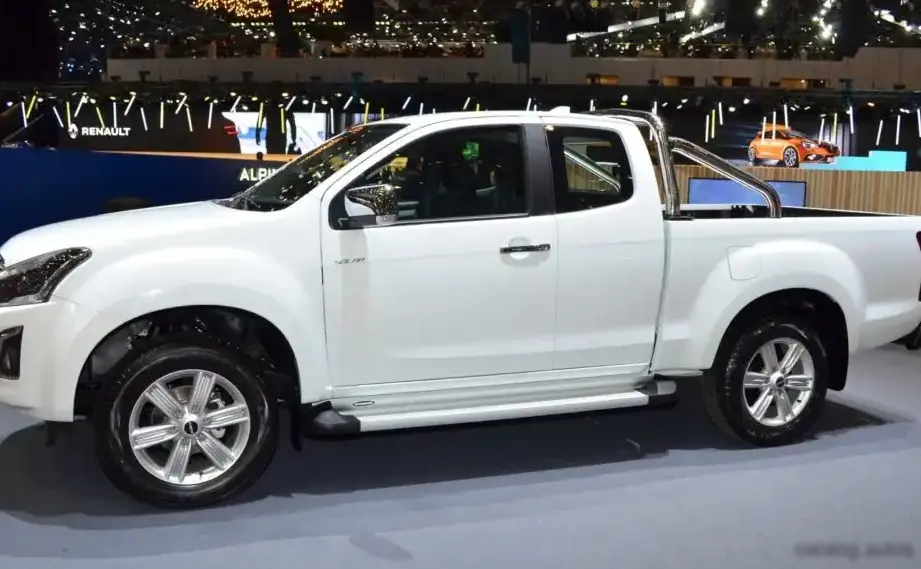
The Isuzu D-Max II, specifically the facelifted version introduced in 2017, represented a significant update to Isuzu’s popular mid-size pickup truck. This iteration of the D-Max, sold from 2017 to 2020, was primarily aimed at the global market, with strong sales in Australia, Europe, and Asia. The 1.9-liter turbocharged diesel engine, producing 164 horsepower, was a key component of this update, offering a balance of fuel efficiency and capability. This variant typically occupied a mid-range position within the D-Max lineup, appealing to buyers seeking a practical and reliable workhorse without the premium price tag of higher-spec models.
Technical Specifications
| Brand | Isuzu |
| Model | D-Max |
| Generation | D-Max II (facelift 2017) |
| Type (Engine) | 1.9 (164 Hp) |
| Start of production | 2017 |
| End of production | 2020 |
| Powertrain Architecture | Internal Combustion engine |
| Body type | Pick-up |
| Seats | 5 |
| Doors | 4 |
| Fuel consumption (urban) | 7.6 l/100 km (30.9 US mpg) |
| Fuel consumption (extra urban) | 6.6 l/100 km (35.6 US mpg) |
| Fuel consumption (combined) | 7 l/100 km (33.6 US mpg) |
| CO2 emissions | 183 g/km |
| Fuel Type | Diesel |
| Acceleration 0 – 100 km/h | 12.7 sec |
| Acceleration 0 – 62 mph | 12.7 sec |
| Acceleration 0 – 60 mph | 12.1 sec |
| Maximum speed | 180 km/h (111.85 mph) |
| Emission standard | Euro 6 |
| Weight-to-power ratio | 11.9 kg/Hp |
| Weight-to-torque ratio | 5.4 kg/Nm |
| Power | 164 Hp @ 3600 rpm |
| Torque | 360 Nm @ 2000-2500 rpm (265.52 lb.-ft.) |
| Engine Model/Code | RZ4E-TC |
| Engine displacement | 1898 cm3 (115.82 cu. in.) |
| Number of cylinders | 4 |
| Engine configuration | Inline |
| Cylinder Bore | 80 mm (3.15 in.) |
| Piston Stroke | 94.4 mm (3.72 in.) |
| Compression ratio | 15.9:1 |
| Number of valves per cylinder | 2 |
| Fuel injection system | Diesel Commonrail |
| Engine aspiration | Turbocharger, Intercooler |
| Engine oil capacity | 6.6 l (6.97 US qt | 5.81 UK qt) |
| Kerb Weight | 1954 kg (4307.83 lbs.) |
| Max. weight | 3050 kg (6724.1 lbs.) |
| Max load | 1096 kg (2416.27 lbs.) |
| Fuel tank capacity | 76 l (20.08 US gal | 16.72 UK gal) |
| Permitted trailer load with brakes (12%) | 3500 kg (7716.18 lbs.) |
| Permitted trailer load without brakes | 750 kg (1653.47 lbs.) |
| Permitted towbar download | 245 kg (540.13 lbs.) |
| Length | 5295 mm (208.46 in.) |
| Width | 1860 mm (73.23 in.) |
| Height | 1795-1870 mm (70.67 – 73.62 in.) |
| Wheelbase | 3095 mm (121.85 in.) |
| Front track | 1570 mm (61.81 in.) |
| Rear track | 1570 mm (61.81 in.) |
| Ride height (ground clearance) | 235 mm (9.25 in.) |
| Approach angle | 30° |
| Departure angle | 23° |
| Ramp-over angle | 22° |
| Drive wheel | All wheel drive (4×4) |
| Number of gears and type of gearbox | 6 gears, manual transmission |
| Front brakes | Ventilated discs |
| Rear brakes | Drum |
| Assisting systems | ABS (Anti-lock braking system) |
| Tires size | 255/60 R18 |
| Wheel rims size | 7.0J x 18 |
Powertrain & Engine Architecture
The heart of this D-Max variant is the RZ4E-TC 1.9-liter inline-four cylinder diesel engine. This engine represented a move towards downsizing and improved efficiency compared to the previous 2.5-liter engine offered in earlier D-Max models. The RZ4E-TC utilizes a cast iron block and aluminum cylinder head, a common configuration for durability and weight reduction. It features a single turbocharger with an intercooler to enhance power and torque output. The fuel injection system is a common rail direct injection system, allowing for precise fuel delivery and optimized combustion. The engine produces 164 horsepower at 3600 rpm and 360 Nm (265.52 lb-ft) of torque between 2000 and 2500 rpm. The six-speed manual transmission was the standard offering for this configuration, providing a good balance between fuel economy and driver control. While an automatic transmission was available in some markets, it wasn’t as commonly paired with this specific engine.
Driving Characteristics
The 1.9-liter engine, paired with the six-speed manual transmission, provided a reasonably responsive driving experience. While not exceptionally quick – 0-60 mph took around 12.1 seconds – it offered sufficient power for everyday driving and hauling moderate loads. The torque curve was relatively flat, providing good pulling power from low engine speeds, which was particularly useful for off-road driving and towing. Compared to the more powerful 2.5-liter engine, the 1.9-liter felt less strained at higher speeds, but also lacked the outright acceleration of its larger counterpart. The manual transmission offered precise shifts, and the gear ratios were well-suited to both on-road and off-road conditions. The overall driving experience was characterized by practicality and dependability rather than sporty performance.
Equipment & Trim Levels
The 1.9-liter D-Max typically came equipped with a respectable level of standard features. These generally included air conditioning, power windows, central locking, and a basic audio system with USB connectivity. Higher trim levels added features such as alloy wheels, a touchscreen infotainment system, rear parking sensors, and a reversing camera. Interior upholstery was typically cloth, with durable plastic trim throughout the cabin. Optional extras included a navigation system, leather upholstery, and a more advanced audio system. Safety features such as ABS brakes and multiple airbags were standard across the range.
Chassis & Braking
The D-Max II utilized a body-on-frame construction, providing a robust and durable platform for demanding applications. The suspension consisted of independent double wishbones at the front and leaf springs at the rear. This setup provided a comfortable ride quality, even when carrying a load. The braking system featured ventilated discs at the front and drum brakes at the rear. ABS (Anti-lock Braking System) was standard, enhancing safety during emergency braking situations. The chassis was designed to handle a substantial payload, with a maximum load capacity of around 1096 kg (2416.27 lbs).
Market Reception & Comparison
The 1.9-liter D-Max was generally well-received by critics as a practical and fuel-efficient workhorse. It offered a good balance between performance, economy, and reliability. Compared to other mid-size pickups in its class, such as the Toyota Hilux and Ford Ranger, the D-Max often stood out for its value for money and robust build quality. However, some reviewers noted that the 1.9-liter engine lacked the refinement and power of some of its competitors. Fuel economy was a strong point, with combined fuel consumption figures around 7 l/100 km (33.6 US mpg). Reliability was also a key strength, with the Isuzu diesel engine having a reputation for longevity.
Legacy
The RZ4E-TC 1.9-liter engine has proven to be a relatively reliable powertrain. While some early models experienced minor issues with the diesel particulate filter (DPF), these were generally addressed through software updates. On the used car market, the 1.9-liter D-Max represents a good value proposition for buyers seeking a dependable and affordable pickup truck. Its fuel efficiency and robust construction make it a practical choice for both work and leisure. The availability of spare parts is generally good, and maintenance costs are relatively reasonable. The D-Max II, particularly the 1.9-liter variant, has cemented Isuzu’s reputation as a manufacturer of tough and reliable pickup trucks.