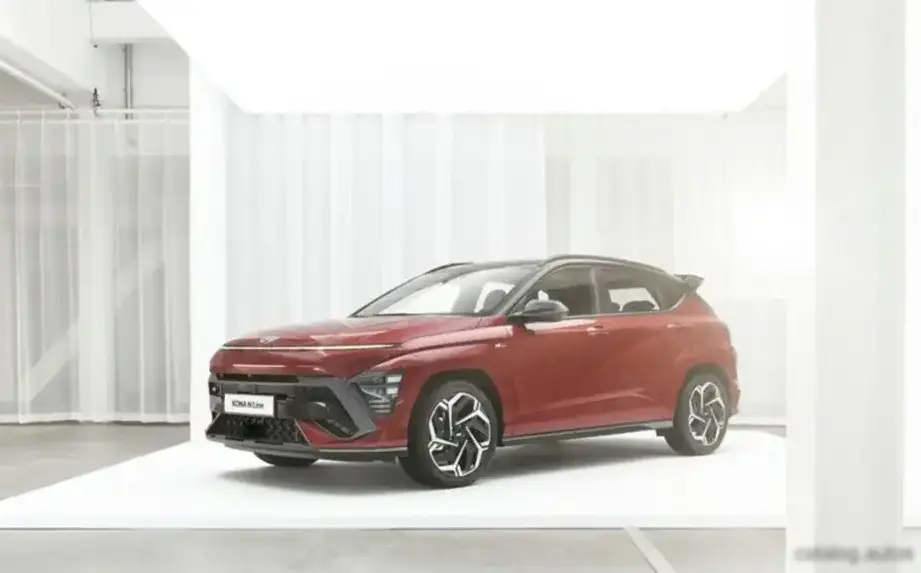
The Hyundai Kona II 1.6 T-GDI, producing 138 horsepower, represents a key variant within the second generation of Hyundai’s popular subcompact SUV. Introduced in August 2024 and continuing through 2025, this model aimed to balance fuel efficiency with adequate performance for everyday driving. It slots into the Kona II lineup as a mid-range offering, positioned between the base engine options and the more powerful turbocharged variants. The Kona II, built on the PF platform, was designed to appeal to a broad audience seeking a stylish, practical, and technologically advanced small SUV, particularly in the European and Asian markets where this size class is highly competitive. While the Kona has gained traction in the US market, the 1.6 T-GDI variant was not widely available there.
Technical Specifications
| Brand | Hyundai |
| Model | Kona |
| Generation | Kona II |
| Type (Engine) | 1.6 T-GDI (138 Hp) |
| Start of production | August, 2024 |
| End of production | August, 2025 |
| Powertrain Architecture | Internal Combustion engine |
| Body type | SUV |
| Seats | 5 |
| Doors | 5 |
| Combined fuel consumption (WLTP) | 6.2-6.5 l/100 km (37.9 – 36.2 US mpg, 45.6 – 43.5 UK mpg, 16.1 – 15.4 km/l) |
| CO2 emissions (WLTP) | 141-148 g/km |
| Fuel Type | Petrol (Gasoline) |
| Acceleration 0 – 100 km/h | 10.2 sec |
| Acceleration 0 – 62 mph | 10.2 sec |
| Acceleration 0 – 60 mph | 9.7 sec |
| Maximum speed | 194 km/h (120.55 mph) |
| Emission standard | Euro 6e |
| Weight-to-power ratio | 9.6 kg/Hp, 103.8 Hp/tonne |
| Weight-to-torque ratio | 5.3 kg/Nm, 188 Nm/tonne |
| Power | 138 Hp @ 5000-6000 rpm |
| Power per litre | 86.4 Hp/l |
| Torque | 250 Nm @ 1600-3500 rpm (184.39 lb.-ft. @ 1600-3500 rpm) |
| Engine layout | Front, Transverse |
| Engine Model/Code | G4FP |
| Engine displacement | 1598 cm3 (97.52 cu. in.) |
| Number of cylinders | 4 |
| Engine configuration | Inline |
| Cylinder Bore | 75.6 mm (2.98 in.) |
| Piston Stroke | 89 mm (3.5 in.) |
| Number of valves per cylinder | 4 |
| Fuel injection system | Direct injection |
| Engine aspiration | Turbocharger, Intercooler |
| Engine oil capacity | 4.8 l (5.07 US qt | 4.22 UK qt) |
| Coolant | 8.6 l (9.09 US qt | 7.57 UK qt) |
| Kerb Weight | 1330-1460 kg (2932.15 – 3218.75 lbs.) |
| Max. weight | 1885 kg (4155.71 lbs.) |
| Max load | 425-555 kg (936.96 – 1223.57 lbs.) |
| Trunk (boot) space – minimum | 466 l (16.46 cu. ft.) |
| Trunk (boot) space – maximum | 1300 l (45.91 cu. ft.) |
| Fuel tank capacity | 47 l (12.42 US gal | 10.34 UK gal) |
| Max. roof load | 100 kg (220.46 lbs.) |
| Permitted trailer load with brakes (12%) | 1310 kg (2888.06 lbs.) |
| Permitted trailer load without brakes | 600 kg (1322.77 lbs.) |
| Permitted towbar download | 80 kg (176.37 lbs.) |
| Length | 4350 mm (171.26 in.) |
| Width | 1825 mm (71.85 in.) |
| Height | 1585 mm (62.4 in.) |
| Wheelbase | 2660 mm (104.72 in.) |
| Front track | 1591 mm (62.64 in.) |
| Rear (Back) track | 1600 mm (62.99 in.) |
| Ride height (ground clearance) | 170 mm (6.69 in.) |
| Drivetrain Architecture | The Internal combustion engine (ICE) drives the front wheels of the vehicle. |
| Drive wheel | Front wheel drive |
| Number of gears and type of gearbox | 6 gears, manual transmission |
| Front suspension | Independent type McPherson |
| Rear suspension | Torsion |
| Front brakes | Ventilated discs |
| Rear brakes | Disc |
| Assisting systems | ABS (Anti-lock braking system) |
| Steering type | Steering rack and pinion |
| Power steering | Electric Steering |
| Tires size | 215/60 R17; 215/55 R18 |
| Wheel rims size | 7.0J x 17; 7.0J x 18 |
Powertrain & Engine Architecture
The heart of the Kona II 1.6 T-GDI is the Hyundai-Kia G4FP engine, a 1.6-liter inline-four cylinder gasoline engine featuring direct injection and a single twin-scroll turbocharger. This engine is part of Hyundai’s “Smartstream” engine family, designed for improved efficiency and reduced emissions. The direct injection system allows for precise fuel delivery, optimizing combustion and boosting power output. The turbocharger provides forced induction, increasing the engine’s power and torque without significantly increasing its displacement. The engine utilizes a timing chain, contributing to reduced maintenance compared to timing belts. The 6-speed manual transmission was standard, offering drivers a direct connection to the engine. The transmission’s gear ratios are tuned for a balance of acceleration and fuel economy, with a relatively tall sixth gear for highway cruising.
Driving Characteristics
The 138 horsepower and 184 lb-ft of torque offered by the 1.6 T-GDI engine provide adequate performance for typical urban and highway driving. Acceleration from 0-60 mph takes around 9.7 seconds, which is competitive within its class. The turbocharger provides a noticeable boost in power during acceleration, but turbo lag is present, particularly at lower engine speeds. The manual transmission allows for precise gear selection, enabling drivers to maximize the engine’s power. Compared to the base engine options, the 1.6 T-GDI offers a more engaging driving experience. However, it doesn’t match the performance of the higher-output turbocharged engines available in the Kona II lineup. The suspension is tuned for comfort, providing a relatively smooth ride, but it can feel slightly soft during spirited driving.
Equipment & Trim Levels
The Kona II 1.6 T-GDI typically came equipped with a respectable level of standard features. These included air conditioning, a touchscreen infotainment system with Apple CarPlay and Android Auto compatibility, Bluetooth connectivity, and a suite of safety features such as ABS, electronic stability control, and multiple airbags. Higher trim levels added features like a larger touchscreen display, a premium sound system, heated seats, a sunroof, and advanced driver-assistance systems such as lane departure warning and automatic emergency braking. Interior upholstery typically consisted of cloth, with leather options available on higher trims. Dashboard materials were generally of good quality, with a modern and stylish design.
Chassis & Braking
The Kona II utilizes a front-wheel-drive platform with an independent McPherson strut suspension in the front and a torsion beam suspension in the rear. This setup provides a good balance of ride comfort and handling. The front brakes are ventilated discs, while the rear brakes are solid discs. The braking system is assisted by ABS and electronic stability control, providing confident stopping power. Steering is handled by an electric power steering system, which offers light and precise steering feel.
Market Reception & Comparison
The Hyundai Kona II 1.6 T-GDI was generally well-received by automotive critics. It was praised for its stylish design, comfortable ride, and good fuel economy. However, some critics noted that the engine could feel underpowered at times, particularly when fully loaded or driving uphill. Compared to other engines in the Kona II lineup, the 1.6 T-GDI offered a good balance of performance and efficiency. It was more economical than the higher-output turbocharged engines, but it didn’t offer the same level of performance. In terms of reliability, the G4FP engine has proven to be generally reliable, with few major issues reported.
Legacy
The Hyundai Kona II 1.6 T-GDI represents a solid and dependable option in the subcompact SUV segment. Its combination of fuel efficiency, practicality, and modern features has made it a popular choice among buyers. On the used car market, these models generally hold their value well, particularly those in good condition with low mileage. The G4FP engine’s proven reliability ensures that these vehicles can provide years of trouble-free service, making them a sensible choice for budget-conscious buyers seeking a stylish and practical small SUV.