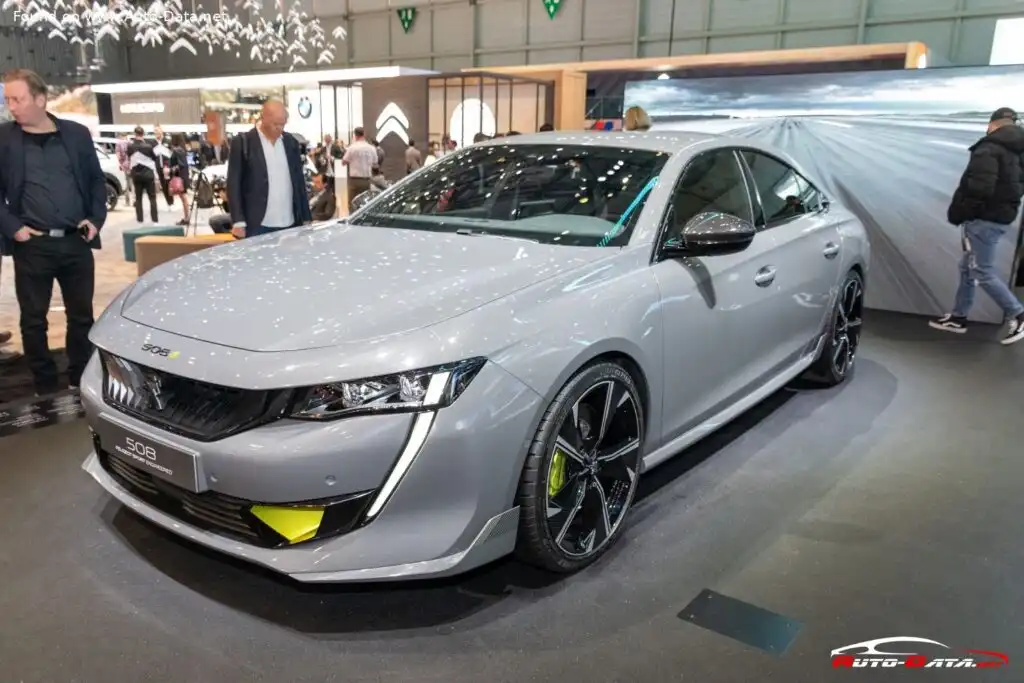
The Peugeot 508 PSE (Peugeot Sport Engineered) 1.6 PureTech, produced from 2020 to 2023, represents the high-performance, plug-in hybrid variant of the second-generation 508 fastback. Positioned as the flagship model within the 508 II (Phase I) range, the PSE combined a turbocharged four-cylinder gasoline engine with dual electric motors, delivering a total system output of 360 horsepower and all-wheel drive capability. It was Peugeot’s initial foray into a dedicated performance-focused hybrid powertrain, aiming to blend sporty driving dynamics with improved fuel efficiency and reduced emissions. The 508 PSE was primarily marketed in Europe and select global markets, offering a unique proposition in the mid-size executive car segment.
Technical Specifications
| Brand | Peugeot |
| Model | 508 |
| Generation | 508 II (Phase I, 2018) |
| Type | PSE 1.6 PureTech (360 Hp) 4WD Plug-in Hybrid e-EAT8 |
| Start of production | 2020 |
| End of production | 2023 |
| Powertrain Architecture | PHEV (Plug-in Hybrid Electric Vehicle) |
| Body type | Fastback |
| Seats | 5 |
| Doors | 5 |
| Combined fuel consumption (WLTP) | 1.8 l/100 km (130.7 US mpg, 156.9 UK mpg, 55.6 km/l) |
| CO2 emissions (WLTP) | 42 g/km |
| Fuel consumption (NEDC) – combined | 1.9 l/100 km (123.8 US mpg, 148.7 UK mpg, 52.6 km/l) |
| CO2 emissions (NEDC) | 42 g/km |
| Fuel Type | Petrol / electricity |
| Acceleration 0 – 100 km/h | 5.2 sec |
| Acceleration 0 – 62 mph | 5.2 sec |
| Acceleration 0 – 60 mph | 4.9 sec |
| Maximum speed | 250 km/h (155.34 mph) – Electronically limited |
| Emission standard | Euro 6d |
| Weight-to-power ratio | 5.1 kg/Hp, 194.6 Hp/tonne |
| Weight-to-torque ratio | 3.6 kg/Nm, 281.1 Nm/tonne |
| Gross battery capacity | 11.5 kWh |
| Battery technology | Lithium-ion (Li-Ion) |
| Battery location | Under the rear seats |
| All-electric range (WLTP) | 45 km (27.96 mi) |
| Average Energy consumption (WLTP) | 15.9 kWh/100 km (25.59 kWh/100 mi, 132 MPGe, 6.3 km/kWh, 3.9 mi/kWh) |
| Max speed (electric) | 135 km/h (83.89 mph) |
| Electric motor power (1) | 110 Hp @ 2500 rpm |
| Electric motor Torque (1) | 320 Nm (236.02 lb.-ft.) |
| Electric motor location (1) | Between the combustion engine and the transmission |
| Electric motor power (2) | 112 Hp @ 14000 rpm |
| Electric motor Torque (2) | 166 Nm (122.44 lb.-ft.) |
| Electric motor location (2) | Rear axle, Transverse |
| System power | 360 Hp |
| System torque | 520 Nm (383.53 lb.-ft.) |
| Engine Power | 200 Hp @ 6000 rpm |
| Power per litre | 125.2 Hp/l |
| Engine Torque | 300 Nm @ 3000 rpm (221.27 lb.-ft. @ 3000 rpm) |
| Engine layout | Front, Transverse |
| Engine Model/Code | EP6FDT |
| Engine displacement | 1598 cm3 (97.52 cu. in.) |
| Number of cylinders | 4 |
| Engine configuration | Inline |
| Cylinder Bore | 77 mm (3.03 in.) |
| Piston Stroke | 85.8 mm (3.38 in.) |
| Compression ratio | 10.2:1 |
| Number of valves per cylinder | 4 |
| Fuel injection system | Direct injection |
| Engine aspiration | Turbocharger, Intercooler |
| Valvetrain | DOHC |
| Engine oil capacity | 4.25 l (4.49 US qt | 3.74 UK qt) |
| Kerb Weight | 1850 kg (4078.55 lbs.) |
| Max. weight | 2340 kg (5158.82 lbs.) |
| Max load | 490 kg (1080.27 lbs.) |
| Trunk (boot) space – minimum | 487 l (17.2 cu. ft.) |
| Trunk (boot) space – maximum | 1537 l (54.28 cu. ft.) |
| Fuel tank capacity | 62 l (16.38 US gal | 13.64 UK gal) |
| Max. roof load | 80 kg (176.37 lbs.) |
| Permitted trailer load with brakes (12%) | 1260 kg (2777.82 lbs.) |
| Permitted trailer load without brakes | 745 kg (1642.44 lbs.) |
| Permitted towbar download | 70 kg (154.32 lbs.) |
| Length | 4750 mm (187.01 in.) |
| Width | 1860 mm (73.23 in.) |
| Width including mirrors | 2079 mm (81.85 in.) |
| Height | 1410 mm (55.51 in.) |
| Wheelbase | 2800 mm (110.24 in.) |
| Front track | 1600 mm (62.99 in.) |
| Rear track | 1600 mm (62.99 in.) |
| Front overhang | 950 mm (37.4 in.) |
| Rear overhang | 1000 mm (39.37 in.) |
| Minimum turning circle | 10.8 m (35.43 ft.) |
| Drivetrain Architecture | ICE drives front wheels, electric motors drive front and rear wheels. Capable of full electric or mixed mode. |
| Drive wheel | All wheel drive (4×4) |
| Number of gears and type of gearbox | 8 gears, automatic transmission e-EAT |
| Front suspension | Independent, McPherson with coil spring and anti-roll bar |
| Rear suspension | Independent multi-link spring suspension with stabilizer |
| Front brakes | Ventilated discs, 380 mm |
| Rear brakes | Disc, 290 mm |
| Assisting systems | ABS (Anti-lock braking system) |
| Steering type | Steering rack and pinion |
| Power steering | Electric |
| Tires size | 245/35 R20 |
| Wheel rims size | 20 |
Powertrain & Engine Architecture
The Peugeot 508 PSE’s powertrain centers around the EP6FDT 1.6-liter turbocharged four-cylinder gasoline engine, a member of the PureTech family. This engine, producing 200 horsepower and 300 Nm (221 lb-ft) of torque, features direct fuel injection and a twin-scroll turbocharger. It’s paired with two electric motors: one 110 hp motor integrated with the eight-speed e-EAT automatic transmission driving the front wheels, and a second 112 hp motor powering the rear axle. This configuration provides a combined system output of 360 horsepower and 520 Nm (383 lb-ft) of torque. The 11.5 kWh lithium-ion battery pack, positioned under the rear seats, provides an all-electric range of up to 45 km (28 miles) under WLTP testing. The e-EAT8 transmission was specifically reinforced to handle the increased torque output from the hybrid system. The engine utilizes a Start & Stop system and includes a particulate filter to meet stringent Euro 6d emissions standards.
Driving Characteristics
The 508 PSE delivers significantly enhanced performance compared to lower-powered 508 variants. The combined output results in a 0-62 mph (0-100 km/h) acceleration time of 5.2 seconds. The all-wheel-drive system, enabled by the dual electric motors, provides excellent traction and stability, particularly in adverse weather conditions. The e-EAT8 transmission offers smooth and responsive gear changes. The driving modes – Electric, Hybrid, and Sport – allow the driver to tailor the powertrain’s behavior to their preferences. In Sport mode, the engine and electric motors work in unison to deliver maximum performance, while Hybrid mode optimizes efficiency and utilizes electric power whenever possible. The rear electric motor contributes to a more dynamic driving experience, providing torque vectoring capabilities for improved cornering agility.
Equipment & Trim Levels
The PSE trim level was the highest specification available for the 508. Standard features included a unique exterior styling package with a distinctive front grille, wider wheel arches, and a rear diffuser. The interior featured sport seats upholstered in Alcantara and leather, with red stitching and PSE badging. Other standard equipment included a 10-inch touchscreen infotainment system, a digital instrument cluster, adaptive cruise control, lane-keeping assist, and a premium sound system. Optional extras included a panoramic sunroof, Nappa leather upholstery, and a hands-free parking assist system.
Chassis & Braking
The 508 PSE features a specifically tuned chassis to complement its increased performance. The suspension utilizes independent McPherson struts at the front and a multi-link setup at the rear, with stiffer springs and dampers compared to standard 508 models. Larger diameter ventilated disc brakes (380mm front, 290mm rear) provide enhanced stopping power. The car also benefits from an electric power steering system with a quicker steering ratio. Stabilizer bars were upgraded to reduce body roll during cornering.
Market Reception & Comparison
The Peugeot 508 PSE was generally well-received by automotive critics, who praised its performance, handling, and fuel efficiency. It was often compared to other high-performance hybrids, such as the BMW 330e and the Mercedes-Benz C300e. The PSE offered a more engaging driving experience than many of its rivals, thanks to its all-wheel-drive system and responsive powertrain. However, some critics noted that the interior, while well-equipped, lacked the premium feel of some German competitors. Fuel economy was a strong point, with the ability to travel significant distances on electric power alone.
Legacy
The Peugeot 508 PSE represents a significant step in Peugeot’s electrification strategy. While production was limited, the PSE demonstrated Peugeot’s capability to develop high-performance hybrid vehicles. The powertrain technology and chassis enhancements introduced in the PSE have influenced subsequent Peugeot models. On the used car market, the 508 PSE holds its value well, appealing to buyers seeking a stylish, sporty, and efficient executive car. The long-term reliability of the hybrid powertrain appears to be generally good, although regular maintenance of the battery pack and hybrid components is essential.