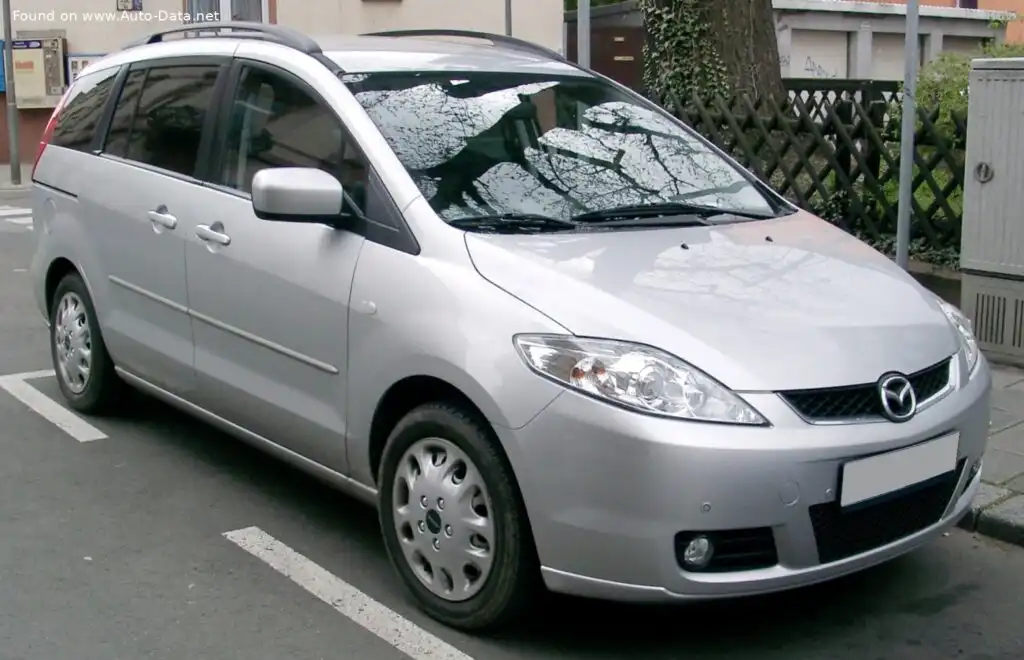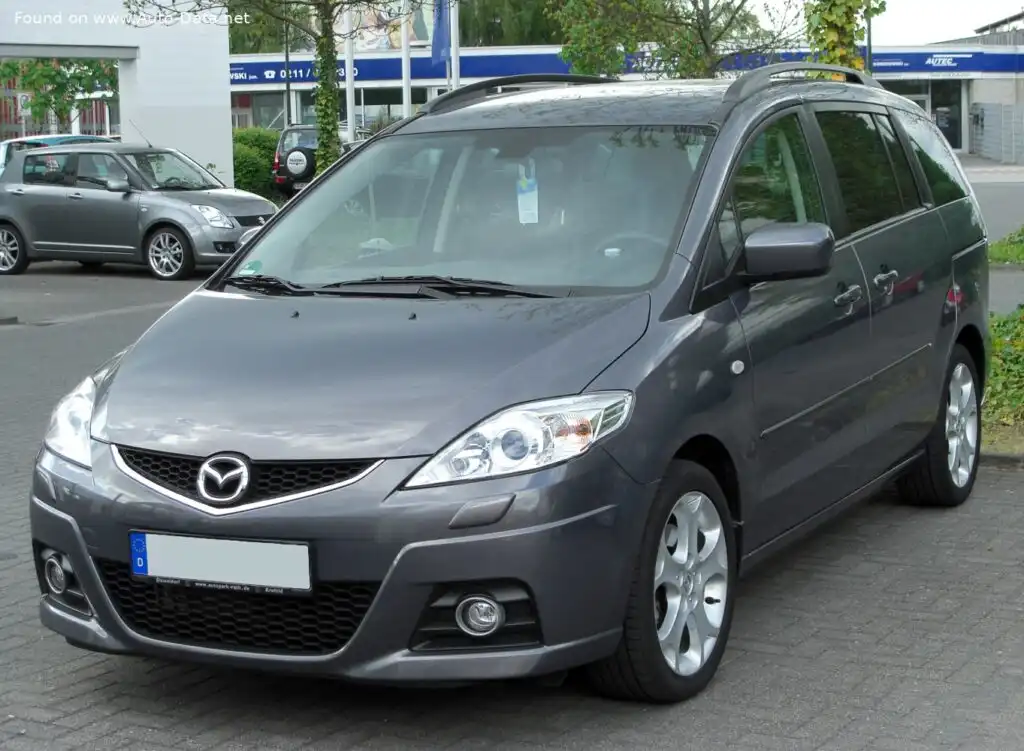
The Mazda 5, known internally as the CR-V platform, represented Mazda’s entry into the compact minivan/multi-purpose vehicle (MPV) segment. The first generation, launched in 2005, aimed to offer a more stylish and driver-focused alternative to traditional boxy minivans. The facelifted version, introduced in 2008 and produced through 2010, brought revised styling and mechanical updates. This article focuses specifically on the 2.0 CD variant with 110 horsepower, a diesel-powered option primarily sold in European and Asian markets. This trim level occupied a mid-range position within the Mazda 5 lineup, offering a balance between fuel efficiency, practicality, and affordability.
Technical Specifications
| Brand | Mazda |
| Model | 5 |
| Generation | 5 I (facelift 2008) |
| Type (Engine) | 2.0 CD (110 Hp) |
| Start of production | 2008 |
| End of production | 2010 |
| Powertrain Architecture | Internal Combustion engine |
| Body type | Minivan |
| Seats | 7 |
| Doors | 5 |
| Fuel consumption (urban) | 7.3 l/100 km (32.2 US mpg) |
| Fuel consumption (extra urban) | 5.4 l/100 km (43.6 US mpg) |
| Fuel consumption (combined) | 6.1 l/100 km (38.6 US mpg) |
| CO2 emissions | 159 g/km |
| Fuel Type | Diesel |
| Acceleration 0 – 100 km/h | 13.9 sec |
| Acceleration 0 – 62 mph | 13.9 sec |
| Acceleration 0 – 60 mph | 13.2 sec |
| Maximum speed | 177 km/h (109.98 mph) |
| Emission standard | Euro 4 |
| Weight-to-power ratio | 14 kg/Hp |
| Weight-to-torque ratio | 5 kg/Nm |
| Power | 110 Hp @ 3500 rpm |
| Torque | 310 Nm @ 2000 rpm (228.64 lb.-ft. @ 2000 rpm) |
| Engine layout | Front, Transverse |
| Engine Model/Code | RF7J |
| Engine displacement | 1998 cm3 (121.93 cu. in.) |
| Number of cylinders | 4 |
| Engine configuration | Inline |
| Cylinder Bore | 86 mm (3.39 in.) |
| Piston Stroke | 86 mm (3.39 in.) |
| Compression ratio | 16.7:1 |
| Number of valves per cylinder | 4 |
| Fuel injection system | Diesel Commonrail |
| Engine aspiration | Turbocharger, Intercooler |
| Valvetrain | SOHC |
| Engine oil capacity | 4.1 l (4.33 US qt | 3.61 UK qt) |
| Kerb Weight | 1535 kg (3384.1 lbs.) |
| Max. weight | 2245 kg (4949.38 lbs.) |
| Max load | 710 kg (1565.28 lbs.) |
| Trunk (boot) space – minimum | 538 l (19 cu. ft.) |
| Trunk (boot) space – maximum | 1678 l (59.26 cu. ft.) |
| Fuel tank capacity | 60 l (15.85 US gal | 13.2 UK gal) |
| Permitted trailer load with brakes (12%) | 1400 kg (3086.47 lbs.) |
| Permitted trailer load without brakes | 600 kg (1322.77 lbs.) |
| Length | 4505 mm (177.36 in.) |
| Width | 1755 mm (69.09 in.) |
| Height | 1615 mm (63.58 in.) |
| Wheelbase | 2750 mm (108.27 in.) |
| Front track | 1530 mm (60.24 in.) |
| Rear (Back) track | 1520 mm (59.84 in.) |
| Ride height (ground clearance) | 140 mm (5.51 in.) |
| Drag coefficient (Cd) | 0.29 |
| Minimum turning circle (turning diameter) | 10.6 m (34.78 ft.) |
| Drivetrain Architecture | Front wheel drive |
| Drive wheel | Front wheel drive |
| Number of gears and type of gearbox | 6 gears, manual transmission |
| Front brakes | Ventilated discs |
| Rear brakes | Disc |
| Assisting systems | ABS (Anti-lock braking system) |
| Steering type | Steering rack and pinion |
| Power steering | Electric Steering |
| Tires size | 195/65 R15 |
| Wheel rims size | 15 |
INTRODUCTION
The 2008 facelift of the Mazda 5 brought subtle but important changes to the original design, including revised front and rear styling, interior enhancements, and improvements to the 2.0-liter diesel engine. The 2.0 CD variant, producing 110 horsepower, was a popular choice for buyers seeking a fuel-efficient and practical family vehicle. It was positioned as a step up from the lower-powered 1.6-liter diesel, offering improved performance for highway driving and carrying a full load of passengers. The Mazda 5 aimed to differentiate itself from larger, more conventional minivans by emphasizing driving dynamics and a more car-like experience.
Powertrain & Engine Architecture
The heart of the 2.0 CD variant is the RF7J engine, a 1998cc inline-four cylinder diesel. This engine utilizes a common-rail direct injection system, delivering fuel directly into the combustion chamber at extremely high pressure for improved efficiency and reduced emissions. The RF7J features a single overhead camshaft (SOHC) valvetrain operating four valves per cylinder. A turbocharger with an intercooler is employed to boost power output and improve torque across the rev range. The 110 horsepower peak is achieved at 3500 rpm, while the substantial 310 Nm (228.64 lb.-ft.) of torque is available from just 2000 rpm. This torque curve makes the engine particularly well-suited for everyday driving and hauling passengers or cargo. The engine was paired with a six-speed manual transmission, which was the standard offering for this variant.
Driving Characteristics
The 110 hp 2.0 CD Mazda 5 offered a reasonable level of performance for its class. Acceleration from 0-60 mph took around 13.2 seconds, and top speed was approximately 109.98 mph. While not particularly sporty, the engine’s strong low-end torque made it feel responsive in typical driving situations. The six-speed manual transmission allowed drivers to keep the engine in its optimal power band. Compared to the lower-powered 1.6-liter diesel, the 2.0 CD provided noticeably more effortless acceleration, especially when fully loaded. It wasn’t as quick as the gasoline-powered variants, but it offered significantly better fuel economy. The gear ratios were tuned for a balance of fuel efficiency and usability, with a relatively long sixth gear for comfortable highway cruising.
Equipment & Trim Levels
The 2.0 CD trim typically included features such as air conditioning, power windows, power mirrors, and a basic audio system with CD player. Safety equipment included ABS brakes, front airbags, and seatbelt pretensioners. Higher trim levels offered options like alloy wheels, fog lights, a multi-function steering wheel, and upgraded audio systems. Interior upholstery was typically cloth, with a dark color scheme. The Mazda 5’s defining feature was its flexible seating arrangement, with individual seats in the second row and a third-row bench that could be folded flat or removed entirely to maximize cargo space.
Chassis & Braking
The Mazda 5 utilized a front-wheel-drive platform with independent suspension at the front and a semi-independent torsion beam suspension at the rear. The front brakes were ventilated discs, providing good stopping power, while the rear brakes were solid discs. The suspension was tuned to provide a comfortable ride, but also offered reasonable handling characteristics. The steering was a rack-and-pinion system with electric power assistance. The 15-inch wheels were typically fitted with 195/65 R15 tires.
Market Reception & Comparison
The Mazda 5 2.0 CD was generally well-received by automotive critics for its practicality, fuel efficiency, and surprisingly engaging driving dynamics. It was often praised for offering a more enjoyable driving experience than many of its competitors. Compared to the 1.6-liter diesel, the 2.0 CD offered a noticeable improvement in performance, making it a more suitable choice for drivers who frequently carried passengers or drove on highways. Fuel economy was a strong point, with combined figures around 38.6 US mpg. Reliability was generally good, although diesel engines can be more prone to issues with the fuel injection system and turbocharger over time.
Legacy
The Mazda 5, including the 2.0 CD variant, has developed a reputation as a reliable and practical family vehicle. The RF7J diesel engine, while not without its potential maintenance needs, proved to be durable when properly maintained. On the used car market, these models represent a good value for buyers seeking an affordable and fuel-efficient MPV. Parts availability is generally good, and the relatively simple mechanical design makes them relatively easy to maintain for DIY mechanics. While no longer in production, the Mazda 5 remains a popular choice for families who prioritize practicality and fuel economy.