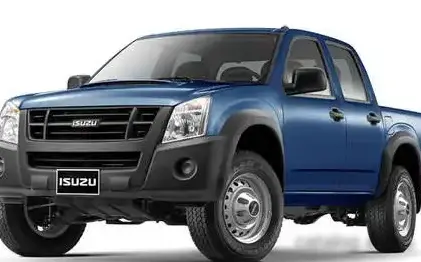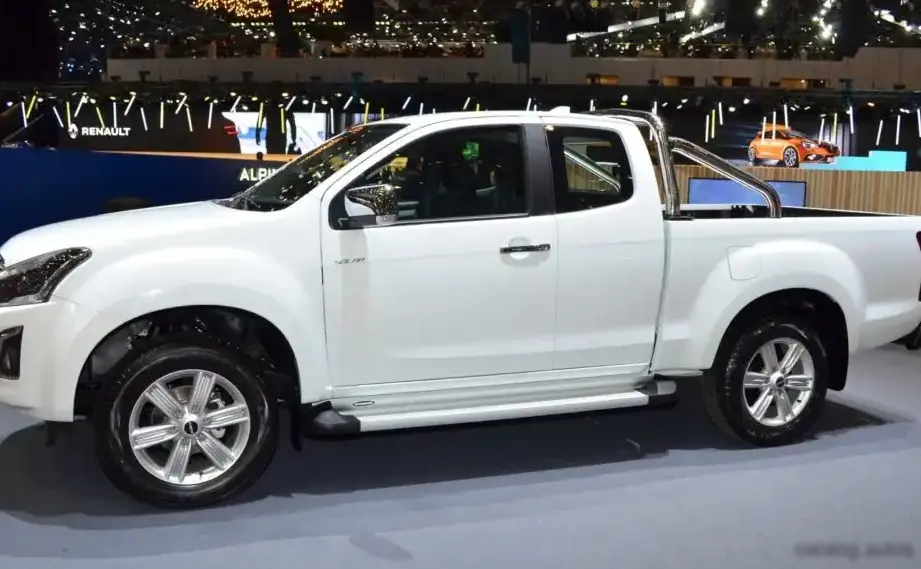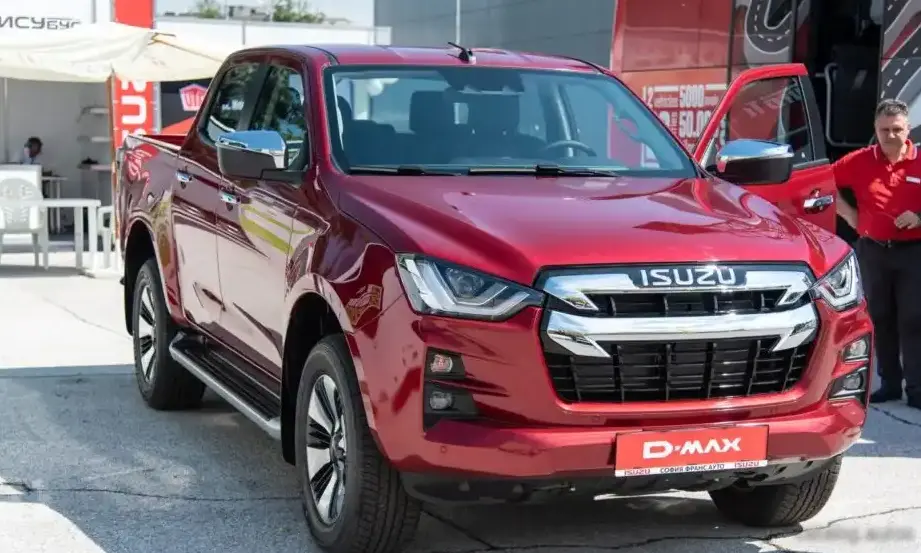
The Isuzu D-Max III Double Cab 1.9d (163 Hp) 4WD Automatic is a mid-size pickup truck produced by Isuzu from 2020 to 2023. Representing the third generation of the D-Max, this variant was primarily aimed at the European, Australian, and Asian markets, offering a blend of practicality, capability, and relative fuel efficiency within the pickup truck segment. It slots into the D-Max lineup as a mid-range offering, positioned between the base model and higher-specification trims with more powerful engines or enhanced features. This particular configuration – the 1.9-liter diesel engine paired with a six-speed automatic transmission and four-wheel drive – was designed to appeal to buyers seeking a versatile vehicle for both work and personal use.
Technical Specifications
| Brand | Isuzu |
| Model | D-Max |
| Generation | D-Max III Double Cab |
| Type (Engine) | 1.9d (163 Hp) 4WD Automatic |
| Start of production | 2020 year |
| End of production | 2023 year |
| Powertrain Architecture | Internal Combustion engine |
| Body type | Pick-up |
| Seats | 5 |
| Doors | 4 |
| Combined fuel consumption (WLTP) | 9.02-9.21 l/100 km (26.1 – 25.5 US mpg, 31.3 – 30.7 UK mpg, 11.1 – 10.9 km/l) |
| CO2 emissions (WLTP) | 236-241 g/km |
| Fuel consumption (economy) – urban (NEDC, WLTP equivalent) | 8.13-8.83 l/100 km (28.9 – 26.6 US mpg, 34.7 – 32 UK mpg, 12.3 – 11.3 km/l) |
| Fuel consumption (economy) – extra urban (NEDC, WLTP equivalent) | 6.58-6.68 l/100 km (35.7 – 35.2 US mpg, 42.9 – 42.3 UK mpg, 15.2 – 15 km/l) |
| Fuel consumption (economy) – combined (NEDC, WLTP equivalent) | 7.22-7.41 l/100 km (32.6 – 31.7 US mpg, 39.1 – 38.1 UK mpg, 13.9 – 13.5 km/l) |
| CO2 emissions (NEDC, WLTP equivalent) | 190-195 g/km |
| Fuel Type | Diesel |
| Maximum speed | 180 km/h (111.85 mph) |
| Emission standard | Euro 6d-ISC-AO |
| Weight-to-power ratio | 12.8 kg/Hp, 78.4 Hp/tonne |
| Weight-to-torque ratio | 5.8 kg/Nm, 173.1 Nm/tonne |
| Power | 163 Hp @ 3600 rpm |
| Power per litre | 85.9 Hp/l |
| Torque | 360 Nm @ 2000-2500 rpm (265.52 lb.-ft. @ 2000-2500 rpm) |
| Engine layout | Front, Longitudinal |
| Engine Model/Code | RZ4E-TC |
| Engine displacement | 1898 cm3 (115.82 cu. in.) |
| Number of cylinders | 4 |
| Engine configuration | Inline |
| Cylinder Bore | 80 mm (3.15 in.) |
| Piston Stroke | 94.4 mm (3.72 in.) |
| Compression ratio | 15.9:1 |
| Number of valves per cylinder | 2 |
| Fuel injection system | Diesel Commonrail |
| Engine aspiration | Turbocharger, Intercooler |
| Engine oil capacity | 6.6 l (6.97 US qt | 5.81 UK qt) |
| Coolant | 11.1 l (11.73 US qt | 9.77 UK qt) |
| Kerb Weight | 2080-2105 kg (4585.62 – 4640.73 lbs.) |
| Max. weight | 3100 kg (6834.33 lbs.) |
| Max load | 995-1020 kg (2193.6 – 2248.72 lbs.) |
| Fuel tank capacity | 76 l (20.08 US gal | 16.72 UK gal) |
| Max. roof load | 100 kg (220.46 lbs.) |
| Permitted trailer load with brakes (12%) | 3500 kg (7716.18 lbs.) |
| Permitted trailer load without brakes | 750 kg (1653.47 lbs.) |
| Permitted towbar download | 245 kg (540.13 lbs.) |
| Length | 5265 mm (207.28 in.) |
| Width | 1870 mm (73.62 in.) |
| Height | 1790 mm (70.47 in.) |
| Wheelbase | 3125 mm (123.03 in.) |
| Front track | 1570 mm (61.81 in.) |
| Rear (Back) track | 1570 mm (61.81 in.) |
| Front overhang | 890 mm (35.04 in.) |
| Rear overhang | 1250 mm (49.21 in.) |
| Minimum turning circle (turning diameter) | 13 m (42.65 ft.) |
| Drivetrain Architecture | The Internal combustion engine (ICE) drives the rear wheels permanently, and the front wheels are driven through an electrically or mechanically operated clutch if necessary. |
| Drive wheel | All wheel drive (4×4) |
| Number of gears and type of gearbox | 6 gears, automatic transmission |
| Front suspension | Double wishbone |
| Rear suspension | Leaf spring |
| Front brakes | Ventilated discs |
| Rear brakes | Drum |
| Assisting systems | ABS (Anti-lock braking system) |
| Steering type | Steering rack and pinion |
| Power steering | Electric Steering |
| Tires size | 265/60 R18 |
| Wheel rims size | 7.5J x 18 |
Powertrain & Engine Architecture
The heart of this D-Max variant is the Isuzu RZ4E-TC 1.9-liter turbocharged diesel engine. This engine, a relatively recent development for Isuzu, was designed to meet increasingly stringent emissions regulations while providing adequate performance for a pickup truck. It features a cast iron block and aluminum cylinder head, a configuration chosen for its durability and weight balance. The engine utilizes a common rail direct injection system, delivering fuel at extremely high pressures for optimized combustion. A variable geometry turbocharger (VGT) and intercooler are employed to enhance power and torque across a wider rev range. The RZ4E-TC produces 163 horsepower at 3600 rpm and 360 Nm (265 lb-ft) of torque between 2000 and 2500 rpm. The engine is longitudinally mounted in the chassis. Paired with the engine is a six-speed automatic transmission, providing smooth gear changes and ease of operation. This transmission is electronically controlled, adapting shift patterns based on driving conditions and throttle input.
Driving Characteristics
The 1.9d Automatic D-Max offers a comfortable and capable driving experience, though it’s not the most dynamically exciting pickup in its class. The automatic transmission provides smooth shifts, making it well-suited for everyday driving and towing. The 360 Nm of torque is sufficient for hauling moderate loads and tackling off-road terrain, but it doesn’t offer the rapid acceleration of higher-powered D-Max variants. The six-speed automatic is geared for efficiency, keeping engine speeds relatively low during highway cruising. Compared to the six-speed manual version of the same engine, the automatic sacrifices some responsiveness but gains in convenience. The 4WD system provides enhanced traction in slippery conditions, with selectable modes for 2H (rear-wheel drive), 4H (four-wheel drive high), and 4L (four-wheel drive low) for more demanding off-road situations.
Equipment & Trim Levels
The D-Max Double Cab 1.9d Automatic typically came equipped with a reasonable level of standard features. These generally included air conditioning, power windows and locks, a basic audio system with Bluetooth connectivity, and steel wheels with hubcaps. Higher trim levels, often denoted by names like “Altitude” or “Arctic,” added features such as alloy wheels, a touchscreen infotainment system with navigation, rear parking sensors, and a reversing camera. Interior upholstery was typically cloth, with options for leather seats on higher-spec models. Safety features included ABS brakes, electronic stability control, and multiple airbags.
Chassis & Braking
The D-Max III utilizes a robust ladder-frame chassis, providing a solid foundation for its pickup truck duties. The front suspension consists of double wishbones, while the rear suspension employs leaf springs – a traditional setup for pickup trucks known for its load-carrying capacity. Braking duties are handled by ventilated discs at the front and drum brakes at the rear. The drum brakes on the rear were a cost-saving measure, common in this segment, but offered adequate stopping power for typical use. Electric power steering provides a light and easy steering feel.
Market Reception & Comparison
The Isuzu D-Max 1.9d Automatic was generally well-received by critics as a practical and reliable workhorse. It was praised for its fuel efficiency, particularly compared to larger-engined rivals. However, some reviewers noted that the 163 hp engine could feel underpowered when fully loaded or tackling steep inclines. Compared to the more powerful 2.5-liter or 3.0-liter D-Max variants, this version offered a more affordable entry point into the D-Max range, but at the expense of outright performance. Against competitors like the Toyota Hilux, Nissan Navara, and Ford Ranger, the D-Max 1.9d Automatic offered a competitive package, particularly in terms of value for money and long-term reliability.
Legacy
The Isuzu RZ4E-TC engine and the six-speed automatic transmission have proven to be relatively reliable units. While not without their occasional issues (such as diesel particulate filter problems common to modern diesels), they generally require routine maintenance and are known for their durability. In the used car market, the D-Max 1.9d Automatic represents a sensible choice for buyers seeking a capable and economical pickup truck. Its lower power output translates to better fuel economy and potentially lower running costs, making it an attractive option for those who prioritize practicality over outright performance.