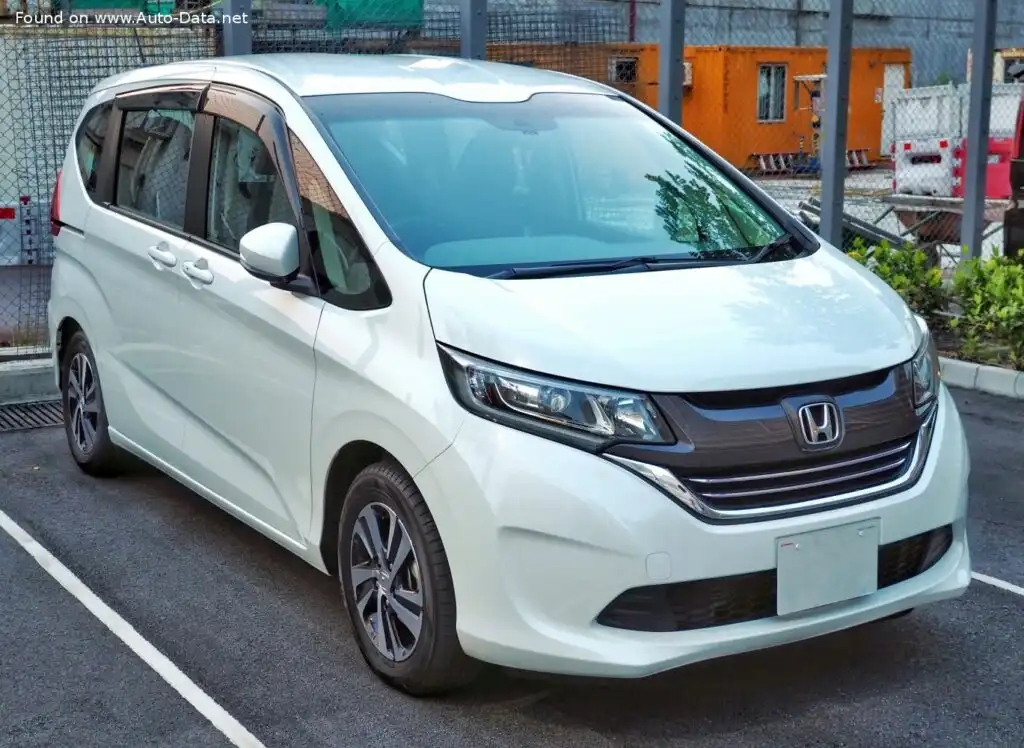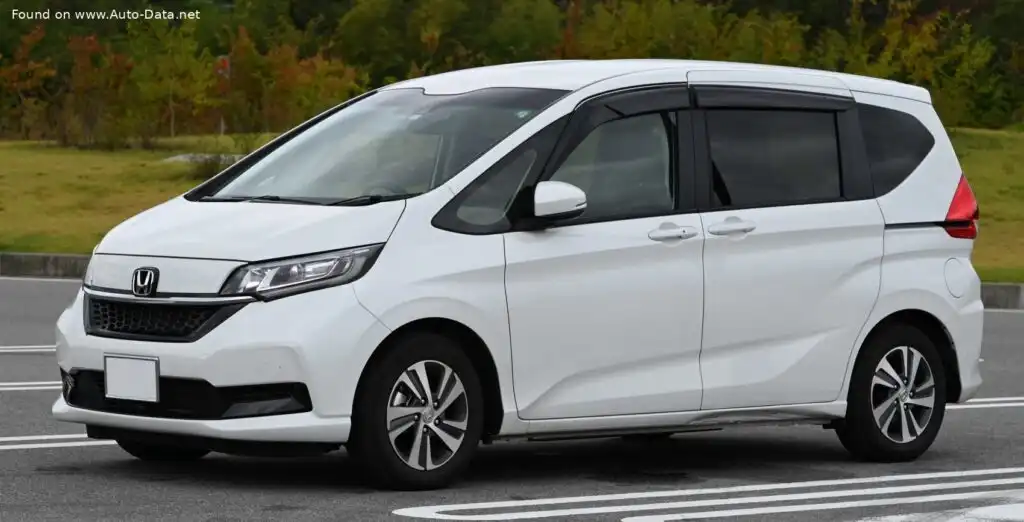
The Honda Freed II, specifically the 1.5 i-VTEC (110 Hp) Hybrid Automatic variant produced from October 2019 to May 2024, represents a significant iteration of Honda’s compact multi-purpose vehicle (MPV). Positioned as a practical and fuel-efficient family vehicle, the Freed II catered primarily to the Japanese domestic market (JDM) where space efficiency and versatility are highly valued. This facelifted version of the second-generation Freed (GB5/GB6) incorporated updated styling, enhanced safety features, and refinements to the hybrid powertrain. It occupied a mid-range position within the Freed lineup, offering a balance between affordability and features compared to more basic trims and the higher-specification models.
Technical Specifications
| Brand | Honda |
| Model | Freed |
| Generation | Freed II (facelift 2019) |
| Type (Engine) | 1.5 i-VTEC (110 Hp) Hybrid Automatic |
| Start of production | October, 2019 |
| End of production | May, 2024 |
| Powertrain Architecture | FHEV (Full Hybrid Electric Vehicle) |
| Body type | MPV |
| Seats | 5-7 |
| Doors | 5 |
| Fuel consumption (urban) | 5.6 l/100 km (42 US mpg, 50.4 UK mpg, 17.9 km/l) |
| Fuel consumption (extra urban) | 4.6 l/100 km (51.1 US mpg, 61.4 UK mpg, 21.7 km/l) |
| Fuel Type | Petrol (Gasoline) |
| Weight-to-power ratio | 12.8 kg/Hp, 78 Hp/tonne |
| Weight-to-torque ratio | 10.5 kg/Nm, 95 Nm/tonne |
| Battery technology | Lithium-ion (Li-Ion) |
| Battery location | Under the front seats |
| Electric motor power | 30 Hp @ 1313-2000 rpm |
| Electric motor Torque | 160 Nm @ 0-1313 rpm (118.01 lb.-ft. @ 0-1313 rpm) |
| Electric motor type | Synchronous |
| Power | 110 Hp @ 6000 rpm |
| Power per litre | 73.5 Hp/l |
| Torque | 134 Nm @ 5000 rpm (98.83 lb.-ft. @ 5000 rpm) |
| Engine layout | Front, Transverse |
| Engine Model/Code | LEB-H1 |
| Engine displacement | 1496 cm3 (91.29 cu. in.) |
| Number of cylinders | 4 |
| Engine configuration | Inline |
| Cylinder Bore | 73 mm (2.87 in.) |
| Piston Stroke | 89.4 mm (3.52 in.) |
| Compression ratio | 13.5:1 |
| Number of valves per cylinder | 4 |
| Fuel injection system | Direct injection |
| Engine aspiration | Naturally aspirated engine |
| Valvetrain | DOHC, i-VTEC |
| Engine oil capacity | 3.3 l (3.49 US qt | 2.9 UK qt) |
| Coolant | 3.65 l (3.86 US qt | 3.21 UK qt) |
| Kerb Weight | 1410-1450 kg (3108.52 – 3196.7 lbs.) |
| Fuel tank capacity | 36 l (9.51 US gal | 7.92 UK gal) |
| Length | 4265-4295 mm (167.91 – 169.09 in.) |
| Width | 1695 mm (66.73 in.) |
| Height | 1710 mm (67.32 in.) |
| Wheelbase | 2740 mm (107.87 in.) |
| Front track | 1480 mm (58.27 in.) |
| Rear track | 1485 mm (58.46 in.) |
| Ride height (ground clearance) | 135 mm (5.31 in.) |
| Minimum turning circle | 10.4 m (34.12 ft.) |
| Drive wheel | Front wheel drive |
| Number of gears | 7 gears, automatic transmission |
| Front suspension | Independent type McPherson |
| Rear suspension | Torsion |
| Front brakes | Ventilated discs |
| Rear brakes | Disc |
| Assisting systems | ABS (Anti-lock braking system) |
| Steering type | Steering rack and pinion |
| Power steering | Electric Steering |
| Tires size | 185/65 R15 88S |
| Wheel rims size | 5.5J x 15 |
Powertrain & Engine Architecture
The heart of the Freed II 1.5 i-VTEC Hybrid Automatic is the LEB-H1 1.5-liter inline-four cylinder engine. This engine utilizes Honda’s Intelligent Variable Valve Control and Timing (i-VTEC) system, optimizing valve lift and timing for improved efficiency and power delivery across the rev range. Direct fuel injection further enhances combustion efficiency. The engine operates on the Atkinson cycle, known for its thermal efficiency, but is paired with an electric motor to compensate for the Atkinson cycle’s lower power output. The hybrid system employs a lithium-ion battery pack located under the front seats, providing power to the electric motor. The electric motor acts as both a generator during deceleration (regenerative braking) and a motor to assist the gasoline engine or, in certain conditions, propel the vehicle solely on electric power. The powertrain is managed by a sophisticated control system that seamlessly switches between engine, motor, or a combination of both, optimizing for fuel economy and performance. The transmission is a continuously variable transmission (CVT) with seven simulated gear ratios, providing smooth and efficient power delivery.
Driving Characteristics
The 110 hp output and the CVT transmission deliver adequate, though not exhilarating, performance. Acceleration is linear and predictable, prioritizing fuel efficiency over outright speed. The electric motor provides instant torque at low speeds, making city driving particularly smooth and responsive. Compared to the higher-output 1.5L direct injection engine available in some Freed trims, this hybrid variant feels less powerful, especially when fully loaded with passengers and cargo. The CVT is tuned for economy, meaning it holds lower RPMs during cruising, which can sometimes feel slightly disconnected from the engine’s output. The hybrid system’s regenerative braking is noticeable but generally unobtrusive. Overall, the driving experience is geared towards comfort and practicality, making it well-suited for daily commutes and family trips.
Equipment & Trim Levels
The 1.5 i-VTEC Hybrid Automatic trim typically included standard features such as automatic climate control, power windows and locks, keyless entry, and a touchscreen infotainment system with Bluetooth connectivity. Safety features included ABS, airbags, and vehicle stability control. Higher trim levels offered additional features like leather upholstery, alloy wheels, a rearview camera, and advanced driver-assistance systems (ADAS) such as lane departure warning and adaptive cruise control. The interior design focused on maximizing space and practicality, with flexible seating configurations allowing for up to seven passengers or increased cargo capacity. The dashboard layout is functional and user-friendly, with logically placed controls.
Chassis & Braking
The Freed II utilizes a front-engine, front-wheel-drive layout. The suspension consists of independent McPherson struts at the front and a torsion beam setup at the rear. This configuration provides a comfortable ride quality, absorbing bumps and imperfections in the road surface effectively. Braking duties are handled by ventilated discs at the front and solid discs at the rear. The ABS system helps to maintain control during emergency braking situations. The steering is electrically assisted, providing light and precise steering feel. The relatively lightweight construction of the Freed II contributes to its nimble handling characteristics.
Market Reception & Comparison
The Honda Freed II 1.5 i-VTEC Hybrid Automatic was well-received in the Japanese market for its practicality, fuel efficiency, and spacious interior. Critics praised its comfortable ride and ease of use. Compared to other MPVs in its class, the Freed II offered a compelling combination of features and value. The hybrid powertrain provided significantly better fuel economy than the non-hybrid versions, making it an attractive option for environmentally conscious buyers. However, some reviewers noted that the engine lacked outright power, particularly when compared to larger MPVs or those with more powerful engines. Reliability was generally considered to be excellent, consistent with Honda’s reputation for building durable vehicles.
Legacy
The Honda Freed II 1.5 i-VTEC Hybrid Automatic has proven to be a reliable and fuel-efficient vehicle, maintaining a good reputation in the used car market. The LEB-H1 engine and the hybrid system have demonstrated long-term durability, with many examples still in service today. The Freed II’s focus on practicality and space efficiency continues to appeal to families and individuals seeking a versatile and economical vehicle. While not exported widely outside of Japan, the Freed II remains a popular choice for those seeking a compact MPV with hybrid technology.