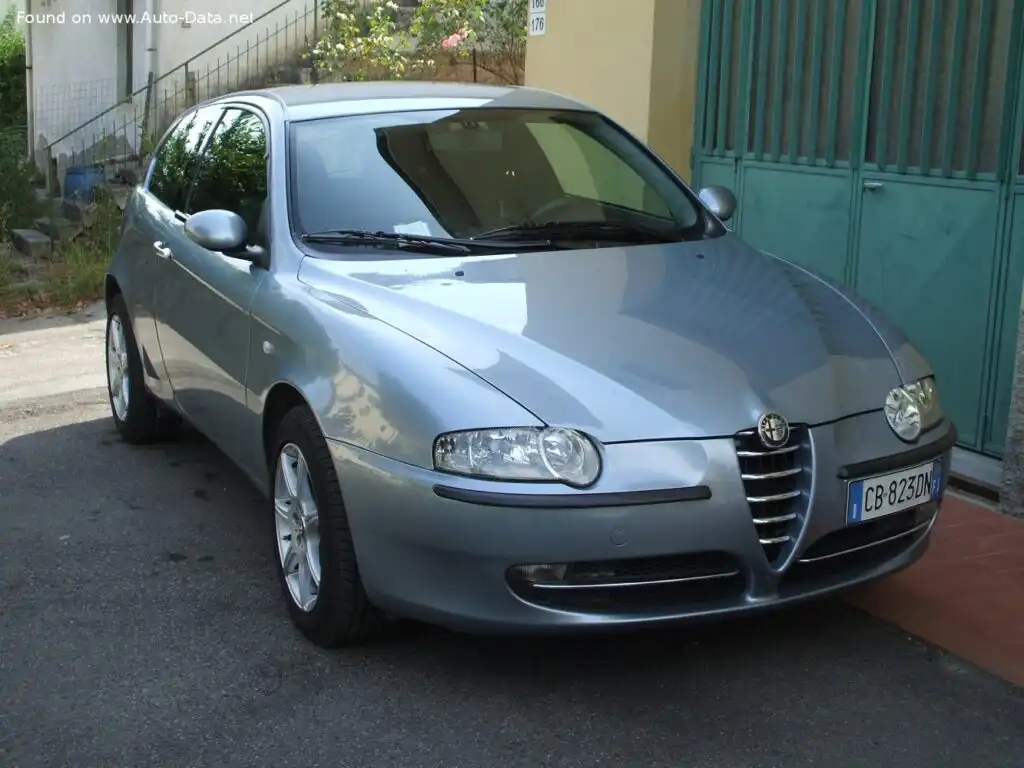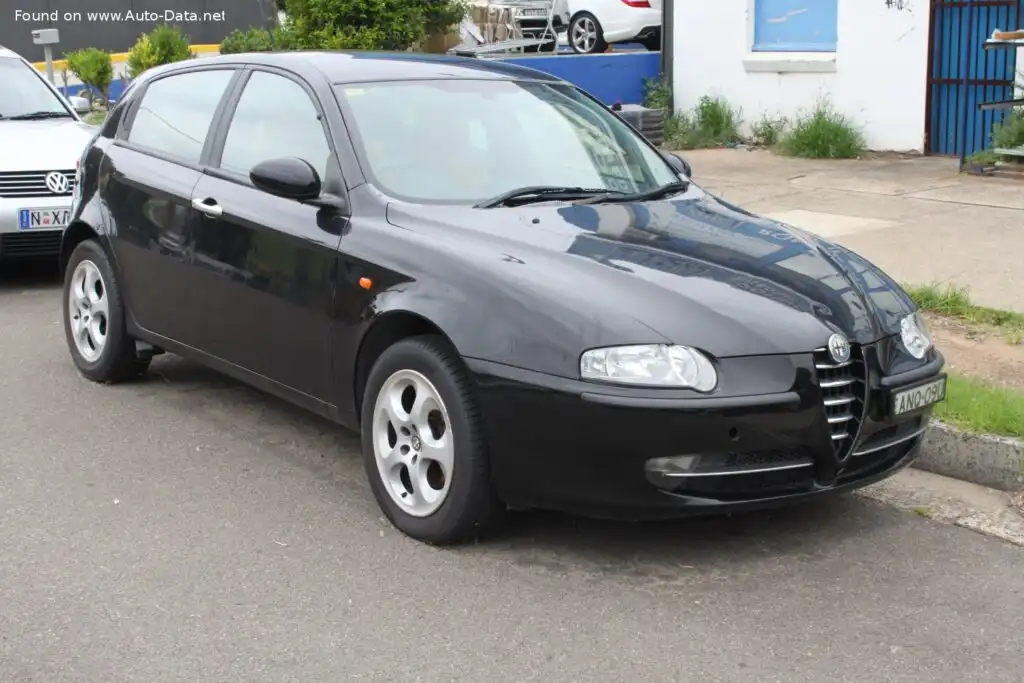
The Alfa Romeo 147 is a C-segment premium compact car produced by the Italian automaker Alfa Romeo from 2000 to 2010. Unveiled at the 2000 Turin Motor Show, the 147 was designed to replace the aging 145 and 146 hatchbacks, immediately capturing public and critical acclaim for its striking design and engaging driving dynamics. It was crowned European Car of the Year in 2001, lauded for its blend of style, performance, and advanced engineering. One of the key models in the initial lineup was the Alfa Romeo 147 5-doors 1.6 Twin Spark 16V (105 Hp), which served as an accessible entry point into the world of Alfa Romeo ownership. This variant, produced from 2000 to 2004 before the model’s mid-cycle facelift, offered the practicality of a five-door layout combined with the brand’s signature flair and a spirited, efficient powertrain.
History and Development
The development of the Alfa Romeo 147 was part of Fiat’s broader strategy to rejuvenate the Alfa Romeo brand in the late 1990s. The project, codenamed Type 937, was built upon a heavily modified version of the platform used for the larger Alfa Romeo 156 saloon. This shared architecture endowed the 147 with a sophisticated suspension setup unusual for its class, contributing significantly to its renowned handling prowess.
The exterior design was penned by a team led by Walter de’Silva and Wolfgang Egger. It drew heavy inspiration from the brand’s rich heritage, featuring the iconic Scudetto triangular grille deeply integrated into the front bumper, a design cue that harked back to classic Alfa Romeos like the 6C 2500 Villa d’Este. The 5-door version was particularly clever in its execution, with the rear door handles concealed in the C-pillar, preserving the clean, coupe-like silhouette of the 3-door model while offering enhanced practicality. This design trick had been used before on the 156 and became a defining feature of Alfa Romeo’s design language during this period.
The Alfa Romeo 147 5-doors 1.6 Twin Spark 16V (105 Hp) was positioned to compete against established premium hatchbacks like the Audi A3, BMW 3 Series Compact, and the upper-tier versions of the Volkswagen Golf and Ford Focus. Its unique selling proposition was its distinctly Italian character, offering a more passionate and design-led alternative in a market often dominated by conservative German engineering.
Technical Analysis: The Alfa Romeo 147 5-doors 1.6 Twin Spark 16V (105 Hp)
Powertrain and Engine Characteristics
At the heart of this particular 147 model is the 1.6-litre Twin Spark 16V engine, a cornerstone of Alfa Romeo’s powertrain lineup at the time. The engine, designated with the model code AR 37203, is a naturally aspirated, inline-four-cylinder unit featuring a Double Overhead Camshaft (DOHC) valvetrain. Its displacement is 1598 cubic centimetres (97.5 cubic inches), achieved with a bore of 82.0 mm and a stroke of 75.7 mm.
The Twin Spark technology, a hallmark of Alfa Romeo engines, refers to the use of two spark plugs per cylinder. This design promotes a more complete and efficient combustion of the air-fuel mixture by creating two flame fronts within the combustion chamber. The intended result is a smoother-running engine with improved low-end torque and better fuel economy compared to a conventional single-plug design.
In this entry-level Eco specification, the engine was engineered for a balance of performance and efficiency. It produces a maximum power output of 105 horsepower (77 kW) at a relatively high 5600 rpm, encouraging drivers to explore the upper rev range to extract maximum performance. The peak torque is rated at 140 Newton-metres (103.3 lb-ft) at 4200 rpm. While these figures were modest compared to the more powerful 120 Hp version of the same engine or the larger 2.0 Twin Spark and V6 GTA models, they were sufficient to provide the lightweight 147 with a lively and engaging character for daily driving. The power-per-litre figure stands at a respectable 65.7 Hp/l.
Mated to this engine was a standard 5-speed manual transmission, sending power to the front wheels. This gearbox was praised for its precise feel and well-spaced ratios that allowed the driver to keep the energetic Twin Spark engine in its optimal power band.
Performance and Fuel Economy
The performance of the Alfa Romeo 147 5-doors 1.6 Twin Spark 16V (105 Hp) reflects its status as an economical yet spirited hatchback. The car accelerates from 0 to 100 km/h (0 to 62 mph) in 11.3 seconds, with an estimated 0-60 mph time of 10.7 seconds. Its maximum speed is 185 km/h (115 mph). While not blistering by modern standards, these figures were competitive for a 1.6-litre hatchback in the early 2000s, ensuring it felt responsive and capable in urban environments and on motorways.
Fuel efficiency was a key consideration for this model. According to official figures, its fuel consumption was:
Urban: 11.1 litres per 100 km (21.2 US mpg / 25.4 UK mpg)
Extra-urban: 6.3 litres per 100 km (37.3 US mpg / 44.8 UK mpg)
* Combined: 8.1 litres per 100 km (29.0 US mpg / 34.9 UK mpg)
The 60-litre fuel tank provided a practical range, making the car suitable for both city commuting and longer journeys.
Chassis, Handling, and Drivetrain
The true standout feature of the Alfa Romeo 147 was its chassis and suspension setup. Unlike most competitors in its class, which utilized a simpler and cheaper MacPherson strut front suspension, the 147 inherited the sophisticated double wishbone front suspension from the 156. This layout allows for better control of camber angle during cornering and suspension travel, resulting in superior grip, improved steering feedback, and a more stable feel. The rear suspension consisted of an advanced MacPherson strut system with transverse and longitudinal links for precise wheel location.
This advanced setup gave the 147 an agile and responsive handling character that set it apart. The steering was a hydraulic power-assisted rack and pinion system, lauded for its quickness and communicative feel, providing the driver with a strong connection to the road. The result was a car that was not only comfortable for daily use but also genuinely fun to drive on winding roads, a trait deeply ingrained in the Alfa Romeo DNA.
Braking was handled by ventilated discs at the front and solid discs at the rear, with an Anti-lock Braking System (ABS) included as a standard safety feature. The car was originally equipped with 185/65 R15 tyres on 6J x 15-inch wheels, a combination that offered a good balance between ride comfort and road-holding.
Design, Interior, and Practicality
The exterior of the 147 remains a high point of early 21st-century automotive design. The assertive front end, with its low-slung Scudetto grille and sweeping headlights, gave it a presence unmatched by its rivals. The 5-door model’s hidden rear door handles were a masterstroke, allowing it to maintain the sporty, coupe-like profile of the 3-door version. Its proportions were well-balanced, with a length of 4170 mm, a width of 1729 mm, and a height of 1442 mm, all resting on a 2546 mm wheelbase.
Inside, the cabin was driver-focused. The dashboard featured two large, deeply cowled dials for the speedometer and tachometer, another classic Alfa Romeo touch. The centre console was angled towards the driver, and the materials, while not always up to the standards of its German rivals, were stylish and well-appointed for the era. The car offered seating for five, although rear passenger space was more suited for short journeys, a common trait in this segment.
From a practical standpoint, the 5-door configuration significantly improved accessibility to the rear seats. The boot space was adequate, offering 280 litres of capacity with the rear seats in place. This could be expanded to a generous 1030 litres by folding the rear seats down, making the 147 a surprisingly versatile vehicle for its size. The kerb weight of 1190 kg contributed to its nimble feel, while it could accommodate a maximum load of 520 kg, bringing its gross weight to 1710 kg.
Full Technical Specifications
| Category | Specification |
| ————————— | ————————————————————————————————————————– |
| General Information | |
| Brand | Alfa Romeo |
| Model | 147 |
| Generation | 147 (5-doors) |
| Engine Type | 1.6 Twin Spark 16V (105 Hp) |
| Production Start | 2000 |
| Production End | 2004 |
| Body Type | Hatchback |
| Seats | 5 |
| Doors | 5 |
| Engine Specifications | |
| Power | 105 Hp @ 5600 rpm |
| Torque | 140 Nm @ 4200 rpm (103.26 lb.-ft. @ 4200 rpm) |
| Engine Model Code | AR 37203 |
| Engine Layout | Front, Transverse |
| Displacement | 1598 cm³ (97.52 cu. in.) |
| Number of Cylinders | 4 |
| Configuration | Inline |
| Cylinder Bore | 82 mm (3.23 in.) |
| Piston Stroke | 75.7 mm (2.98 in.) |
| Compression Ratio | 10.3:1 |
| Valves per Cylinder | 4 |
| Valvetrain | DOHC |
| Fuel System | Multi-port Manifold Injection |
| Aspiration | Naturally Aspirated |
| Engine Oil Capacity | 4.4 L |
| Coolant Capacity | 7.0 L |
| Performance | |
| Maximum Speed | 185 km/h (114.