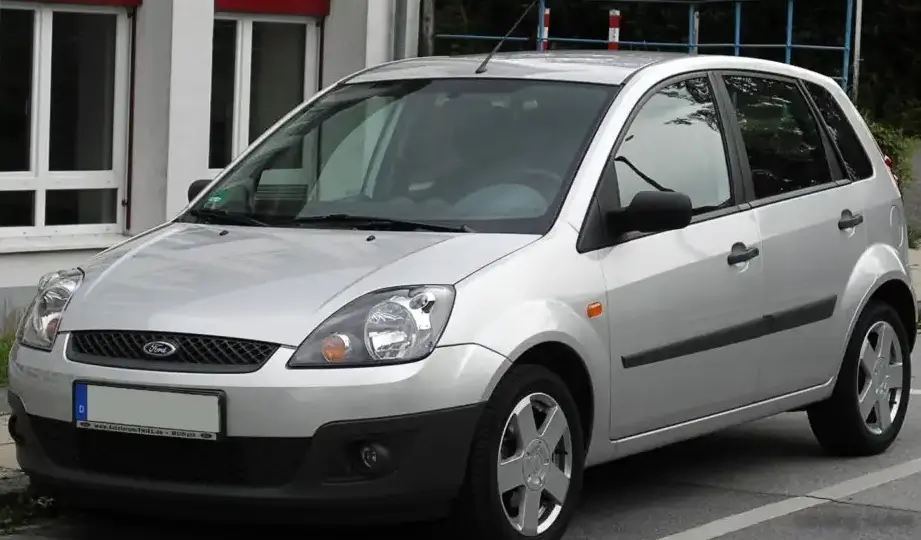
The Ford Fiesta Mk6, specifically the facelifted version produced from 2005 to 2008, represented a significant evolution of Ford’s popular supermini. Within the Mk6 range, the 5-door 1.6 Duratec model, producing 100 horsepower, occupied a middle ground in the lineup, offering a balance between affordability, practicality, and performance. This variant aimed to appeal to buyers seeking a more refined driving experience than the base models, without the higher price tag of the sportier ST or higher-specification trims. It was a key offering in the European market, where the Fiesta consistently ranked among the best-selling vehicles in its class.
Technical Specifications
| Brand | Ford |
| Model | Fiesta |
| Generation | Fiesta VI (Mk6, facelift 2005) 5 door |
| Type (Engine) | 1.6 Duratec (100 Hp) |
| Start of production | 2005 |
| End of production | 2008 |
| Powertrain Architecture | Internal Combustion engine |
| Body type | Hatchback |
| Seats | 5 |
| Doors | 5 |
| Fuel consumption (urban) | 8.8 l/100 km (26.7 US mpg, 32.1 UK mpg, 11.4 km/l) |
| Fuel consumption (extra urban) | 5.1 l/100 km (46.1 US mpg, 55.4 UK mpg, 19.6 km/l) |
| Fuel consumption (combined) | 6.4 l/100 km (36.8 US mpg, 44.1 UK mpg, 15.6 km/l) |
| CO2 emissions | 153 g/km |
| Fuel Type | Petrol (Gasoline) |
| Acceleration 0 – 100 km/h | 11 sec |
| Acceleration 0 – 62 mph | 11 sec |
| Acceleration 0 – 60 mph | 10.2 sec |
| Maximum speed | 183 km/h (113.71 mph) |
| Emission standard | Euro 4 |
| Weight-to-power ratio | 10.5 kg/Hp, 95.6 Hp/tonne |
| Weight-to-torque ratio | 7.2 kg/Nm, 139.6 Nm/tonne |
| Power | 100 Hp @ 6000 rpm |
| Power per litre | 62.7 Hp/l |
| Torque | 146 Nm @ 4000 rpm (107.68 lb.-ft. @ 4000 rpm) |
| Engine layout | Front, Transverse |
| Engine Model/Code | FYJA |
| Engine displacement | 1596 cm3 (97.39 cu. in.) |
| Number of cylinders | 4 |
| Engine configuration | Inline |
| Number of valves per cylinder | 4 |
| Fuel injection system | Multi-port manifold injection |
| Engine aspiration | Naturally aspirated engine |
| Valvetrain | DOHC |
| Engine oil capacity | 4.1 l (4.33 US qt | 3.61 UK qt) |
| Coolant capacity | 5 l (5.28 US qt | 4.4 UK qt) |
| Kerb Weight | 1046 kg (2306.04 lbs.) |
| Max. weight | 1540 kg (3395.12 lbs.) |
| Max load | 494 kg (1089.08 lbs.) |
| Trunk (boot) space – minimum | 284 l (10.03 cu. ft.) |
| Trunk (boot) space – maximum | 947 l (33.44 cu. ft.) |
| Fuel tank capacity | 45 l (11.89 US gal | 9.9 UK gal) |
| Max. roof load | 75 kg (165.35 lbs.) |
| Permitted trailer load with brakes (12%) | 750 kg (1653.47 lbs.) |
| Length | 3924 mm (154.49 in.) |
| Width | 1685 mm (66.34 in.) |
| Width including mirrors | 1912 mm (75.28 in.) |
| Height | 1464 mm (57.64 in.) |
| Wheelbase | 2486 mm (97.87 in.) |
| Front track | 1464-1474 mm (57.64 – 58.03 in.) |
| Rear track | 1435-1444 mm (56.5 – 56.85 in.) |
| Minimum turning circle | 9.3 m (30.51 ft.) |
| Drivetrain | Front wheel drive |
| Number of gears | 5 |
| Gearbox type | Manual transmission |
| Front suspension | Independent type McPherson, Transverse stabilizer |
| Rear suspension | Coil spring, Elastic beam |
| Front brakes | Disc |
| Rear brakes | Drum |
| Assisting systems | ABS (Anti-lock braking system) |
| Steering type | Steering rack and pinion |
| Power steering | Hydraulic Steering |
| Tires size | 195/50 R 15 |
| Wheel rims size | 15 |
INTRODUCTION
The Ford Fiesta Mk6, launched in 2002 and facelifted in 2005, was a crucial model for Ford in Europe. The facelift brought revised styling, improved interior materials, and updated engine options. The 1.6-liter Duratec engine, producing 100 horsepower, was introduced as a step up from the smaller 1.25 and 1.4-liter engines, offering a noticeable increase in performance. Available in both 3-door and 5-door configurations, the 1.6 model aimed to provide a more mature and capable driving experience for those seeking a versatile and economical supermini. This particular variant was positioned as a mid-range offering, bridging the gap between the entry-level models and the more performance-oriented ST version.
Powertrain & Engine Architecture
The heart of this Fiesta variant is the Ford Duratec 1.6-liter inline-four cylinder engine, designated as the FYJA engine code. This engine is a naturally aspirated unit featuring a multi-port fuel injection system. The Duratec series was known for its relatively simple design and robust construction. The engine utilizes a double overhead camshaft (DOHC) valvetrain with four valves per cylinder, contributing to its respectable power output for its displacement. The 100 hp output is achieved at 6000 rpm, while peak torque of 146 Nm (107.68 lb-ft) arrives at 4000 rpm. The engine is transversely mounted in the front of the vehicle. The transmission is a five-speed manual gearbox, chosen for its affordability and efficiency. While an automatic transmission was available on other Fiesta Mk6 models, it was not typically paired with the 1.6L 100hp engine.
Driving Characteristics
The 1.6-liter Fiesta offered a noticeable improvement in driving experience compared to the smaller-engined models. Acceleration from 0-60 mph took around 10.2 seconds, and top speed was approximately 113.71 mph. While not a sports car, the 1.6L engine provided sufficient power for everyday driving and overtaking maneuvers. The five-speed manual transmission allowed for precise gear selection, and the gear ratios were well-matched to the engine’s powerband. Compared to the 1.25L or 1.4L models, the 1.6 felt more responsive and less strained, particularly when carrying passengers or luggage. It didn’t possess the outright punch of the later Fiesta ST models, but offered a more refined and accessible driving experience. The steering was light and accurate, making it easy to maneuver in urban environments.
Equipment & Trim Levels
The 1.6-liter Fiesta typically came equipped with a reasonable level of standard features. These included central locking, power steering, front airbags, and an adjustable steering column. Higher trim levels, such as the Style or Zetec, added features like alloy wheels, air conditioning, electric windows, and a CD player. Interior upholstery was typically cloth, with a relatively simple dashboard layout. Optional extras included metallic paint, a sunroof, and upgraded audio systems. The 5-door configuration offered increased practicality and easier access to the rear seats, making it a popular choice for families.
Chassis & Braking
The Fiesta Mk6 utilized a McPherson strut front suspension and an elastic beam rear suspension. This setup provided a good balance between ride comfort and handling. The front suspension incorporated a transverse stabilizer bar to reduce body roll. Braking duties were handled by disc brakes at the front and drum brakes at the rear. ABS (Anti-lock Braking System) was standard equipment, enhancing safety. The chassis was relatively lightweight, contributing to the car’s agility. The suspension tuning was geared towards comfort, but still provided adequate control in corners.
Market Reception & Comparison
The 1.6-liter Fiesta was generally well-received by automotive critics. It was praised for its improved performance, refined engine, and comfortable ride. Compared to the smaller-engined models, the 1.6 offered a more enjoyable driving experience without a significant increase in price. Fuel economy was respectable, averaging around 36.8 US mpg in combined driving. Reliability was generally good, although some owners reported minor issues with the electrical system. Compared to rivals like the Volkswagen Polo and Renault Clio, the Fiesta offered a competitive package in terms of price, performance, and features.
Legacy
The Ford Fiesta Mk6 1.6 Duratec remains a popular choice in the used car market. Its relatively simple mechanicals and robust engine make it a reliable and affordable option. The Duratec engine is known for its longevity, and parts are readily available. While not a particularly exciting car, it represents a well-rounded and practical supermini that continues to provide dependable transportation for many owners. Its enduring popularity is a testament to Ford’s successful formula for a compact, economical, and enjoyable vehicle.