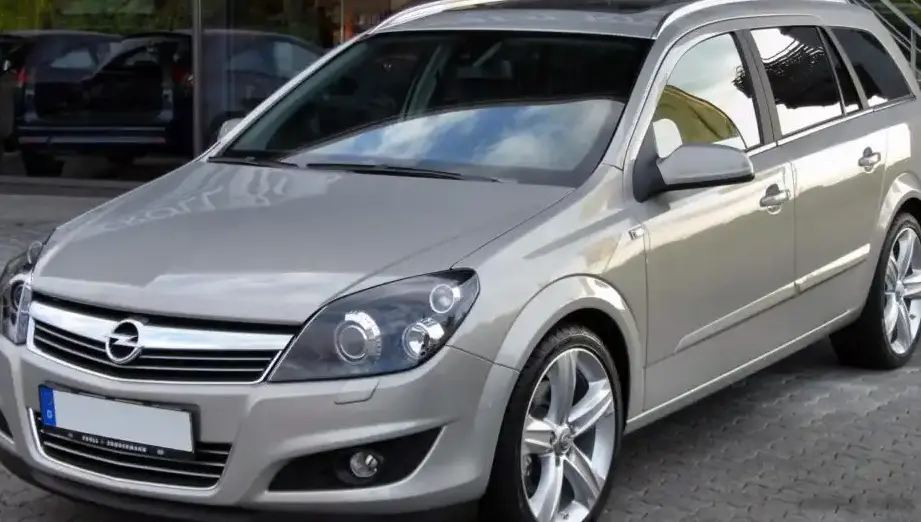
The Opel Astra H Caravan (facelift, produced 2007-2010) 1.7 CDTI ecoFLEX, generating 110 horsepower, represented a fuel-efficient option within the Astra H series, a compact estate car (wagon) aimed primarily at the European market. Introduced in December 2008 and continuing through October 2010, this variant focused on balancing practicality with reduced running costs, appealing to families and individuals seeking an economical vehicle without sacrificing cargo space. It sat in the mid-range of the Astra H lineup, offering a step up from the base models in terms of efficiency and features, but positioned below the more powerful petrol and diesel variants.
Technical Specifications
| Brand | Opel |
| Model | Astra |
| Generation | Astra H Caravan (facelift 2007) |
| Type (Engine) | 1.7 CDTI ecoFLEX (110 Hp) |
| Start of production | December, 2008 |
| End of production | October, 2010 |
| Powertrain Architecture | Internal Combustion engine |
| Body type | Station wagon (estate) |
| Seats | 5 |
| Doors | 5 |
| Fuel consumption (urban) | 5.6 l/100 km (42 US mpg, 50.4 UK mpg) |
| Fuel consumption (extra urban) | 3.9 l/100 km (60.3 US mpg, 72.4 UK mpg) |
| Fuel consumption (combined) | 4.5 l/100 km (52.3 US mpg, 62.8 UK mpg) |
| CO2 emissions | 119 g/km |
| Fuel Type | Diesel |
| Acceleration 0 – 100 km/h | 12.3 sec |
| Acceleration 0 – 62 mph | 12.3 sec |
| Acceleration 0 – 60 mph | 11.7 sec |
| Maximum speed | 188 km/h (116.82 mph) |
| Emission standard | Euro 4 |
| Weight-to-power ratio | 12 kg/Hp |
| Weight-to-torque ratio | 5.1 kg/Nm |
| Power | 110 Hp @ 3800 rpm |
| Torque | 260 Nm @ 2300 rpm (191.77 lb.-ft. @ 2300 rpm) |
| Engine layout | Front, Transverse |
| Engine Model/Code | Z17DTJ |
| Engine displacement | 1686 cm3 (102.89 cu. in.) |
| Number of cylinders | 4 |
| Engine configuration | Inline |
| Cylinder Bore | 79 mm (3.11 in.) |
| Piston Stroke | 86 mm (3.39 in.) |
| Compression ratio | 18:1 |
| Number of valves per cylinder | 4 |
| Fuel injection system | Diesel Commonrail |
| Engine aspiration | Turbocharger, Intercooler |
| Valvetrain | DOHC |
| Engine oil capacity | 5.4 l (5.71 US qt | 4.75 UK qt) |
| Coolant capacity | 7.1 l (7.5 US qt | 6.25 UK qt) |
| Kerb Weight | 1318 kg (2905.69 lbs.) |
| Max. weight | 1935 kg (4265.94 lbs.) |
| Max load | 617 kg (1360.25 lbs.) |
| Trunk (boot) space – minimum | 500 l (17.66 cu. ft.) |
| Trunk (boot) space – maximum | 1590 l (56.15 cu. ft.) |
| Fuel tank capacity | 52 l (13.74 US gal | 11.44 UK gal) |
| Max. roof load | 100 kg (220.46 lbs.) |
| Permitted trailer load (braked) | 1000 kg (2204.62 lbs.) |
| Permitted trailer load (unbraked) | 690 kg (1521.19 lbs.) |
| Length | 4515 mm (177.76 in.) |
| Width | 1753 mm (69.02 in.) |
| Width with mirrors folded | 1804 mm (71.02 in.) |
| Width including mirrors | 2033 mm (80.04 in.) |
| Height | 1500 mm (59.06 in.) |
| Wheelbase | 2703 mm (106.42 in.) |
| Front track | 1488 mm (58.58 in.) |
| Rear track | 1488 mm (58.58 in.) |
| Ride height (ground clearance) | 160 mm (6.3 in.) |
| Drag coefficient (Cd) | 0.31 |
| Minimum turning circle | 11.5 m (37.73 ft.) |
| Drivetrain | Front wheel drive |
| Number of gears | 6 |
| Gearbox type | Manual transmission |
| Front suspension | Independent, McPherson with coil spring and anti-roll bar |
| Rear suspension | Torsion |
| Front brakes | Ventilated discs |
| Rear brakes | Disc |
INTRODUCTION
The Opel Astra H Caravan 1.7 CDTI ecoFLEX (110 hp) was a key variant within the facelifted Astra H range, launched in 2007 and continuing until 2010. Built on the GM Delta platform (internally known as 1HX0/A3), the Astra H aimed to provide a competitive package in the crowded European C-segment. The “ecoFLEX” designation signified Opel’s commitment to fuel efficiency, incorporating technologies designed to minimize emissions and maximize mileage. This particular engine and transmission combination was designed to appeal to buyers prioritizing economy and practicality in a family-oriented estate car.
Powertrain & Engine Architecture
The heart of this Astra variant is the Z17DTJ, a 1.7-liter four-cylinder turbocharged diesel engine. This engine is part of Opel/Fiat’s family of common rail diesel engines, known for their relatively compact size and efficiency. The Z17DTJ utilizes a second-generation common rail direct injection system, delivering fuel at extremely high pressures for optimized combustion. The engine features a single overhead camshaft (SOHC) design per cylinder bank (DOHC overall) operating four valves per cylinder. A fixed geometry turbocharger with an intercooler provides forced induction, boosting power and torque. The 110 hp output is achieved at 3800 rpm, while the peak torque of 260 Nm (191.77 lb-ft) is available from 2300 rpm. This engine was paired with a six-speed manual transmission, chosen for its efficiency and driver engagement. The transmission’s gear ratios were tuned to maximize fuel economy and provide adequate acceleration.
Driving Characteristics
The 1.7 CDTI ecoFLEX, with its 110 horsepower and manual transmission, offered a respectable, though not exhilarating, driving experience. Acceleration from 0-60 mph took approximately 11.7 seconds, and top speed was around 116.82 mph. The engine’s torque delivery was its strong suit, providing sufficient pulling power for everyday driving and overtaking maneuvers. However, compared to the more powerful 1.9 CDTI variants, the 1.7 felt noticeably less responsive, particularly at higher speeds. The six-speed gearbox helped to keep the engine within its optimal power band, but required frequent shifting to maintain momentum on inclines. The suspension, tuned for comfort, provided a reasonably smooth ride, although it wasn’t particularly sporty. Steering feel was adequate, but lacked the precision of some competitors.
Equipment & Trim Levels
The 1.7 CDTI ecoFLEX typically came equipped with a reasonable level of standard features. These included air conditioning, electric front windows, a CD/radio system, and ABS brakes. Safety features such as front and side airbags were also standard. Interior upholstery was typically cloth, with a functional, if somewhat basic, dashboard layout. Optional extras included alloy wheels, rear parking sensors, cruise control, and an upgraded audio system. Trim levels varied slightly depending on the market, but generally offered a progression of features, with higher trims adding items like automatic climate control, rain-sensing wipers, and more premium interior materials.
Chassis & Braking
The Astra H Caravan featured an independent McPherson strut suspension at the front, providing a good balance of comfort and handling. The rear suspension utilized a torsion beam setup, which was cost-effective and space-efficient. Braking duties were handled by ventilated discs at the front and solid discs at the rear. ABS (Anti-lock Braking System) was standard, enhancing safety during emergency braking. The chassis was designed to provide a stable and predictable driving experience, although it wasn’t particularly focused on sporty handling. Stabilizer bars were fitted front and rear to reduce body roll during cornering.
Market Reception & Comparison
The Astra H Caravan 1.7 CDTI ecoFLEX was generally well-received by critics for its fuel efficiency and practicality. It offered a compelling alternative to petrol-powered rivals, particularly for drivers covering long distances. However, some reviewers noted the engine’s lack of outright performance compared to higher-powered variants. Compared to the 1.9 CDTI models, the 1.7 offered significantly better fuel economy but at the expense of acceleration and overall refinement. The 1.7 CDTI also competed with other diesel estates from manufacturers like Ford, Volkswagen, and Peugeot, often holding its own in terms of value for money and running costs.
Legacy
The Z17DTJ engine, while not without its quirks, proved to be a relatively reliable unit when properly maintained. Common issues included diesel particulate filter (DPF) clogging, particularly on vehicles used primarily for short journeys, and occasional turbocharger failures. However, these issues were not widespread, and the engine generally offered good longevity. Today, the Astra H Caravan 1.7 CDTI ecoFLEX represents a reasonably affordable and economical used car option. Its fuel efficiency and spacious interior continue to appeal to buyers seeking a practical and cost-effective estate car. Parts availability is generally good, and maintenance costs are relatively low, making it a sensible choice for those seeking a dependable and economical vehicle.