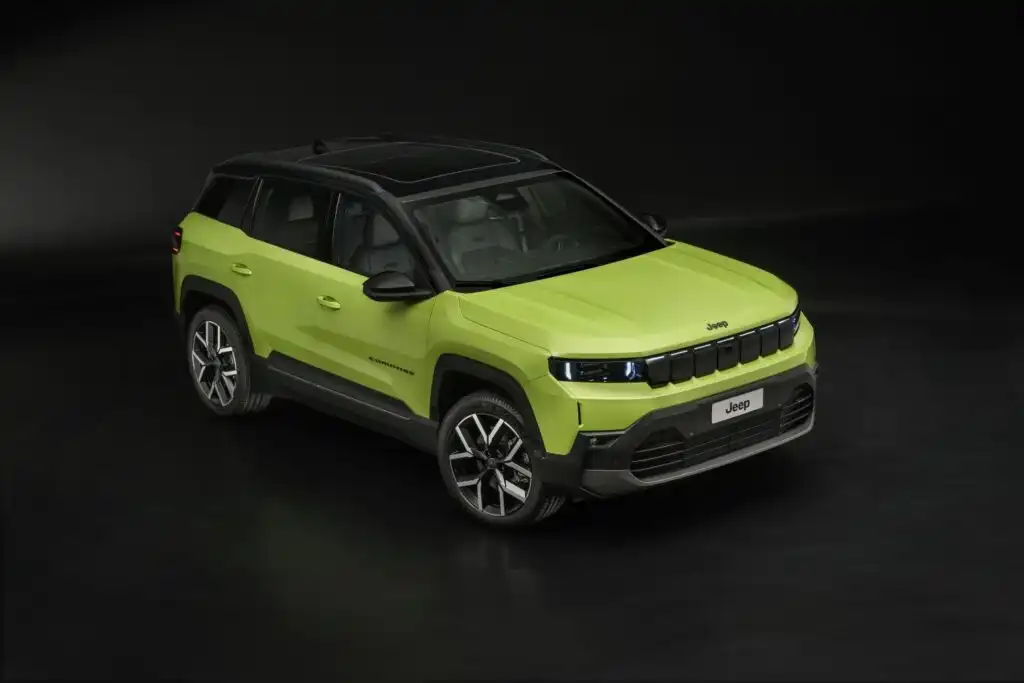
The Jeep Compass III 1.2 (145 Hp) e-Hybrid eDCT represents Jeep’s entry into the increasingly competitive compact SUV market with a focus on fuel efficiency and mild hybridization. Introduced in May 2025, this variant is positioned as a more economical option within the Compass III range, appealing to buyers seeking a balance between practicality, technology, and reduced running costs. It builds upon the foundation of the Compass III, which utilizes the Small Wide architecture shared with other Stellantis vehicles. The “e-Hybrid” designation signifies the integration of a 48-volt mild hybrid system designed to assist the internal combustion engine, improving fuel economy and reducing emissions.
Technical Specifications
| Brand | Jeep |
| Model | Compass |
| Generation | Compass III |
| Type (Engine) | 1.2 (145 Hp) e-Hybrid eDCT |
| Start of production | May, 2025 |
| Powertrain Architecture | MHEV (Mild Hybrid Electric Vehicle) |
| Body type | SUV, Crossover |
| Seats | 5 |
| Doors | 5 |
| Combined fuel consumption (WLTP) | 5.9 l/100 km (39.9 US mpg, 47.9 UK mpg, 16.9 km/l) |
| CO2 emissions (WLTP) | 133 g/km |
| Fuel Type | Petrol (Gasoline) |
| Acceleration 0 – 100 km/h | 10.3 sec |
| Acceleration 0 – 62 mph | 10.3 sec |
| Acceleration 0 – 60 mph | 9.8 sec |
| Maximum speed | 188 km/h (116.82 mph) |
| Weight-to-power ratio | 11 kg/Hp, 91.1 Hp/tonne |
| Weight-to-torque ratio | 6.9 kg/Nm, 144.5 Nm/tonne |
| Gross battery capacity | 0.9 kWh |
| Battery technology | Lithium-ion (Li-Ion) |
| Electric motor power | 28 Hp |
| Electric motor Torque | 50 Nm (36.88 lb.-ft.) |
| Electric motor location | Integrated into the transmission |
| Electric motor type | Synchronous |
| System power | 145 Hp |
| Power | 136 Hp |
| Power per litre | 113.4 Hp/l |
| Torque | 230 Nm @ 1750 rpm (169.64 lb.-ft. @ 1750 rpm) |
| Engine layout | Front, Transverse |
| Engine displacement | 1199 cm3 (73.17 cu. in.) |
| Number of cylinders | 3 |
| Engine configuration | Inline |
| Number of valves per cylinder | 4 |
| Fuel injection system | Direct injection |
| Engine aspiration | Turbocharger, Intercooler |
| Engine systems | Start & Stop System, Particulate filter |
| Kerb Weight | 1592 kg (3509.76 lbs.) |
| Trunk (boot) space – minimum | 550 l (19.42 cu. ft.) |
| Permitted trailer load with brakes (12%) | 1150 kg (2535.32 lbs.) |
| Length | 4552 mm (179.21 in.) |
| Width with mirrors folded | 1928 mm (75.91 in.) |
| Height | 1675 mm (65.94 in.) |
| Wheelbase | 2795 mm (110.04 in.) |
| Ride height (ground clearance) | 200 mm (7.87 in.) |
| Approach angle | 20° |
| Departure angle | 28° |
| Ramp-over (brakeover) angle | 15° |
| Wading depth | 408 mm (16.06 in.) |
| Drivetrain Architecture | Front wheel drive, MHEV |
| Number of gears and type of gearbox | 6 gears, automatic transmission eDCT |
| Front brakes | Ventilated discs |
| Rear brakes | Disc |
Powertrain & Engine Architecture
The heart of the Jeep Compass III 1.2 e-Hybrid is a 1.2-liter turbocharged inline-three cylinder engine, internally designated as part of the Firefly family. This engine utilizes direct fuel injection and a single scroll turbocharger with an intercooler to deliver 136 horsepower. The mild hybrid system consists of a 48-volt electric motor and a small battery pack (0.9 kWh) integrated into the eDCT transmission. This system provides torque assist during acceleration, allowing the engine to operate more efficiently and reduce emissions. The electric motor contributes an additional 28 horsepower and 50 Nm of torque. The eDCT (dual-clutch transmission) is a six-speed automatic, chosen for its responsiveness and efficiency. The Start & Stop system further contributes to fuel savings by automatically shutting off the engine when the vehicle is stationary.
Driving Characteristics
The 1.2-liter e-Hybrid powertrain delivers adequate performance for everyday driving. Acceleration from 0-60 mph takes approximately 9.8 seconds, and the top speed is 188 km/h (116.82 mph). While not a performance-oriented setup, the electric motor assist provides a noticeable boost during initial acceleration, making it feel more responsive than a comparable non-hybrid engine. Compared to higher-powered Compass variants (like those with the 1.3L engine), this version prioritizes fuel economy over outright speed. The eDCT transmission offers smooth and quick gear changes, enhancing the driving experience. The mild hybrid system is most effective in urban driving conditions, where frequent stop-and-go traffic allows for regenerative braking and electric assist. On the highway, the benefits are less pronounced, but the engine remains relatively quiet and refined.
Equipment & Trim Levels
The 1.2 e-Hybrid trim typically comes standard with features such as air conditioning, a touchscreen infotainment system with Apple CarPlay and Android Auto compatibility, and a suite of safety features including automatic emergency braking, lane departure warning, and adaptive cruise control. Interior upholstery is generally cloth, with options for leather upgrades on higher sub-trims. Available optional extras include a panoramic sunroof, premium audio system, and advanced driver-assistance systems like blind-spot monitoring and rear cross-traffic alert. The specific trim levels and standard equipment can vary depending on the market.
Chassis & Braking
The Jeep Compass III utilizes a front-wheel-drive chassis with independent suspension in the front and a multi-link setup in the rear. The suspension is tuned for comfort, providing a relatively smooth ride over various road surfaces. The front brakes are ventilated discs, while the rear brakes are solid discs. The steering is electric power-assisted, offering light and precise control. The vehicle’s weight of 1592 kg (3509.76 lbs) is typical for a compact SUV, and the suspension is designed to handle this weight effectively. Stabilizer bars are included both front and rear to reduce body roll during cornering.
Market Reception & Comparison
The Jeep Compass III 1.2 e-Hybrid eDCT has been generally well-received by automotive critics as a practical and fuel-efficient option in the compact SUV segment. Its fuel economy of 5.9 l/100 km (39.9 US mpg) is competitive with other hybrid and non-hybrid vehicles in its class. Compared to the higher-powered Compass variants, the 1.2 e-Hybrid offers a lower price point and improved fuel efficiency, making it an attractive choice for budget-conscious buyers. However, some reviewers have noted that the engine can feel strained when fully loaded or driving uphill. Reliability reports are still emerging, but the Firefly engine family has generally proven to be durable, and the mild hybrid system is relatively simple, reducing the potential for complex failures.
Legacy
The Jeep Compass III 1.2 e-Hybrid eDCT represents a step towards electrification for the Jeep brand. While it’s a mild hybrid and not a full hybrid or electric vehicle, it demonstrates Jeep’s commitment to reducing emissions and improving fuel efficiency. The long-term reliability of this powertrain remains to be seen, but the combination of a proven engine architecture and a relatively simple hybrid system suggests it should be a dependable option for years to come. In the used car market, this variant is likely to appeal to buyers seeking a fuel-efficient and well-equipped compact SUV with the Jeep brand’s reputation for off-road capability (although this specific model is primarily designed for on-road use).