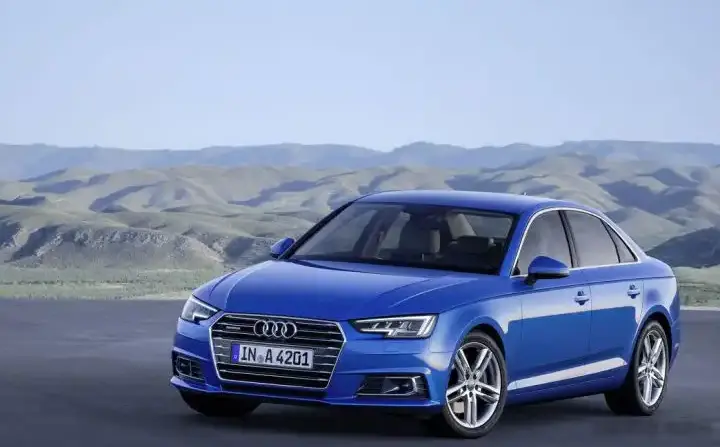
The Audi A4 (B9 8W) 2.0 TFSI ultra, producing 190 horsepower, was a key variant within the fifth generation of Audi’s popular executive sedan, produced from 2015 to 2018. Positioned as a fuel-efficient option within the A4 range, it aimed to balance performance with economy, appealing to buyers seeking a refined driving experience without excessive running costs. This model occupied a mid-range position in the B9 lineup, slotting between the entry-level 1.4 TFSI and the more potent 2.0 TFSI quattro models. It was primarily marketed in Europe and other global markets where fuel efficiency and lower emissions were highly valued, though it was also available in limited quantities in North America.
Technical Specifications
| Brand | Audi |
| Model | A4 |
| Generation | A4 (B9 8W) |
| Type (Engine) | 2.0 TFSI ultra (190 Hp) |
| Start of production | 2015 year |
| End of production | 2018 year |
| Powertrain Architecture | Internal Combustion engine |
| Body type | Sedan |
| Seats | 5 |
| Doors | 4 |
| Fuel consumption (economy) – urban | 7-7.4 l/100 km (33.6 – 31.8 US mpg, 40.4 – 38.2 UK mpg, 14.3 – 13.5 km/l) |
| Fuel consumption (economy) – extra urban | 4.4-5 l/100 km (53.5 – 47 US mpg, 64.2 – 56.5 UK mpg, 22.7 – 20 km/l) |
| Fuel consumption (economy) – combined | 5.4-5.9 l/100 km (43.6 – 39.9 US mpg, 52.3 – 47.9 UK mpg, 18.5 – 16.9 km/l) |
| CO2 emissions | 122-134 g/km |
| Fuel Type | Petrol (Gasoline) |
| Acceleration 0 – 100 km/h | 7.2 sec |
| Acceleration 0 – 62 mph | 7.2 sec |
| Acceleration 0 – 60 mph | 6.8 sec |
| Maximum speed | 240 km/h (149.13 mph) |
| Emission standard | Euro 6 |
| Weight-to-power ratio | 7.3 kg/Hp, 137.7 Hp/tonne |
| Weight-to-torque ratio | 4.3 kg/Nm, 231.9 Nm/tonne |
| Power | 190 Hp @ 4200-6000 rpm |
| Power per litre | 95.8 Hp/l |
| Torque | 320 Nm @ 1450-4200 rpm (236.02 lb.-ft. @ 1450-4200 rpm) |
| Engine layout | Front, Longitudinal |
| Engine Model/Code | EA888 / CVKB |
| Engine displacement | 1984 cm3 (121.07 cu. in.) |
| Number of cylinders | 4 |
| Engine configuration | Inline |
| Cylinder Bore | 82.5 mm (3.25 in.) |
| Piston Stroke | 92.8 mm (3.65 in.) |
| Compression ratio | 11.65:1 |
| Number of valves per cylinder | 4 |
| Fuel injection system | Direct injection and Multi-port manifold injection |
| Engine aspiration | Turbocharger, Intercooler |
| Valvetrain | DOHC |
| Engine oil capacity | 5.2 l (5.49 US qt | 4.58 UK qt) |
| Coolant | 7.8 l (8.24 US qt | 6.86 UK qt) |
| Kerb Weight | 1380 kg (3042.38 lbs.) |
| Max. weight | 1960 kg (4321.06 lbs.) |
| Max load | 580 kg (1278.68 lbs.) |
| Trunk (boot) space – minimum | 480 l (16.95 cu. ft.) |
| Trunk (boot) space – maximum | 965 l (34.08 cu. ft.) |
| Fuel tank capacity | 54 l (14.27 US gal | 11.88 UK gal) |
| Max. roof load | 90 kg (198.42 lbs.) |
| Permitted trailer load with brakes (8%) | 1700 kg (3747.86 lbs.) |
| Permitted trailer load with brakes (12%) | 1500 kg (3306.93 lbs.) |
| Permitted trailer load without brakes | 720 kg (1587.33 lbs.) |
| Permitted towbar download | 80 kg (176.37 lbs.) |
| Length | 4726 mm (186.06 in.) |
| Width | 1842 mm (72.52 in.) |
| Width including mirrors | 2022 mm (79.61 in.) |
| Height | 1427 mm (56.18 in.) |
| Wheelbase | 2820 mm (111.02 in.) |
| Front track | 1572 mm (61.89 in.) |
| Rear (Back) track | 1555 mm (61.22 in.) |
| Front overhang | 880 mm (34.65 in.) |
| Rear overhang | 1026 mm (40.39 in.) |
| Drag coefficient (Cd) | 0.27 |
| Minimum turning circle (turning diameter) | 11.6 m (38.06 ft.) |
| Drivetrain Architecture | The Internal combustion engine (ICE) drives the front wheels of the vehicle. |
| Drive wheel | Front wheel drive |
| Number of gears and type of gearbox | 6 gears, manual transmission |
| Front suspension | Independent multi-link suspension, Transverse stabilizer |
| Rear suspension | Independent multi-link spring suspension with stabilizer |
| Front brakes | Ventilated discs |
| Rear brakes | Disc |
| Assisting systems | ABS (Anti-lock braking system) |
| Steering type | Steering rack and pinion |
| Power steering | Electric Steering |
| Tires size | 225/50 R17; 245/40 R18; 245/35 R19 |
| Wheel rims size | 7.5J x 17; 8J x 18; 8.5J x 19 |
INTRODUCTION
The Audi A4 (B9) 2.0 TFSI ultra, launched in 2015, represented a significant step forward in efficiency for the A4 model line. Built on the Volkswagen Group’s MLB Evo platform (1HX0/A3), this variant was engineered to deliver a compelling blend of performance and fuel economy. The “ultra” designation signified Audi’s commitment to lightweight construction and optimized engine management. This model aimed to appeal to a broad audience, offering a premium experience without the higher running costs associated with more powerful engines. It was a key player in Audi’s strategy to reduce fleet emissions and meet increasingly stringent environmental regulations.
Powertrain & Engine Architecture
At the heart of the A4 2.0 TFSI ultra lies the EA888 engine, specifically the CVKB code. This is a 1.984-liter, inline-four cylinder engine featuring direct injection and multi-point fuel injection. The combination of these two systems optimizes combustion efficiency and reduces emissions. The engine utilizes a single turbocharger with an intercooler to boost power output. The valvetrain employs a dual overhead camshaft (DOHC) configuration with four valves per cylinder, enhancing breathing and overall performance. The engine’s output of 190 horsepower at 4200-6000 rpm and 320 Nm (236 lb-ft) of torque between 1450-4200 rpm is a testament to its sophisticated engineering. The engine is paired with a six-speed manual transmission, contributing to the car’s efficiency and driver engagement. While an S tronic dual-clutch transmission was available on other A4 variants, the 190 hp ultra model was primarily offered with the manual gearbox in many markets.
Driving Characteristics
The 2.0 TFSI ultra with the manual transmission delivers a respectable driving experience. Acceleration from 0-100 km/h (0-62 mph) takes approximately 7.2 seconds. While not as brisk as the higher-powered quattro models, the 190 hp variant provides sufficient power for everyday driving and overtaking maneuvers. The manual gearbox offers precise shifts and allows for greater driver control. The gear ratios are tuned to prioritize fuel efficiency, meaning the engine doesn’t feel overly stressed at highway speeds. Compared to the 2.0 TFSI quattro, the front-wheel-drive ultra model exhibits slightly more understeer, but it remains composed and predictable. The lower weight, due to the absence of the quattro system, contributes to a more agile feel.
Equipment & Trim Levels
The A4 2.0 TFSI ultra typically came well-equipped, reflecting Audi’s commitment to luxury and technology. Standard features included automatic climate control, a multi-function steering wheel, Audi’s MMI infotainment system with a central display screen, and cloth upholstery. Higher trim levels offered options such as leather seats, a sunroof, navigation system, and advanced driver-assistance systems like adaptive cruise control and lane departure warning. The interior design was characterized by Audi’s signature clean lines and high-quality materials. The dashboard layout was straightforward and user-friendly, with intuitive controls.
Chassis & Braking
The A4 B9’s chassis features independent multi-link suspension at both the front and rear, providing a comfortable and controlled ride. A transverse stabilizer bar at the front helps to reduce body roll during cornering. The front brakes are ventilated discs, while the rear brakes are solid discs. ABS (Anti-lock Braking System) is standard, enhancing safety and stability. The suspension tuning is geared towards comfort, but it still offers a reasonable level of handling precision. The steering is electrically assisted, providing a light and responsive feel.
Market Reception & Comparison
The Audi A4 2.0 TFSI ultra was generally well-received by automotive critics. It was praised for its fuel efficiency, comfortable ride, and refined interior. However, some reviewers noted that the performance wasn’t as exhilarating as that of the more powerful A4 variants. Compared to the 1.4 TFSI, the 2.0 TFSI ultra offered a noticeable improvement in performance. Against the 2.0 TFSI quattro, it provided a more economical option, albeit with slightly less grip and acceleration. The fuel economy figures of 5.4-5.9 l/100 km (43.6-39.9 US mpg) were competitive within its segment, making it an attractive choice for drivers prioritizing efficiency.
Legacy
The Audi A4 (B9) 2.0 TFSI ultra has proven to be a reliable and durable vehicle. The EA888 engine is known for its robustness, and with regular maintenance, it can provide many years of trouble-free service. On the used car market, these models are generally sought after for their balance of performance, economy, and refinement. Common issues are relatively minor, often related to routine wear and tear. The availability of parts and qualified mechanics ensures that maintenance and repairs are relatively straightforward. The A4 B9 2.0 TFSI ultra remains a popular choice for buyers seeking a premium executive sedan that doesn’t break the bank.