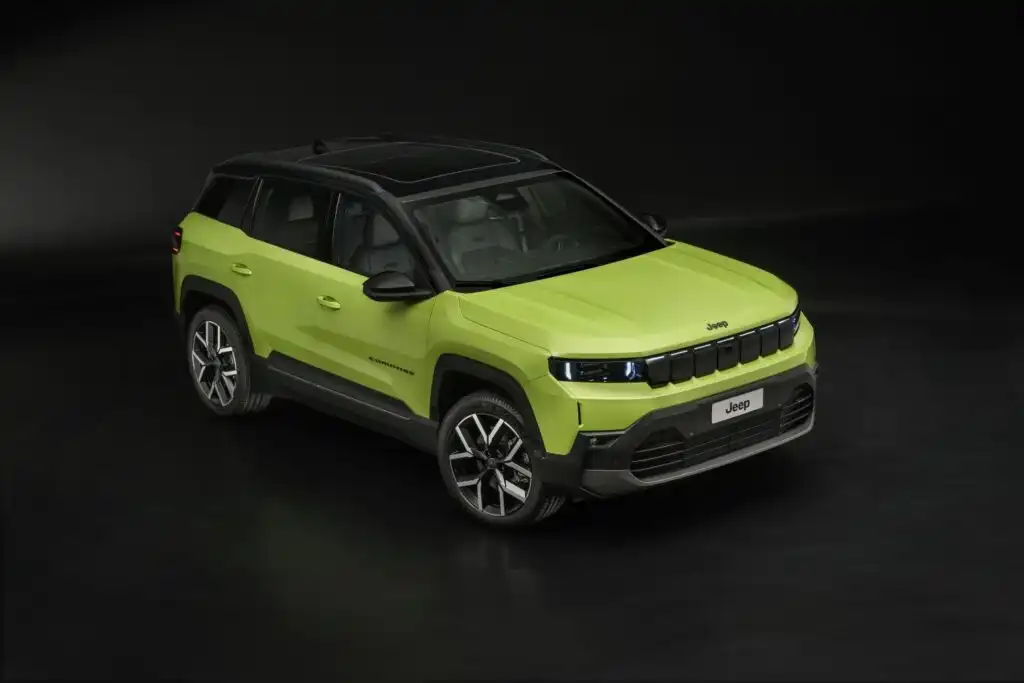
The Jeep Compass III e 74 kWh, producing 213 horsepower, represents Jeep’s entry into the all-electric compact SUV segment. Production began in May 2025, positioning it as a key component of Jeep’s broader electrification strategy. This variant is built upon the Compass III platform, offering a fully electric powertrain within the familiar Compass body style. It aims to provide a balance of Jeep’s renowned capability with the efficiency and environmental benefits of electric propulsion, primarily targeting the European and North American markets.
Technical Specifications
| Brand | Jeep |
| Model | Compass |
| Generation | Compass III |
| Type (Engine) | e 74 kWh (213 Hp) Electric |
| Start of production | May, 2025 |
| Powertrain Architecture | BEV (Electric Vehicle) |
| Body type | SUV, Crossover |
| Seats | 5 |
| Doors | 5 |
| Fuel Type | Electricity |
| Acceleration 0 – 100 km/h | 8.5 sec |
| Acceleration 0 – 62 mph | 8.5 sec |
| Acceleration 0 – 60 mph | 8.1 sec |
| Maximum speed | 180 km/h (111.85 mph) |
| Weight-to-power ratio | 10 kg/Hp, 100.3 Hp/tonne |
| Weight-to-torque ratio | 6.2 kg/Nm, 162.5 Nm/tonne |
| Gross battery capacity | 80 kWh |
| Net (usable) battery capacity | 74 kWh |
| Battery location | Below the floor |
| All-electric range (WLTP) | 500 km (310.69 mi) |
| Average Energy consumption (WLTP) | 17.5 kWh/100 km (28.16 kWh/100 mi) |
| MPGe | 120 |
| km/kWh | 5.7 |
| mi/kWh | 3.6 |
| Electric motor power | 213 Hp |
| Electric motor Torque | 345 Nm (254.46 lb.-ft.) |
| Electric motor location | Front axle, Transverse |
| Electric motor type | Synchronous |
| System power | 213 Hp |
| System torque | 345 Nm (254.46 lb.-ft.) |
| Kerb Weight | 2123 kg (4680.41 lbs.) |
| Trunk (boot) space – minimum | 550 l (19.42 cu. ft.) |
| Permitted trailer load with brakes (12%) | 1000 kg (2204.62 lbs.) |
| Length | 4552 mm (179.21 in.) |
| Width with mirrors folded | 1928 mm (75.91 in.) |
| Height | 1675 mm (65.94 in.) |
| Wheelbase | 2795 mm (110.04 in.) |
| Ride height (ground clearance) | 200 mm (7.87 in.) |
| Approach angle | 20° |
| Departure angle | 28° |
| Ramp-over (brakeover) angle | 15° |
| Wading depth | 408 mm (16.06 in.) |
| Drivetrain Architecture | One electric motor drives the front wheels. |
| Drive wheel | Front wheel drive |
| Number of gears and type of gearbox | 1 gears, automatic transmission |
| Front brakes | Ventilated discs |
| Rear brakes | Disc |
| Assisting systems | ABS (Anti-lock braking system) |
| Steering type | Steering rack and pinion |
| Power steering | Electric Steering |
| Wheel rims size | 19; 20 |
Powertrain & Engine Architecture
The Compass III e 74 kWh utilizes a fully electric powertrain, foregoing a traditional internal combustion engine. The heart of the system is a permanent magnet synchronous motor located on the front axle, delivering 213 horsepower and 345 Nm (254.46 lb.-ft.) of torque. Power is drawn from a lithium-ion battery pack with a gross capacity of 80 kWh, providing a usable capacity of 74 kWh. The battery is positioned under the vehicle floor, contributing to a lower center of gravity and improved handling. The vehicle employs a single-speed automatic transmission, typical for electric vehicles, simplifying the drivetrain and maximizing efficiency. The electric motor is directly coupled to the wheels, eliminating the need for a multi-gear transmission. The charging system supports both AC and DC fast charging, allowing for convenient replenishment of the battery at home or on the road.
Driving Characteristics
The front-wheel-drive configuration of the Compass III e delivers a smooth and responsive driving experience. Acceleration from 0 to 60 mph is achieved in approximately 8.1 seconds, making it competitive within the electric compact SUV segment. The instant torque characteristic of electric motors provides brisk acceleration at lower speeds. While not as dynamically focused as some performance-oriented EVs, the Compass III e offers adequate power for everyday driving and highway cruising. The single-speed transmission provides seamless acceleration, and the regenerative braking system allows for energy recovery and increased range. Compared to potential future all-wheel-drive variants, this front-wheel-drive model prioritizes efficiency and affordability.
Equipment & Trim Levels
The Compass III e 74 kWh is generally well-equipped, reflecting its position as a modern electric vehicle. Standard features typically include a touchscreen infotainment system with Apple CarPlay and Android Auto compatibility, a digital instrument cluster, automatic climate control, and a suite of advanced driver-assistance systems (ADAS) such as automatic emergency braking, lane departure warning, and adaptive cruise control. Interior upholstery is typically cloth or available with optional leather trim. Higher trim levels may offer features such as a panoramic sunroof, premium audio system, and heated/ventilated seats. The exterior styling is consistent with the Compass III range, with subtle electric-specific badging.
Chassis & Braking
The Compass III e utilizes a conventional MacPherson strut front suspension and a multi-link rear suspension, tuned to provide a comfortable ride and stable handling. Ventilated disc brakes are employed at the front, while solid discs are used at the rear. The electric powertrain’s weight distribution necessitates careful suspension calibration to maintain balanced handling characteristics. The vehicle is equipped with an electric power steering system, providing precise and responsive steering feel. Standard safety features include ABS (Anti-lock Braking System) and electronic stability control.
Market Reception & Comparison
The Jeep Compass III e 74 kWh has been generally well-received by automotive critics, who praise its comfortable ride, spacious interior, and competitive range. Its efficiency, rated at 17.5 kWh/100 km, is comparable to other electric SUVs in its class. Compared to gasoline-powered Compass models, the electric variant offers significantly lower running costs and reduced emissions. However, some reviewers note that its acceleration is not as brisk as some rivals and that the interior materials could be of higher quality. The price point positions it competitively within the electric SUV market, making it an attractive option for buyers seeking a practical and environmentally friendly vehicle.
Legacy
The Jeep Compass III e 74 kWh represents a significant step in Jeep’s transition to electric mobility. Its long-term reliability will depend on the durability of the battery pack and electric motor. Early reports suggest that the powertrain is robust and reliable, but further long-term testing is needed. As the electric vehicle market matures, the Compass III e is likely to become a popular choice in the used car market, offering a compelling combination of practicality, efficiency, and Jeep’s brand reputation. The success of this model will be crucial in shaping Jeep’s future electric vehicle offerings.