Technical Specifications
| Brand | Mazda |
| Model | 5 |
| Generation | 5 II |
| Type (Engine) | 2.0i (150 Hp) |
| Start of production | 2010 |
| End of production | 2015 |
| Powertrain Architecture | Internal Combustion engine |
| Body type | Minivan |
| Seats | 7 |
| Doors | 5 |
| Fuel consumption (urban) | 9 l/100 km (26.1 US mpg, 31.4 UK mpg, 11.1 km/l) |
| Fuel consumption (extra urban) | 5.7 l/100 km (41.3 US mpg, 49.6 UK mpg, 17.5 km/l) |
| Fuel consumption (combined) | 6.9 l/100 km (34.1 US mpg, 40.9 UK mpg, 14.5 km/l) |
| CO2 emissions | 159 g/km |
| Fuel Type | Petrol (Gasoline) |
| Acceleration 0 – 100 km/h | 11.2 sec |
| Acceleration 0 – 62 mph | 11.2 sec |
| Acceleration 0 – 60 mph | 10.6 sec |
| Maximum speed | 193 km/h (119.92 mph) |
| Emission standard | Euro 5 |
| Weight-to-power ratio | 9.4 kg/Hp, 106.4 Hp/tonne |
| Weight-to-torque ratio | 7.4 kg/Nm, 135.5 Nm/tonne |
| Power | 150 Hp @ 6200 rpm |
| Power per litre | 75 Hp/l |
| Torque | 191 Nm @ 4500 rpm (140.87 lb.-ft. @ 4500 rpm) |
| Engine layout | Front, Transverse |
| Engine Model/Code | LF-ZB |
| Engine displacement | 1999 cm3 (121.99 cu. in.) |
| Number of cylinders | 4 |
| Engine configuration | Inline |
| Cylinder Bore | 87.5 mm (3.44 in.) |
| Piston Stroke | 83.1 mm (3.27 in.) |
| Compression ratio | 11.5:1 |
| Number of valves per cylinder | 4 |
| Fuel injection system | Multi-port manifold injection |
| Engine aspiration | Naturally aspirated engine |
| Valvetrain | DOHC |
| Engine oil capacity | 4.3 l (4.54 US qt | 3.78 UK qt) |
| Coolant | 6.1 l (6.45 US qt | 5.37 UK qt) |
| Kerb Weight | 1410 kg (3108.52 lbs.) |
| Max. weight | 2125 kg (4684.82 lbs.) |
| Max load | 715 kg (1576.31 lbs.) |
| Trunk (boot) space – minimum | 112 l (3.96 cu. ft.) |
| Trunk (boot) space – maximum | 1485 l (52.44 cu. ft.) |
| Fuel tank capacity | 60 l (15.85 US gal | 13.2 UK gal) |
| Permitted trailer load with brakes (12%) | 1200 kg (2645.55 lbs.) |
| Permitted trailer load without brakes | 550 kg (1212.54 lbs.) |
| Length | 4585 mm (180.51 in.) |
| Width | 1750 mm (68.9 in.) |
| Height | 1615 mm (63.58 in.) |
| Wheelbase | 2750 mm (108.27 in.) |
| Front track | 1530 mm (60.24 in.) |
| Rear (Back) track | 1520 mm (59.84 in.) |
| Ride height (ground clearance) | 130 mm (5.12 in.) |
| Drag coefficient (Cd) | 0.30 |
| Minimum turning circle (turning diameter) | 10.6 m (34.78 ft.) |
| Drivetrain Architecture | The Internal combustion engine (ICE) drives the front wheels of the vehicle. |
| Drive wheel | Front wheel drive |
| Number of gears and type of gearbox | 6 gears, manual transmission |
| Front brakes | Ventilated discs |
| Rear brakes | Disc |
| Assisting systems | ABS (Anti-lock braking system) |
| Steering type | Steering rack and pinion |
| Power steering | Electric Steering |
| Tires size | 205/60 R16 |
| Wheel rims size | 16 |
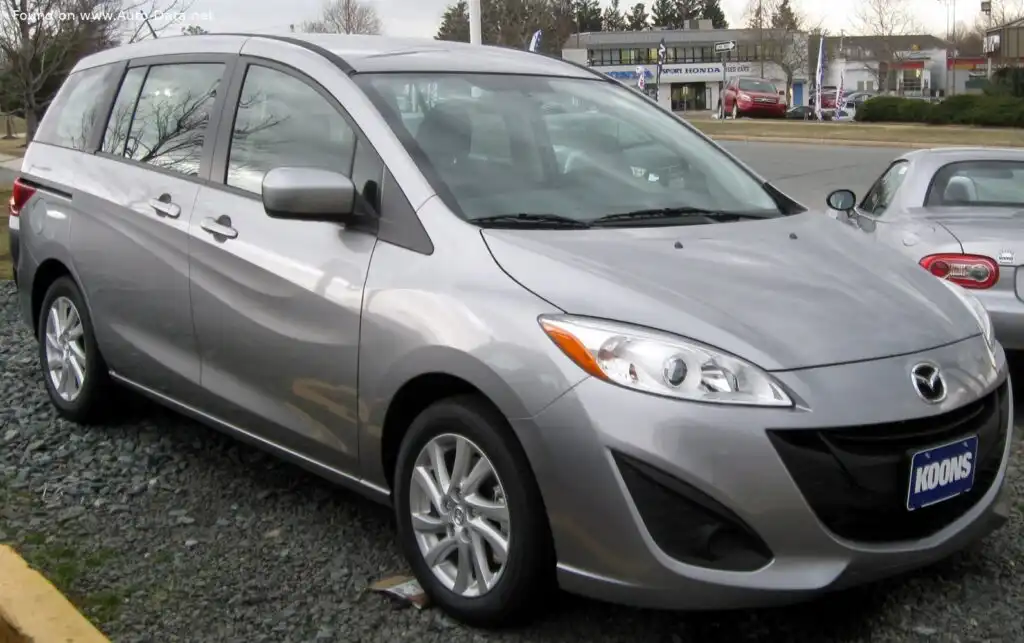
The Mazda 5 II 2.0i, produced from 2010 to 2015, represents a significant evolution of Mazda’s compact minivan. Positioned as a mid-range offering within the second-generation (CW) Mazda 5 lineup, it aimed to deliver a practical, fuel-efficient family vehicle while retaining Mazda’s sporty character. Primarily marketed in Europe, Australia, and parts of Asia, this variant offered a compelling alternative to larger, more expensive multi-purpose vehicles (MPVs). It was built upon Mazda’s “Zoom-Zoom” philosophy, striving for a more engaging driving experience than typically found in the minivan segment.
Powertrain & Engine Architecture
The Mazda 5 II 2.0i’s core is the LF-ZB engine, a 1.999-liter inline-four cylinder gasoline engine. While part of Mazda’s technology family, this engine predates the full implementation of Skyactiv technology. It features a double overhead camshaft (DOHC) valvetrain with four valves per cylinder and utilizes multi-point fuel injection. The 11.5:1 compression ratio contributes to its efficiency. The LF-ZB is known for its smooth power delivery and reasonable reliability. It produces 150 horsepower at 6200 rpm and 191 Nm (140.87 lb-ft) of torque at 4500 rpm. Typically, this engine was paired with a six-speed manual transmission, offering a balance of fuel economy and driver engagement. An automatic transmission was available in some markets, but the manual was the more common choice.
Driving Characteristics
The 2.0i variant offered a noticeable performance increase over lower-displacement engine options. While not a sports car, the 150 hp engine provided sufficient power for daily driving and highway cruising, even when carrying passengers and luggage. The six-speed manual transmission allowed drivers to maintain the engine in its optimal power band, resulting in responsive acceleration. A 0-60 mph time of around 10.6 seconds is respectable for a compact minivan. Compared to the 1.8L engine, the 2.0i felt more relaxed on the highway and offered more confident overtaking. The manual transmission demanded more driver involvement than the automatic. The suspension was tuned for comfort, providing a reasonably smooth ride, but wasn’t particularly sporty.
Equipment & Trim Levels
The Mazda 5 II 2.0i came standard with features like air conditioning, power windows and mirrors, a basic audio system with a CD player, and ABS brakes. Higher trims, such as ‘Sport’ or ‘Luxury’, added alloy wheels, fog lights, a more advanced audio system with Bluetooth, and climate control. Interior upholstery was typically cloth, with leather available on higher trims. Optional extras included a sunroof, navigation system, and parking sensors. The interior design was functional and well-built, showcasing Mazda’s attention to detail. The sliding rear doors, a signature feature of the Mazda 5, simplified access to the third-row seats.
Chassis & Braking
The Mazda 5 II used a front-wheel-drive platform with a MacPherson strut front suspension and a multi-link rear suspension, balancing ride comfort and handling. The braking system featured ventilated discs on the front and solid discs on the rear, with ABS standard. The lightweight chassis contributed to the vehicle’s agility. Steering was electrically assisted, providing a light and precise feel. The 205/60 R16 tires offered adequate grip in most conditions.
Market Reception & Comparison
The Mazda 5 II 2.0i received generally positive reviews. Critics praised its practical interior, engaging driving dynamics (for a minivan), and relatively fuel-efficient engine. Compared to competitors like the Renault Scenic or Citroën C4 Picasso, the Mazda 5 offered a more driver-focused experience. The 2.0i was considered a good compromise between performance and fuel economy. Some critics noted the interior space wasn’t as generous as some rivals. Fuel economy around 34.1 US mpg combined was competitive. Reliability was generally good, with few major issues reported.
Legacy
The Mazda 5 II 2.0i remains a popular choice in the used car market, especially for families needing a practical and reliable vehicle. The LF-ZB engine is known for its durability, and with proper maintenance, it can provide years of service. While lacking the prestige of some brands, the Mazda 5 II 2.0i offers a compelling combination of value, practicality, and driving enjoyment. Its innovative design, particularly the sliding rear doors, continues to appeal to buyers today. The model represents a unique offering in the minivan segment, bridging the gap between traditional MPVs and conventional hatchbacks.