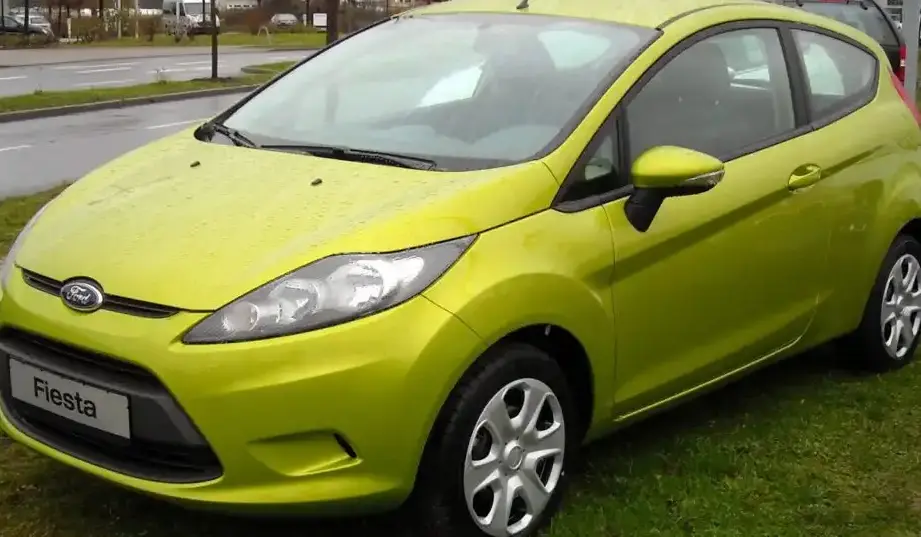
The Ford Fiesta Mk7, produced from 2008 to 2012, represented a significant step forward for Ford’s supermini. The 3-door 1.25-liter variant, delivering 60 horsepower, served as the entry point into the Mk7 Fiesta range. Positioned as an affordable and economical option, it aimed to attract buyers prioritizing fuel efficiency and low running costs over outright performance. This model was a key component of Ford’s strategy to offer a diverse Fiesta lineup catering to a broad spectrum of customer needs within the highly competitive European B-segment. It was built on the global B2E platform, shared with the Mazda2, and represented a move towards more sophisticated engineering and design compared to its predecessor.
Technical Specifications
| Brand | Ford |
| Model | Fiesta |
| Generation | Fiesta VII (Mk7) 3 door |
| Type (Engine) | 1.25 (60 Hp) |
| Start of production | 2008 |
| End of production | 2012 |
| Powertrain Architecture | Internal Combustion engine |
| Body type | Hatchback |
| Seats | 5 |
| Doors | 3 |
| Fuel consumption (urban) | 7.3 l/100 km (32.2 US mpg, 38.7 UK mpg, 13.7 km/l) |
| Fuel consumption (extra urban) | 4.3 l/100 km (54.7 US mpg, 65.7 UK mpg, 23.3 km/l) |
| Fuel consumption (combined) | 5.4 l/100 km (43.6 US mpg, 52.3 UK mpg, 18.5 km/l) |
| CO2 emissions | 128 g/km |
| Fuel Type | Petrol (Gasoline) |
| Acceleration 0 – 100 km/h | 16.9 sec |
| Acceleration 0 – 62 mph | 16.9 sec |
| Acceleration 0 – 60 mph | 16.1 sec |
| Maximum speed | 152 km/h (94.45 mph) |
| Emission standard | Euro 5 |
| Weight-to-power ratio | 17.3 kg/Hp |
| Weight-to-torque ratio | 9.5 kg/Nm |
| Power | 60 Hp @ 6000 rpm |
| Torque | 109 Nm @ 3600 rpm (80.39 lb.-ft. @ 3600 rpm) |
| Engine layout | Front, Transverse |
| Engine Model/Code | STJA, STJB |
| Engine displacement | 1242 cm3 (75.79 cu. in.) |
| Number of cylinders | 4 |
| Engine configuration | Inline |
| Cylinder Bore | 71.9 mm (2.83 in.) |
| Piston Stroke | 76.5 mm (3.01 in.) |
| Number of valves per cylinder | 4 |
| Fuel injection system | Multi-port manifold injection |
| Engine aspiration | Naturally aspirated engine |
| Valvetrain | OHC |
| Engine oil capacity | 3.8 l (4.02 US qt | 3.34 UK qt) |
| Coolant | 5.5 l (5.81 US qt | 4.84 UK qt) |
| Kerb Weight | 1035 kg (2281.78 lbs.) |
| Max. weight | 1495 kg (3295.91 lbs.) |
| Max load | 460 kg (1014.13 lbs.) |
| Trunk (boot) space – minimum | 295 l (10.42 cu. ft.) |
| Trunk (boot) space – maximum | 979 l (34.57 cu. ft.) |
| Fuel tank capacity | 45 l (11.89 US gal | 9.9 UK gal) |
| Length | 3950 mm (155.51 in.) |
| Width | 1722 mm (67.8 in.) |
| Width including mirrors | 1973 mm (77.68 in.) |
| Height | 1481 mm (58.31 in.) |
| Wheelbase | 2489 mm (97.99 in.) |
| Front track | 1493 mm (58.78 in.) |
| Rear (Back) track | 1480 mm (58.27 in.) |
| Minimum turning circle | 10.2 m (33.46 ft.) |
| Drivetrain Architecture | Front wheel drive |
| Number of gears | 5 gears, manual transmission |
| Front suspension | Independent, type McPherson with coil spring and anti-roll bar |
| Rear suspension | Coil spring, Torsion |
| Front brakes | Ventilated discs |
| Rear brakes | Drum |
| Assisting systems | ABS (Anti-lock braking system) |
| Steering type | Steering rack and pinion |
| Power steering | Electric Steering |
| Tires size | 175/65 R 14 |
| Wheel rims size | 5.5J x 14 |
Powertrain & Engine Architecture
The heart of this Fiesta variant is the Duratec 1.25-liter inline-four cylinder engine, designated with engine codes STJA or STJB depending on specific calibration and market. This engine is a naturally aspirated unit, meaning it doesn’t employ turbocharging or supercharging. It utilizes a multi-port fuel injection system, delivering fuel directly into the intake ports, and a single overhead camshaft (SOHC) valvetrain. The engine’s design prioritized fuel economy and smooth operation over high performance. The 1.25L engine produces 60 horsepower at 6000 rpm and 109 Nm (80.39 lb-ft) of torque at 3600 rpm. The engine is transversely mounted, driving the front wheels. The transmission is a five-speed manual gearbox, chosen for its simplicity and cost-effectiveness. While an automatic transmission was offered on other Fiesta Mk7 models, it wasn’t paired with the 1.25L engine.
Driving Characteristics
The 1.25-liter Fiesta is not known for its blistering acceleration. Its 0-60 mph time of around 16.1 seconds reflects its focus on economy. The engine feels relatively strained when pushed hard, requiring frequent downshifts to maintain momentum. The five-speed manual gearbox is light and easy to use, but the gear ratios are spaced to prioritize fuel efficiency rather than spirited driving. In typical urban and highway driving, the engine provides adequate power for everyday tasks. The steering is light and precise, making the Fiesta easy to maneuver in tight spaces. The suspension provides a comfortable ride, absorbing bumps and imperfections in the road surface reasonably well. Compared to the higher-output 1.6-liter versions, the 1.25L feels significantly slower, but it offers a more relaxed and economical driving experience.
Equipment & Trim Levels
The 1.25-liter Fiesta typically came equipped with basic, but functional, features. Standard equipment generally included power steering, ABS brakes, front airbags, and a basic audio system. Trim levels varied by market, but generally included options like air conditioning, electric front windows, and central locking. Interior upholstery was typically cloth, with a simple dashboard layout. Optional extras included alloy wheels, a trip computer, and upgraded audio systems. The base trim level was deliberately spartan, keeping the price point low and appealing to budget-conscious buyers.
Chassis & Braking
The Fiesta Mk7 utilizes a McPherson strut front suspension and a torsion beam rear suspension. This setup provides a good balance between ride comfort and handling. The front brakes are ventilated discs, providing adequate stopping power, while the rear brakes are drums, a cost-saving measure for the entry-level model. The steering is a rack and pinion system with electric power assistance, offering light and precise control. The chassis is relatively lightweight, contributing to the Fiesta’s nimble handling characteristics. Stabilizer bars were fitted to both the front and rear axles to reduce body roll during cornering.
Market Reception & Comparison
The 1.25-liter Fiesta was generally well-received as an affordable and economical city car. Critics praised its fuel efficiency and low running costs, but noted its lack of performance. Compared to the 1.6-liter variants, the 1.25L offered significantly lower fuel consumption but considerably less power. The 1.4-liter diesel versions provided better fuel economy and more torque, but at a higher purchase price. The 1.25L appealed to buyers who prioritized practicality and affordability over driving excitement. Its reliability was generally good, although the engine could be prone to occasional issues with the ignition system.
Legacy
The 1.25-liter Fiesta Mk7 remains a popular choice in the used car market, particularly for first-time drivers or those seeking an economical runabout. The Duratec 1.25L engine is known for its relative simplicity and ease of maintenance. While not a performance powerhouse, it is a reliable and durable unit when properly maintained. Parts availability is generally good, and repair costs are relatively low. The Fiesta Mk7 as a whole established a strong reputation for build quality and reliability, contributing to its continued popularity in the used car market today. The 1.25L variant, while the least powerful in the range, represents a practical and affordable entry point into Ford’s popular supermini lineup.