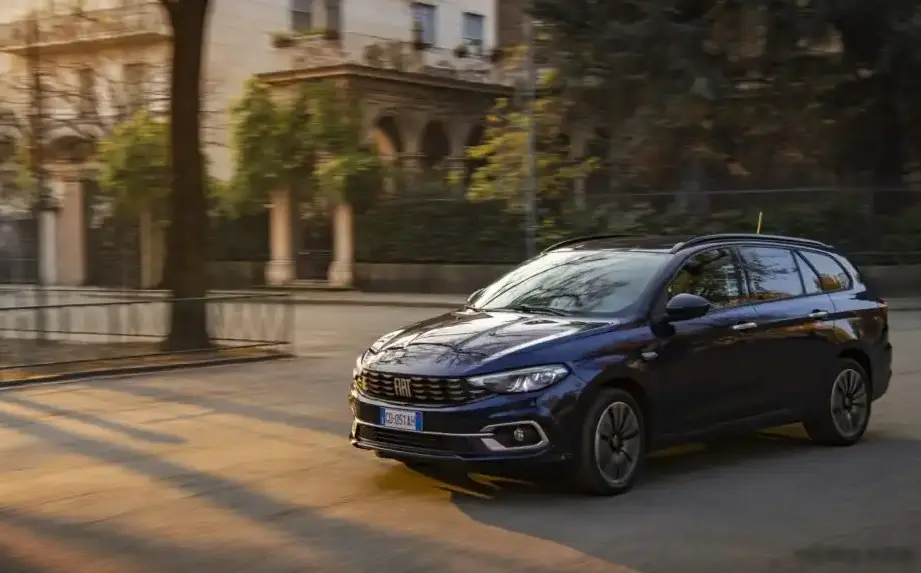
The Fiat Tipo Wagon 1.0 (100 Hp) represents an entry-level offering within the refreshed 358 series of the Tipo, introduced with a facelift in 2020. Positioned as a practical and economical choice in the European market, this variant combined a small-displacement turbocharged engine with a five-speed manual transmission, offering a balance between fuel efficiency and usability. The Tipo itself is a compact family car, designed to offer a spacious interior and generous cargo capacity in a station wagon (estate) body style. This particular engine and transmission combination was aimed at buyers prioritizing affordability and low running costs over outright performance.
Technical Specifications
| Brand | Fiat |
| Model | Tipo |
| Generation | Tipo (358, facelift 2020) Wagon |
| Type (Engine) | 1.0 (100 Hp) |
| Start of production | 2020 |
| Powertrain Architecture | Internal Combustion engine |
| Body type | Station wagon (estate) |
| Seats | 5 |
| Doors | 5 |
| Fuel consumption at Low speed (WLTP) | 7.3 l/100 km (32.2 US mpg, 38.7 UK mpg, 13.7 km/l) |
| Fuel consumption at Medium speed (WLTP) | 5.6 l/100 km (42 US mpg, 50.4 UK mpg, 17.9 km/l) |
| Fuel consumption at high speed (WLTP) | 4.9 l/100 km (48 US mpg, 57.6 UK mpg, 20.4 km/l) |
| Fuel consumption at very high speed (WLTP) | 5.8 l/100 km (40.6 US mpg, 48.7 UK mpg, 17.2 km/l) |
| Combined fuel consumption (WLTP) | 5.7 l/100 km (41.3 US mpg, 49.6 UK mpg, 17.5 km/l) |
| CO2 emissions (WLTP) | 127-128 g/km |
| Fuel consumption (economy) – urban (NEDC) | 6.6 l/100 km (35.6 US mpg, 42.8 UK mpg, 15.2 km/l) |
| Fuel consumption (economy) – extra urban (NEDC) | 4.7 l/100 km (50 US mpg, 60.1 UK mpg, 21.3 km/l) |
| Fuel consumption (economy) – combined (NEDC) | 5.4 l/100 km (43.6 US mpg, 52.3 UK mpg, 18.5 km/l) |
| CO2 emissions (NEDC) | 124 g/km |
| Fuel Type | Petrol (Gasoline) |
| Acceleration 0 – 100 km/h | 12.0 sec |
| Acceleration 0 – 62 mph | 12.0 sec |
| Acceleration 0 – 60 mph | 11.4 sec |
| Maximum speed | 191 km/h (118.68 mph) |
| Emission standard | Euro 6d Final |
| Weight-to-power ratio | 12.7 kg/Hp, 78.7 Hp/tonne |
| Weight-to-torque ratio | 6.7 kg/Nm, 149.6 Nm/tonne |
| Power | 100 Hp @ 5000 rpm |
| Torque | 190 Nm @ 1500 rpm (140.14 lb.-ft. @ 1500 rpm) |
| Engine layout | Front, Transverse |
| Engine Model/Code | 55282151 |
| Engine displacement | 999 cm3 (60.96 cu. in.) |
| Number of cylinders | 3 |
| Engine configuration | Inline |
| Cylinder Bore | 70 mm (2.76 in.) |
| Piston Stroke | 86.5 mm (3.41 in.) |
| Compression ratio | 10.5:1 |
| Number of valves per cylinder | 4 |
| Fuel injection system | Direct injection |
| Engine aspiration | Turbocharger, Intercooler |
| Engine oil capacity | 3.3 l (3.49 US qt | 2.9 UK qt) |
| Coolant | 8.4 l (8.88 US qt | 7.39 UK qt) |
| Kerb Weight | 1270 kg (2799.87 lbs.) |
| Max. weight | 1820 kg (4012.41 lbs.) |
| Max load | 550 kg (1212.54 lbs.) |
| Trunk (boot) space – minimum | 550 l (19.42 cu. ft.) |
| Fuel tank capacity | 50 l (13.21 US gal | 11 UK gal) |
| Permitted trailer load with brakes (12%) | 1500 kg (3306.93 lbs.) |
| Permitted trailer load without brakes | 500 kg (1102.31 lbs.) |
| Permitted towbar download | 60 kg (132.28 lbs.) |
| Length | 4571 mm (179.96 in.) |
| Width | 1792 mm (70.55 in.) |
| Height | 1514 mm (59.61 in.) |
| Wheelbase | 2638 mm (103.86 in.) |
| Front track | 1542 mm (60.71 in.) |
| Rear (Back) track | 1543 mm (60.75 in.) |
| Front overhang | 893 mm (35.16 in.) |
| Rear overhang | 1040 mm (40.94 in.) |
| Minimum turning circle (turning diameter) | 10.9 m (35.76 ft.) |
| Drivetrain Architecture | The Internal combustion engine (ICE) drives the front wheels of the vehicle. |
| Drive wheel | Front wheel drive |
| Number of gears and type of gearbox | 5 gears, manual transmission |
| Front suspension | Independent type McPherson |
| Rear suspension | Coil spring, Elastic beam |
| Front brakes | Disc, 281 mm |
| Rear brakes | Disc, 251 mm |
| Assisting systems | ABS (Anti-lock braking system) |
| Steering type | Steering rack and pinion |
| Power steering | Electric Steering |
INTRODUCTION
The Fiat Tipo Wagon 1.0 (100 Hp) is a five-door station wagon that forms part of the third generation of the Tipo, launched in 2016. The 2020 facelift brought updated styling, improved technology, and refined engine options. This particular variant, powered by a 1.0-liter turbocharged three-cylinder engine, was designed to appeal to budget-conscious buyers seeking a practical and fuel-efficient family vehicle. It occupied the entry-level position in the Tipo Wagon lineup, offering a more affordable alternative to the higher-powered diesel and gasoline options.
Powertrain & Engine Architecture
The heart of the Tipo Wagon 1.0 is the Fiat FireFly engine, specifically the 55282151 code. This is a 999cc turbocharged three-cylinder engine featuring direct fuel injection and an intercooler. The engine utilizes a single overhead camshaft (SOHC) with four valves per cylinder. The turbocharger is a key component, providing a significant boost in power and torque despite the small displacement. The engine produces 100 horsepower at 5000 rpm and 190 Nm (140 lb-ft) of torque at 1500 rpm. This torque figure is particularly noteworthy, as it provides good low-end responsiveness. The engine is paired with a five-speed manual transmission, which is the only transmission option available for this variant. The transmission is a conventional setup, designed for durability and ease of maintenance.
Driving Characteristics
The Tipo Wagon 1.0 offers a comfortable, if not particularly exhilarating, driving experience. Acceleration from 0 to 100 km/h (0-62 mph) takes around 12.0 seconds, and the top speed is 191 km/h (118.68 mph). While these figures aren’t impressive, the engine’s torque delivery makes it feel more responsive in everyday driving situations. The five-speed gearbox is well-matched to the engine, allowing for relaxed cruising on the highway. Compared to higher-powered versions of the Tipo, such as the 1.4 T-Jet, the 1.0 feels less refined and can be somewhat noisy under heavy acceleration. However, the fuel economy benefits are significant, making it a more economical choice for those who prioritize running costs.
Equipment & Trim Levels
The Tipo Wagon 1.0 typically came with a reasonable level of standard equipment. This included air conditioning, power steering, electric front windows, a basic audio system with Bluetooth connectivity, and ABS brakes. Safety features such as electronic stability control (ESC) and traction control were also standard. Higher trim levels offered additional features such as alloy wheels, a touchscreen infotainment system, rear parking sensors, and cruise control. Interior upholstery was typically cloth, with a functional and durable design. The dashboard layout was straightforward and easy to use, with a focus on practicality.
Chassis & Braking
The Tipo Wagon utilizes a McPherson strut suspension setup at the front and a torsion beam suspension at the rear. This configuration provides a good balance between ride comfort and handling. The front brakes are ventilated discs, while the rear brakes are solid discs. The steering is electrically assisted, providing a light and easy steering feel. The chassis is designed to provide a stable and predictable driving experience, although it’s not particularly sporty. The weight-to-power ratio of 12.7 kg/Hp indicates that the car is not overly burdened by its weight, contributing to its reasonable performance.
Market Reception & Comparison
The Fiat Tipo Wagon 1.0 was generally well-received by critics as a practical and affordable family car. Its fuel efficiency and low running costs were particularly praised. However, some reviewers noted that the engine could feel strained when fully loaded or driving uphill. Compared to other compact wagons in the European market, such as the Skoda Octavia and Volkswagen Golf Estate, the Tipo offered a more affordable price point but lacked some of the refinement and features of its rivals. The 1.0-liter engine provided significantly better fuel economy than the larger gasoline and diesel options in the Tipo lineup, but at the expense of performance.
Legacy
The Fiat FireFly engine has proven to be a reliable and durable unit, and the Tipo Wagon 1.0 is generally considered to be a dependable used car. Maintenance costs are relatively low, and parts are readily available. As a used vehicle, the Tipo Wagon 1.0 represents a good value proposition for buyers seeking a spacious and economical family car. While it may not offer the most exciting driving experience, its practicality, fuel efficiency, and affordability make it a compelling choice in the used car market.