Technical Specifications
| Brand | Opel |
| Model | Astra |
| Generation | Astra H (facelift 2007) |
| Type (Engine) | 1.4 Twinport ECOTEC (90 Hp) |
| Start of production | 2007 |
| End of production | 2009 |
| Powertrain Architecture | Internal Combustion engine |
| Body type | Hatchback |
| Seats | 5 |
| Doors | 5 |
| Fuel consumption (urban) | 8 l/100 km (29.4 US mpg, 35.3 UK mpg, 12.5 km/l) |
| Fuel consumption (extra urban) | 5 l/100 km (47 US mpg, 56.5 UK mpg, 20 km/l) |
| Fuel consumption (combined) | 6.1 l/100 km (38.6 US mpg, 46.3 UK mpg, 16.4 km/l) |
| CO2 emissions | 146 g/km |
| Fuel Type | Petrol (Gasoline) |
| Acceleration 0 – 100 km/h | 13.7 sec |
| Acceleration 0 – 62 mph | 13.7 sec |
| Acceleration 0 – 60 mph | 13 sec |
| Maximum speed | 178 km/h (110.6 mph) |
| Emission standard | Euro 4 |
| Weight-to-power ratio | 12.9 kg/Hp, 77.3 Hp/tonne |
| Weight-to-torque ratio | 9.3 kg/Nm, 107.3 Nm/tonne |
| Power | 90 Hp @ 5600 rpm |
| Power per litre | 66 Hp/l |
| Torque | 125 Nm @ 4000 rpm (92.2 lb.-ft. @ 4000 rpm) |
| Engine layout | Front, Transverse |
| Engine Model/Code | Z14XEP |
| Engine displacement | 1364 cm3 (83.24 cu. in.) |
| Number of cylinders | 4 |
| Engine configuration | Inline |
| Cylinder Bore | 73.4 mm (2.89 in.) |
| Piston Stroke | 80.6 mm (3.17 in.) |
| Compression ratio | 10.5:1 |
| Number of valves per cylinder | 4 |
| Fuel injection system | Multi-port manifold injection |
| Engine aspiration | Naturally aspirated engine |
| Valvetrain | DOHC |
| Engine oil capacity | 3.5 l (3.7 US qt | 3.08 UK qt) |
| Coolant capacity | 5.6 l (5.92 US qt | 4.93 UK qt) |
| Kerb Weight | 1165 kg (2568.39 lbs.) |
| Max. weight | 1715 kg (3780.93 lbs.) |
| Max load | 550 kg (1212.54 lbs.) |
| Trunk (boot) space – minimum | 380 l (13.42 cu. ft.) |
| Trunk (boot) space – maximum | 1295 l (45.73 cu. ft.) |
| Fuel tank capacity | 52 l (13.74 US gal | 11.44 UK gal) |
| Max. roof load | 75 kg (165.35 lbs.) |
| Permitted trailer load with brakes (12%) | 1000 kg (2204.62 lbs.) |
| Permitted trailer load without brakes | 615 kg (1355.84 lbs.) |
| Length | 4249 mm (167.28 in.) |
| Width | 1753 mm (69.02 in.) |
| Width with mirrors folded | 1804 mm (71.02 in.) |
| Width including mirrors | 2033 mm (80.04 in.) |
| Height | 1460 mm (57.48 in.) |
| Wheelbase | 2614 mm (102.91 in.) |
| Front track | 1488 mm (58.58 in.) |
| Rear track | 1488 mm (58.58 in.) |
| Front overhang | 871 mm (34.29 in.) |
| Rear overhang | 764 mm (30.08 in.) |
| Drag coefficient (Cd) | 0.31 |
| Minimum turning circle | 11.2 m (36.75 ft.) |
| Drivetrain Architecture | Front wheel drive |
| Number of gears and type of gearbox | 5 gears, manual transmission |
| Front suspension | Independent, type McPherson with coil spring and anti-roll bar |
| Rear suspension | Torsion |
| Front brakes | Ventilated discs |
| Rear brakes | Disc |
| Assisting systems | ABS (Anti-lock braking system) |
| Steering type | Steering rack and pinion |
| Power steering | Electric Steering |
| Tires size | 195/65 R15; 205/55 R16; 225/45 R17; 225/40 R18 |
| Wheel rims size | 6.5J x 15; 6.5J x 16; 7J x 17; 7.5J x 18 |
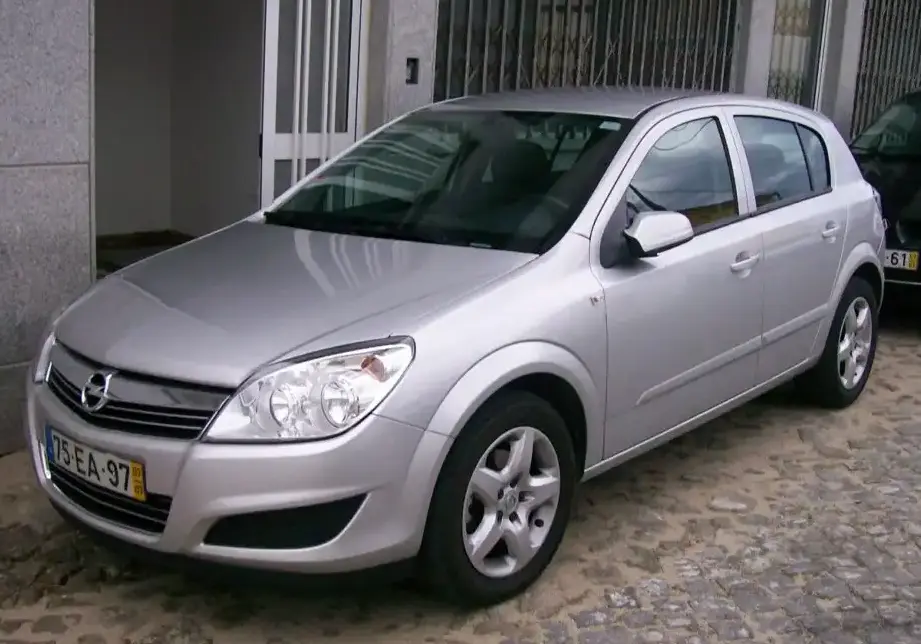
The Opel Astra H (facelift, produced 2007-2009) 1.4 Twinport ECOTEC 90 hp variant served as the entry point into the Astra H range. Designed as a fuel-conscious and affordable option, it appealed to buyers who prioritized economy over spirited performance. Built on the GM Delta platform (internally designated as 1HX0/A3), this version of the Astra H was primarily marketed in Europe, where it competed with popular models like the Ford Focus, Volkswagen Golf, and Peugeot 308. The 2007 facelift brought with it subtle styling refinements and minor mechanical updates compared to the pre-facelift Astra H models.
Powertrain & Engine Architecture
The 1.4-liter Astra H’s engine was the Z14XEP, an inline-four cylinder belonging to Opel’s ECOTEC family. This engine utilized multi-port fuel injection and a double overhead camshaft (DOHC) valvetrain. The ‘Twinport’ designation signified the use of two intake ports per cylinder, engineered to enhance swirl and improve combustion efficiency. The engine generated 90 horsepower at 5600 rpm and 125 Nm (92.2 lb-ft) of torque at 4000 rpm. The engine’s modest output was intentionally achieved through a focus on fuel economy. The Z14XEP was known for its relatively straightforward design, which contributed to its generally good reliability. While a five-speed manual transmission was the standard offering, a four-speed automatic transmission was also available, though less frequently chosen. This automatic transmission was a conventional hydraulic unit, prioritizing smooth operation over sporty responsiveness.
Driving Characteristics
The 1.4-liter 90 hp Astra H equipped with the automatic transmission delivered a comfortable, but not particularly exhilarating, driving experience. Acceleration was unhurried, requiring approximately 13.7 seconds to reach 62 mph (100 km/h). The automatic transmission, while convenient, diminished the engine’s limited power, resulting in noticeable hesitation during overtaking. Gear ratios were tuned for fuel efficiency, causing the engine to operate at higher RPMs during acceleration. Compared to the more powerful 1.6-liter or 1.8-liter versions, or even the diesel variants, this Astra felt considerably slower. However, for typical urban driving and commuting, the engine provided adequate power, and the automatic transmission simplified navigating traffic.
Equipment & Trim Levels
The 1.4 Twinport ECOTEC Automatic typically occupied the base or mid-range trim levels of the Astra H lineup, often labeled as ‘Essentia’ or ‘Enjoy’ depending on the specific market. Standard features generally included power steering, ABS brakes, front airbags, and a basic audio system. Higher trim levels added amenities such as air conditioning, alloy wheels, electric windows, and a more advanced audio system. Interior upholstery was typically cloth, with a functional, if somewhat spartan, dashboard layout. Optional extras included parking sensors, a sunroof, and upgraded audio systems.
Chassis & Braking
The Astra H employed a McPherson strut front suspension and a torsion beam rear suspension. This configuration provided a reasonable compromise between ride comfort and handling. Brakes were typically ventilated discs on the front wheels and solid discs on the rear, sufficient for the car’s weight and performance capabilities. The 1.4-liter models generally featured smaller diameter wheels and tires compared to the higher-performance variants, contributing to a slightly softer ride quality. Stabilizer bars were fitted to both the front and rear axles to minimize body roll during cornering maneuvers.
Market Reception & Comparison
The 1.4 Twinport ECOTEC Automatic Astra H was generally well-received as a sensible and economical choice. Critics acknowledged its fuel efficiency and affordability, but noted its lack of dynamic performance. Compared to the 1.6-liter or 1.8-liter models, the 1.4 offered significantly less power, but at a lower purchase price and with improved fuel economy. The diesel variants, such as the 1.7 CDTI, delivered superior torque and fuel efficiency, but came with a higher initial investment. Reliability was generally considered good, with the Z14XEP engine proving to be a durable and dependable unit.
Legacy
The 1.4 Twinport ECOTEC engine, including the Z14XEP variant, has demonstrated a reputation for being a relatively reliable powertrain. While not celebrated for its performance, it is known for its longevity and relatively low maintenance costs. In the used car market, these Astra H models are often sought after by buyers seeking an affordable and fuel-efficient vehicle. Common issues encountered are typically related to age and mileage, such as wear and tear on suspension components and the potential for minor oil leaks. However, the engine itself is generally considered robust and capable of achieving high mileage with consistent and proper maintenance.