
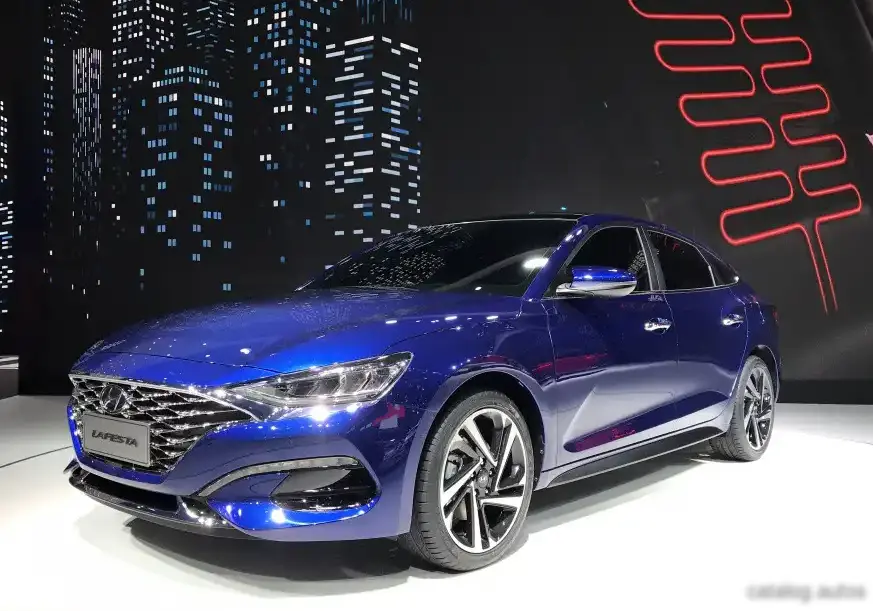
The Hyundai Lafesta 240 T GDi, equipped with a 140 horsepower turbocharged engine and a 7-speed Dual Clutch Transmission (DCT), was introduced in 2018 as a key variant within the Lafesta lineup. Positioned as a mid-range offering, it aimed to bridge the gap between more economical base models and higher-performance trims. The Lafesta itself was designed primarily for the Chinese market, representing Hyundai’s efforts to cater to evolving consumer preferences in that region with a focus on style and technology. This specific configuration, the 1.4-liter turbocharged four-cylinder paired with the DCT, offered a balance of fuel efficiency and responsive performance, appealing to buyers seeking a modern and comfortable sedan.
Technical Specifications
| Brand | Hyundai |
| Model | Lafesta |
| Type (Engine) | 240 T GDi (140 Hp) DCT |
| Start of production | 2018 |
| Powertrain Architecture | Internal Combustion engine |
| Body type | Sedan |
| Seats | 5 |
| Doors | 4 |
| Fuel consumption (combined) | 5.2 l/100 km (45.2 US mpg, 54.3 UK mpg, 19.2 km/l) |
| Fuel Type | Petrol (Gasoline) |
| Maximum speed | 203 km/h (126.14 mph) |
| Weight-to-power ratio | 9.1 kg/Hp, 109.8 Hp/tonne |
| Weight-to-torque ratio | 5.3 kg/Nm, 189.8 Nm/tonne |
| Power | 140 Hp @ 6000 rpm |
| Power per litre | 103.5 Hp/l |
| Torque | 242 Nm @ 1500-3200 rpm (178.49 lb.-ft. @ 1500-3200 rpm) |
| Engine layout | Front, Transverse |
| Engine Model/Code | Kappa II / G4LD |
| Engine displacement | 1353 cm3 (82.57 cu. in.) |
| Number of cylinders | 4 |
| Engine configuration | Inline |
| Fuel injection system | Direct injection |
| Engine aspiration | Turbocharger, Intercooler |
| Engine oil capacity | 4.2 l (4.44 US qt | 3.7 UK qt) |
| Coolant | 6.3 l (6.66 US qt | 5.54 UK qt) |
| Kerb Weight | 1275-1315 kg (2810.89 – 2899.08 lbs.) |
| Trunk (boot) space – maximum | 475 l (16.77 cu. ft.) |
| Fuel tank capacity | 53 l (14 US gal | 11.66 UK gal) |
| Length | 4660 mm (183.46 in.) |
| Width | 1790 mm (70.47 in.) |
| Height | 1425 mm (56.1 in.) |
| Wheelbase | 2700 mm (106.3 in.) |
| Drivetrain Architecture | The Internal combustion engine (ICE) drives the front wheels of the vehicle. |
| Drive wheel | Front wheel drive |
| Number of gears and type of gearbox | 7 gears, automatic transmission DCT |
| Front suspension | Independent type McPherson |
| Rear suspension | Independent multi-link suspension |
| Tires size | 205/55 R16 |
| Wheel rims size | 16 |
Powertrain & Engine Architecture
The heart of the Lafesta 240 T GDi is the Kappa II 1.4-liter turbocharged inline-four cylinder engine, designated G4LD. This engine utilizes direct fuel injection, a technology that improves both power and fuel efficiency by injecting fuel directly into the combustion chamber. The turbocharger, coupled with an intercooler, forces more air into the engine, boosting power output. The engine’s architecture is designed for responsiveness, with peak torque of 242 Nm (178.49 lb.-ft.) available from a low 1500 rpm and sustained through 3200 rpm. This broad torque curve contributes to strong acceleration in everyday driving situations. The engine is transversely mounted at the front of the vehicle. The 7-speed Dual Clutch Transmission (DCT) is a crucial component, offering quick and smooth gear changes compared to a traditional automatic transmission. DCTs use two separate clutches for odd and even gears, allowing for pre-selection of the next gear and minimizing interruption in power delivery.
Driving Characteristics
The 140 hp output and the DCT combine to deliver a driving experience that prioritizes responsiveness and efficiency. While not a performance-oriented trim, the Lafesta 240 T GDi offers adequate acceleration for merging onto highways and navigating city traffic. The DCT’s quick shifts contribute to a feeling of agility. Compared to lower-powered, naturally aspirated versions of the Lafesta, the 240 T GDi provides a noticeable improvement in acceleration and overall driving enjoyment. However, it doesn’t match the performance of higher-output turbocharged variants. The DCT is programmed for comfort, with smooth transitions between gears, but also offers a sport mode for more aggressive shifting. The gear ratios are tuned to balance fuel economy with usable power across a wide range of speeds.
Equipment & Trim Levels
The Lafesta 240 T GDi typically came equipped with a respectable level of standard features. These generally included air conditioning, power windows and locks, a touchscreen infotainment system with Bluetooth connectivity, and basic safety features like airbags and ABS. Higher trim levels within the 240 T GDi range offered upgrades such as leather upholstery, a sunroof, automatic climate control, and advanced driver-assistance systems (ADAS) like lane departure warning and automatic emergency braking. Interior aesthetics focused on a modern and stylish design, with a user-friendly dashboard layout. Optional extras often included premium sound systems and navigation systems.
Chassis & Braking
The Lafesta 240 T GDi utilizes a front-wheel-drive layout with an independent McPherson strut suspension in the front and an independent multi-link suspension in the rear. This suspension setup is designed to provide a comfortable ride while maintaining reasonable handling characteristics. The use of independent suspension on all four wheels helps to isolate the cabin from road imperfections. Braking systems typically consisted of ventilated disc brakes in the front and either disc or drum brakes in the rear, depending on the specific trim level. Stabilizer bars were included to reduce body roll during cornering. The chassis was engineered to balance rigidity with weight reduction, contributing to both handling and fuel efficiency.
Market Reception & Comparison
The Hyundai Lafesta 240 T GDi was generally well-received in the Chinese market, where it competed with other compact sedans like the Volkswagen Lavida and the Honda Civic. Critics praised its stylish design, comfortable interior, and responsive powertrain. Fuel economy was also a strong point, with the 1.4-liter turbo engine achieving competitive figures. Compared to the base Lafesta models with naturally aspirated engines, the 240 T GDi offered a significant performance upgrade. However, some reviewers noted that the DCT could occasionally exhibit some hesitation at low speeds. In terms of reliability, the Kappa II engine and the DCT have generally proven to be reasonably dependable, although long-term maintenance costs for the turbocharger and DCT should be considered.
Legacy
The Hyundai Lafesta 240 T GDi represents a significant step in Hyundai’s design and engineering capabilities, particularly for the Chinese market. The combination of a turbocharged engine and a DCT offered a modern and efficient driving experience. While the Lafesta itself may not have achieved widespread global recognition, the technologies and design elements introduced in this model have influenced subsequent Hyundai vehicles. On the used car market, the Lafesta 240 T GDi remains a relatively affordable option, offering a good balance of features, performance, and fuel economy. Regular maintenance, particularly concerning the turbocharger and DCT, is crucial for ensuring long-term reliability.
