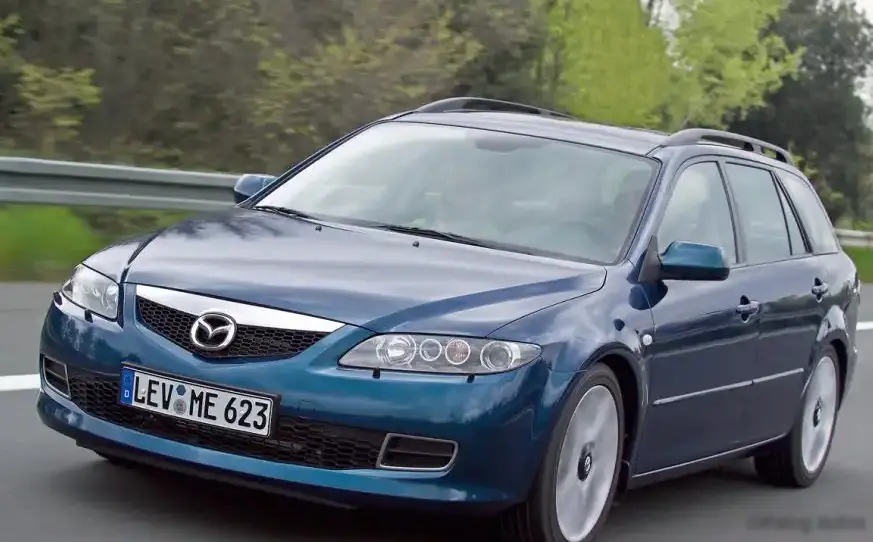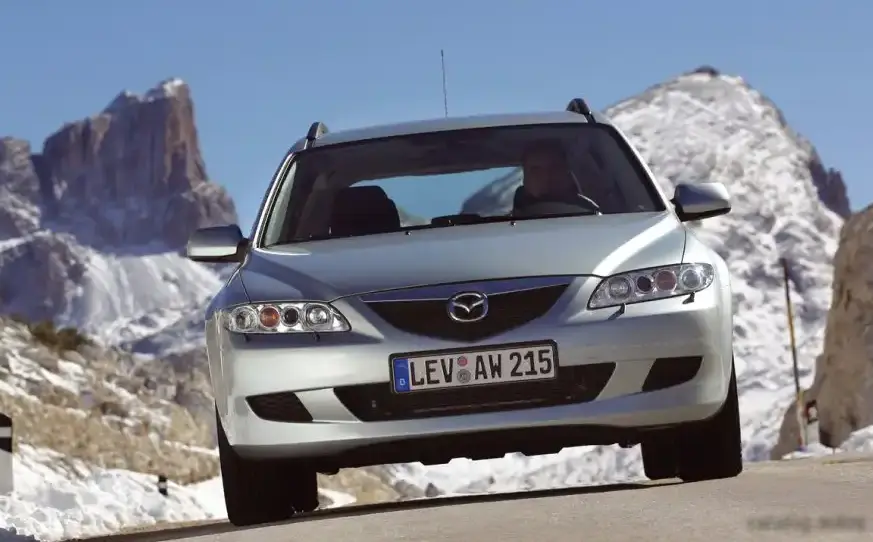
The Mazda 6 first generation Combi (estate) model, internally designated Typ GG/GY/GG1, was produced from 2002 to 2005. The 2.3-liter, 162 horsepower all-wheel drive (AWD) variant with an automatic transmission represented a relatively premium offering within the first-generation 6 lineup. Positioned above the base 1.8L and 2.0L models, it aimed to provide a blend of practicality, performance, and all-weather capability for buyers seeking a more refined driving experience. This model was primarily sold in the European market, where station wagons held significant popularity, and to a lesser extent in Australia and other regions. It competed with vehicles like the Ford Mondeo Estate, Volkswagen Passat Variant, and Opel/Vauxhall Vectra Estate.
Technical Specifications
| Brand | Mazda |
| Model | 6 |
| Generation | 6 I Combi (Typ GG/GY/GG1) |
| Type (Engine) | 2.3 (162 Hp) AWD Automatic |
| Start of production | 2002 |
| End of production | 2005 |
| Powertrain Architecture | Internal Combustion engine |
| Body type | Station wagon (estate) |
| Seats | 5 |
| Doors | 5 |
| Fuel consumption (urban) | 15.2 l/100 km (15.5 US mpg, 18.6 UK mpg, 6.6 km/l) |
| Fuel consumption (extra urban) | 8.2 l/100 km (28.7 US mpg, 34.4 UK mpg, 12.2 km/l) |
| Fuel consumption (combined) | 10.8 l/100 km (21.8 US mpg, 26.2 UK mpg, 9.3 km/l) |
| CO2 emissions | 250 g/km |
| Fuel Type | Petrol (Gasoline) |
| Acceleration 0 – 100 km/h | 12.3 sec |
| Acceleration 0 – 62 mph | 12.3 sec |
| Acceleration 0 – 60 mph | 11.7 sec |
| Maximum speed | 189 km/h (117.44 mph) |
| Emission standard | Euro 3 |
| Weight-to-power ratio | 9.4 kg/Hp, 105.9 Hp/tonne |
| Weight-to-torque ratio | 7.5 kg/Nm, 134 Nm/tonne |
| Power | 162 Hp @ 6500 rpm |
| Power per litre | 71.6 Hp/l |
| Torque | 205 Nm @ 4000 rpm (151.2 lb.-ft. @ 4000 rpm) |
| Engine layout | Front, Transverse |
| Engine Model/Code | L3X |
| Engine displacement | 2261 cm3 (137.97 cu. in.) |
| Number of cylinders | 4 |
| Engine configuration | Inline |
| Cylinder Bore | 87.5 mm (3.44 in.) |
| Piston Stroke | 94 mm (3.7 in.) |
| Compression ratio | 10.6:1 |
| Number of valves per cylinder | 4 |
| Fuel injection system | Multi-port manifold injection |
| Engine aspiration | Naturally aspirated engine |
| Valvetrain | DOHC |
| Engine oil capacity | 4.3 l (4.54 US qt | 3.78 UK qt) |
| Coolant | 7.5 l (7.93 US qt | 6.6 UK qt) |
| Kerb Weight | 1530 kg (3373.07 lbs.) |
| Max. weight | 2025 kg (4464.36 lbs.) |
| Max load | 495 kg (1091.29 lbs.) |
| Trunk (boot) space – minimum | 490 l (17.3 cu. ft.) |
| Fuel tank capacity | 62 l (16.38 US gal | 13.64 UK gal) |
| Permitted trailer load with brakes (12%) | 1800 kg (3968.32 lbs.) |
| Permitted trailer load without brakes | 550 kg (1212.54 lbs.) |
| Length | 4700 mm (185.04 in.) |
| Width | 1780 mm (70.08 in.) |
| Height | 1490 mm (58.66 in.) |
| Wheelbase | 2675 mm (105.31 in.) |
| Front track | 1540 mm (60.63 in.) |
| Rear (Back) track | 1540 mm (60.63 in.) |
| Drag coefficient (Cd) | 0.32 |
| Minimum turning circle (turning diameter) | 10.8 m (35.43 ft.) |
| Drive wheel | All wheel drive (4×4) |
| Number of gears and type of gearbox | 5 gears, automatic transmission |
| Front brakes | Ventilated discs |
| Rear brakes | Disc |
| Assisting systems | ABS (Anti-lock braking system) |
| Steering type | Steering rack and pinion |
| Tires size | 215/45 R17 V |
| Wheel rims size | 17 |
Powertrain & Engine Architecture
The heart of this Mazda 6 variant is the L3X engine, a 2.3-liter inline-four cylinder gasoline engine. This engine utilizes a naturally aspirated configuration, relying on displacement and variable valve timing rather than forced induction for its power output. The L3X features multi-port fuel injection, delivering fuel directly into the intake ports, and a double overhead camshaft (DOHC) valvetrain for optimized airflow and efficient combustion. The engine’s 10.6:1 compression ratio contributes to its performance. Paired with this engine is a five-speed automatic transmission. While not known for being particularly sporty, this transmission was designed for smooth and comfortable shifts, prioritizing ease of use over outright performance. The automatic transmission was a key selling point for buyers who preferred convenience over the engagement of a manual gearbox.
Driving Characteristics
The 2.3L AWD automatic Mazda 6 Combi offered a comfortable and capable driving experience. Acceleration from 0-60 mph took around 11.7 seconds, which was adequate for everyday driving but not particularly quick compared to other options in the segment. The automatic transmission, while smooth, did result in some power loss compared to the available manual transmission. The AWD system provided enhanced traction, particularly in inclement weather conditions, making it a practical choice for regions with frequent rain or snow. The gear ratios were tuned for fuel efficiency and relaxed cruising, rather than aggressive acceleration. The steering was light and precise, contributing to a generally easy-to-drive character.
Equipment & Trim Levels
The 2.3L AWD automatic trim typically included features such as air conditioning, power windows and locks, a CD player, and alloy wheels. Higher trim levels offered options like leather upholstery, a sunroof, and upgraded audio systems. Safety features included ABS brakes and front airbags. The interior design was functional and well-built, with a focus on ergonomics and practicality. The Combi body style offered a generous 490 liters of cargo space, making it a versatile vehicle for families and those needing to transport larger items.
Chassis & Braking
The Mazda 6 Combi utilized a MacPherson strut front suspension and a multi-link rear suspension, providing a good balance of ride comfort and handling. The AWD system added weight, but also improved stability and cornering grip. Braking duties were handled by ventilated discs at the front and solid discs at the rear. ABS was standard, enhancing braking performance and safety. The suspension was tuned for a comfortable ride, prioritizing smoothness over sporty handling. Stabilizer bars were fitted front and rear to reduce body roll during cornering.
Market Reception & Comparison
The 2.3L AWD automatic Mazda 6 Combi was generally well-received by automotive critics. It was praised for its spacious interior, comfortable ride, and all-weather capability. However, some reviewers noted that the automatic transmission dulled the engine’s performance and that fuel economy was not particularly impressive (around 21.8 US mpg combined). Compared to the 1.8L and 2.0L models, the 2.3L offered significantly more power and a more refined driving experience, but at a higher price point. The AWD system added to the cost and complexity, but provided a valuable advantage in slippery conditions. Compared to competitors like the Ford Mondeo Estate and Volkswagen Passat Variant, the Mazda 6 offered a more engaging driving experience and a stylish design.
Legacy
The L3X engine, while not known for being exceptionally durable, generally proved to be reliable with proper maintenance. Common issues included oil leaks and occasional sensor failures. The automatic transmission, if serviced regularly, also proved to be reasonably reliable. Today, the first-generation Mazda 6 Combi 2.3L AWD automatic is becoming increasingly rare. Well-maintained examples are sought after by enthusiasts who appreciate their blend of practicality, performance, and all-weather capability. The car represents a significant step forward in Mazda’s design and engineering, and remains a popular choice for those seeking a comfortable and reliable estate car.