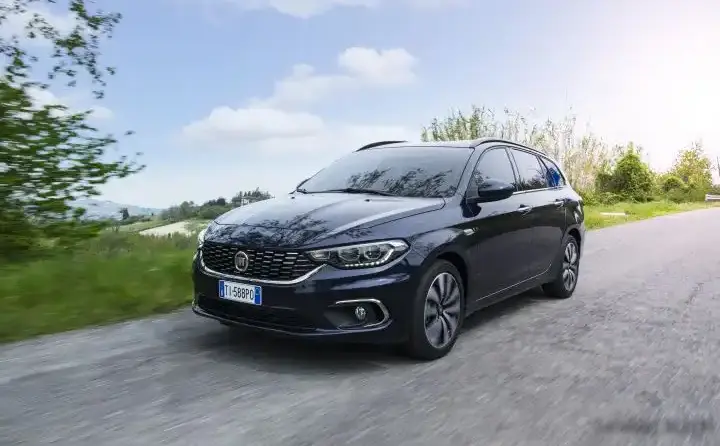
The Fiat Tipo (358) Wagon 1.4 (95 hp) was a station wagon variant produced by Fiat between 2016 and 2018. Positioned as an entry-level offering within the Tipo wagon lineup, it aimed to provide practical family transport with reasonable fuel economy. The Tipo, relaunched in 2015 after a two-decade hiatus, represented Fiat’s attempt to regain market share in the competitive C-segment, offering a blend of space, practicality, and affordability. This particular variant, with its 1.4-liter engine and six-speed manual transmission, was primarily targeted at buyers seeking a cost-effective and efficient wagon for everyday use.
Technical Specifications
| Brand | Fiat |
| Model | Tipo |
| Generation | Tipo (358) Wagon |
| Type (Engine) | 1.4 (95 Hp) |
| Start of production | 2016 |
| End of production | 2018 |
| Powertrain Architecture | Internal Combustion engine |
| Body type | Station wagon (estate) |
| Seats | 5 |
| Doors | 5 |
| Fuel consumption (urban) | 7.7 l/100 km (30.5 US mpg) |
| Fuel consumption (extra urban) | 4.5 l/100 km (52.3 US mpg) |
| Fuel consumption (combined) | 5.7 l/100 km (41.3 US mpg) |
| CO2 emissions | 132 g/km |
| Fuel Type | Petrol (Gasoline) |
| Acceleration 0 – 100 km/h | 12.3 sec |
| Acceleration 0 – 62 mph | 12.3 sec |
| Acceleration 0 – 60 mph | 11.7 sec |
| Maximum speed | 185 km/h (114.95 mph) |
| Emission standard | Euro 6 |
| Weight-to-power ratio | 13.5 kg/Hp |
| Weight-to-torque ratio | 10.1 kg/Nm |
| Power | 95 Hp @ 6000 rpm |
| Torque | 127 Nm @ 4500 rpm (93.67 lb.-ft. @ 4500 rpm) |
| Engine layout | Front, Transverse |
| Engine Model/Code | 843A1000 |
| Engine displacement | 1368 cm3 (83.48 cu. in.) |
| Number of cylinders | 4 |
| Engine configuration | Inline |
| Cylinder Bore | 72 mm (2.83 in.) |
| Piston Stroke | 84 mm (3.31 in.) |
| Compression ratio | 11:1 |
| Number of valves per cylinder | 4 |
| Fuel injection system | Multi-port manifold injection |
| Engine aspiration | Naturally aspirated engine |
| Engine oil capacity | 3 l (3.17 US qt | 2.64 UK qt) |
| Coolant capacity | 4.6 l (4.86 US qt | 4.05 UK qt) |
| Kerb Weight | 1280 kg (2821.92 lbs.) |
| Max. weight | 1780 kg (3924.23 lbs.) |
| Max load | 500 kg (1102.31 lbs.) |
| Trunk (boot) space – minimum | 550 l (19.42 cu. ft.) |
| Fuel tank capacity | 50 l (13.21 US gal | 11 UK gal) |
| Permitted trailer load with brakes (12%) | 1200 kg (2645.55 lbs.) |
| Length | 4571 mm (179.96 in.) |
| Width | 1792 mm (70.55 in.) |
| Height | 1514 mm (59.61 in.) |
| Wheelbase | 2638 mm (103.86 in.) |
| Front track | 1542 mm (60.71 in.) |
| Rear track | 1543 mm (60.75 in.) |
| Front overhang | 893 mm (35.16 in.) |
| Rear overhang | 1040 mm (40.94 in.) |
| Minimum turning circle | 10.93 m (35.86 ft.) |
| Drivetrain Architecture | Front wheel drive |
| Number of gears | 6 gears, manual transmission |
| Front suspension | Independent type McPherson |
| Rear suspension | Semi-independent, coil spring |
| Front brakes | Disc |
| Rear brakes | Disc |
| Assisting systems | ABS (Anti-lock braking system) |
| Steering type | Steering rack and pinion |
| Power steering | Electric Steering |
INTRODUCTION
The Fiat Tipo (358) Wagon 1.4 (95 hp) was a five-door, five-seat station wagon introduced as part of the revived Tipo range in 2016. Built on the Small Wide Architecture (SWA) platform – also used for other Stellantis vehicles – the Tipo aimed to offer a spacious and practical alternative to more established rivals in the European C-segment. The 1.4-liter engine variant represented the entry point into the wagon range, prioritizing fuel efficiency and affordability over outright performance. Production of this specific configuration continued until 2018, when Fiat streamlined the Tipo lineup.
Powertrain & Engine Architecture
The heart of the Tipo Wagon 1.4 (95 hp) is the 843A1000 engine, a 1.4-liter inline-four cylinder petrol engine. This engine utilizes a multi-point fuel injection system and a naturally aspirated configuration. It produces 95 horsepower at 6000 rpm and 127 Nm (93.67 lb-ft) of torque at 4500 rpm. The engine features a double overhead camshaft (DOHC) valvetrain with four valves per cylinder, contributing to its relatively efficient operation. The engine is transversely mounted at the front of the vehicle. Paired with this engine is a six-speed manual transmission, chosen for its cost-effectiveness and contribution to fuel economy. The transmission’s gear ratios are tuned for everyday drivability, prioritizing smooth shifts and reasonable acceleration rather than sporty performance.
Driving Characteristics
The driving experience in the Tipo Wagon 1.4 (95 hp) is best described as comfortable and practical. Acceleration is adequate for everyday driving, with a 0-60 mph time of around 11.7 seconds. However, it’s noticeably slower than higher-powered Tipo variants, such as those equipped with the 1.6-liter engine. The six-speed manual transmission allows for reasonable control over the engine’s power band, but the engine lacks the low-end torque found in diesel alternatives. The suspension is tuned for comfort, absorbing bumps and imperfections in the road well. The steering is light and easy to use, making it well-suited for urban driving. While not a particularly engaging car to drive, the Tipo Wagon 1.4 provides a stable and predictable ride.
Equipment & Trim Levels
The 1.4 (95 hp) variant of the Tipo Wagon typically came with a modest level of standard equipment. Features generally included air conditioning, electric front windows, a basic audio system with USB connectivity, and ABS brakes. Safety features such as electronic stability control (ESC) and traction control were also standard. Higher trim levels offered options such as alloy wheels, a touchscreen infotainment system with navigation, rear parking sensors, and cruise control. Interior upholstery was typically cloth, with a functional and durable design. The dashboard layout was straightforward and user-friendly, prioritizing practicality over aesthetic flair.
Chassis & Braking
The Tipo Wagon utilizes a McPherson strut independent suspension setup at the front, providing a good balance of comfort and handling. The rear suspension employs a semi-independent torsion beam configuration, which is a cost-effective solution for maintaining ride quality. Braking duties are handled by disc brakes on all four wheels, providing adequate stopping power for the vehicle’s weight and performance. The steering system is a rack and pinion setup with electric power assistance, offering light and precise steering feel. The chassis is designed to maximize interior space and provide a stable platform for carrying passengers and cargo.
Market Reception & Comparison
The Fiat Tipo Wagon 1.4 (95 hp) was generally well-received by critics as a practical and affordable family car. However, its performance was often criticized as being somewhat underwhelming, particularly when compared to more powerful alternatives. Fuel economy was a strong point, with the 1.4-liter engine achieving combined fuel consumption figures of around 41.3 US mpg. Compared to the 1.6-liter petrol and 1.3-liter diesel variants, the 1.4 offered a compromise between performance and economy. The diesel models provided superior fuel efficiency and torque, while the 1.6-liter offered more spirited acceleration. The 1.4 was positioned as the entry-level option for buyers prioritizing affordability and fuel economy.
Legacy
The Fiat Tipo Wagon 1.4 (95 hp) has proven to be a relatively reliable vehicle in the used car market. The 843A1000 engine is known for its durability, and routine maintenance is relatively straightforward and inexpensive. While not a particularly exciting car, it offers a practical and affordable solution for families seeking a spacious and economical wagon. Today, these vehicles can be found at attractive price points, making them a viable option for budget-conscious buyers. The Tipo’s revival demonstrated Fiat’s commitment to providing practical and affordable vehicles, and the 1.4 variant played a key role in making the Tipo accessible to a wider range of customers.