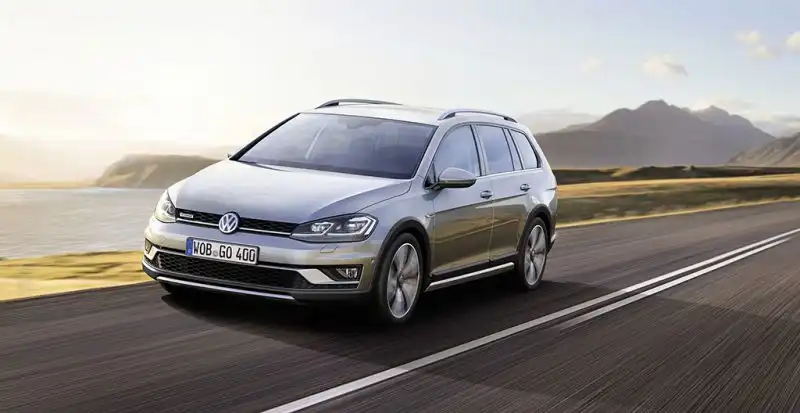
The Volkswagen Golf VII Alltrack (facelift, produced 2017-2019) 2.0 TDI 184 hp with 4MOTION all-wheel drive and a dual-clutch gearbox (DSG) represents a niche offering within the broader Golf VII range. Positioned as a compact crossover estate, the Alltrack aimed to blend the practicality of a wagon with the capability of an all-wheel-drive system, appealing to drivers seeking a versatile vehicle for both daily commuting and recreational pursuits. This variant sat towards the upper end of the Golf VII lineup, offering a more premium experience than base models while remaining more accessible than the performance-oriented GTI or R variants.
Technical Specifications
| Brand | Volkswagen |
| Model | Golf |
| Generation | Golf VII Alltrack (facelift 2017) |
| Type (Engine) | 2.0 TDI (184 Hp) 4MOTION DSG |
| Start of production | 2017 |
| End of production | 2019 |
| Powertrain Architecture | Internal Combustion engine |
| Body type | Station wagon (estate), Crossover |
| Seats | 5 |
| Doors | 5 |
| Fuel consumption (urban) | 5.9-6.0 l/100 km (39.9 – 39.2 US mpg, 47.9 – 47.1 UK mpg, 16.9 – 16.7 km/l) |
| Fuel consumption (extra urban) | 4.8-4.9 l/100 km (49 – 48 US mpg, 58.9 – 57.6 UK mpg, 20.8 – 20.4 km/l) |
| Fuel consumption (combined) | 5.2-5.3 l/100 km (45.2 – 44.4 US mpg, 54.3 – 53.3 UK mpg, 19.2 – 18.9 km/l) |
| CO2 emissions | 137-139 g/km |
| Fuel Type | Diesel |
| Acceleration 0 – 100 km/h | 7.8 sec |
| Acceleration 0 – 62 mph | 7.8 sec |
| Acceleration 0 – 60 mph | 7.4 sec |
| Maximum speed | 219 km/h (136.08 mph) |
| Emission standard | Euro 6 |
| Weight-to-power ratio | 8.2 kg/Hp, 122.6 Hp/tonne |
| Weight-to-torque ratio | 4 kg/Nm, 253.2 Nm/tonne |
| Power | 184 Hp @ 3500-4000 rpm |
| Torque | 380 Nm @ 1750-3250 rpm (280.27 lb.-ft. @ 1750-3250 rpm) |
| Engine layout | Front, Transverse |
| Engine Model/Code | CUNA, DGCA |
| Engine displacement | 1968 cm3 (120.09 cu. in.) |
| Number of cylinders | 4 |
| Engine configuration | Inline |
| Number of valves per cylinder | 4 |
| Fuel injection system | Diesel Commonrail |
| Engine aspiration | Turbocharger, Intercooler |
| Engine oil capacity | 4.7 l (4.97 US qt | 4.14 UK qt) |
| Kerb Weight | 1501 kg (3309.14 lbs.) |
| Max. weight | 2090 kg (4607.66 lbs.) |
| Max load | 589 kg (1298.52 lbs.) |
| Trunk (boot) space – minimum | 605 l (21.37 cu. ft.) |
| Trunk (boot) space – maximum | 1620 l (57.21 cu. ft.) |
| Fuel tank capacity | 55 l (14.53 US gal | 12.1 UK gal) |
| Max. roof load | 75 kg (165.35 lbs.) |
| Permitted trailer load with brakes (8%) | 2000 kg (4409.25 lbs.) |
| Permitted trailer load with brakes (12%) | 2000 kg (4409.25 lbs.) |
| Permitted trailer load without brakes | 750 kg (1653.47 lbs.) |
| Permitted towbar download | 80 kg (176.37 lbs.) |
| Length | 4679 mm (184.21 in.) |
| Width | 1799 mm (70.83 in.) |
| Height | 1515 mm (59.65 in.) |
| Wheelbase | 2629 mm (103.5 in.) |
| Front track | 1549 mm (60.98 in.) |
| Rear (Back) track | 1520 mm (59.84 in.) |
| Minimum turning circle | 10.9 m (35.76 ft.) |
| Drive wheel | All wheel drive (4×4) |
| Number of gears and type of gearbox | 7 gears, automatic transmission DSG |
| Front brakes | Ventilated discs |
| Rear brakes | Disc |
Powertrain & Engine Architecture
The heart of the Golf VII Alltrack 2.0 TDI 184 hp is the Volkswagen Group’s 2.0-liter four-cylinder diesel engine, specifically the CUNA or DGCA engine code depending on the exact production date and market. This engine utilizes a common rail direct injection system, delivering fuel at extremely high pressures for optimized combustion. A turbocharger with an intercooler is employed to boost power output and improve efficiency. The engine features four valves per cylinder and a sophisticated engine management system to balance performance and fuel economy. The 184 horsepower output is achieved between 3500 and 4000 rpm, while the substantial 380 Nm (280 lb-ft) of torque is available from a low 1750 rpm, providing strong pulling power. The engine is transversely mounted in the front of the vehicle. Paired with this engine is the 7-speed dual-clutch transmission (DSG), known for its quick and smooth gear changes. The DSG automatically manages gear selection, optimizing for both performance and fuel efficiency.
Driving Characteristics
The 2.0 TDI 184 hp Alltrack offers a compelling blend of performance and practicality. Acceleration from 0-60 mph takes approximately 7.4-7.8 seconds, making it reasonably quick for a wagon. The DSG transmission contributes to this, providing rapid shifts and keeping the engine in its optimal power band. Compared to the lower-powered 1.6 TDI variants, the 2.0 TDI offers significantly more punch, especially during overtaking maneuvers. While not as sporty as the Golf GTI, the Alltrack provides ample power for everyday driving and longer journeys. The 4MOTION all-wheel-drive system enhances traction, particularly on slippery surfaces, providing added confidence in adverse weather conditions. The DSG transmission’s gear ratios are tuned for a balance between acceleration and fuel efficiency, with taller gears for relaxed cruising on the highway.
Equipment & Trim Levels
The Alltrack trim level generally included a generous amount of standard equipment. This typically included features such as alloy wheels, automatic climate control, a touchscreen infotainment system with navigation, parking sensors, and a leather-wrapped steering wheel. Specific interior upholstery varied, but often featured patterned fabric or optional leather seats. Optional extras included features like a panoramic sunroof, adaptive cruise control, and upgraded sound systems. The Alltrack also featured unique exterior styling cues, such as rugged body cladding, silver-colored underbody protection, and distinctive alloy wheel designs, setting it apart from other Golf VII variants.
Chassis & Braking
The Golf VII Alltrack utilizes a MacPherson strut front suspension and a multi-link rear suspension, providing a comfortable and controlled ride. The suspension is tuned to handle the added weight and all-wheel-drive system. Braking duties are handled by ventilated discs at the front and solid discs at the rear. The Alltrack is equipped with ABS (Anti-lock Braking System), electronic stability control, and other safety features as standard. The 4MOTION system distributes power between the front and rear axles as needed, optimizing traction and stability. Steering is via a power-assisted rack and pinion system.
Market Reception & Comparison
The Golf VII Alltrack was generally well-received by automotive critics, who praised its versatility, practicality, and all-weather capability. It was often seen as a more appealing alternative to traditional SUVs, offering a similar level of functionality in a more compact and fuel-efficient package. Compared to the standard Golf Estate, the Alltrack’s 4MOTION system and raised ride height provided added confidence on rough roads and in challenging conditions. Fuel economy was a strong point, with combined figures around 5.2-5.3 l/100 km (45.2-44.4 US mpg). Reliability was generally good, although, like any diesel vehicle, the particulate filter could require occasional maintenance. Compared to the Golf GTI, the Alltrack prioritized practicality and all-weather capability over outright performance.
Legacy
The 2.0 TDI engine with the DSG transmission has proven to be a relatively reliable powertrain combination, although preventative maintenance is crucial, particularly regarding the diesel particulate filter and DSG gearbox. The Golf VII Alltrack, and specifically this 184 hp variant, holds its value reasonably well in the used car market, appealing to buyers seeking a versatile and capable vehicle. Its blend of practicality, fuel efficiency, and all-wheel-drive capability continues to make it a desirable option for those looking for a compact crossover estate.