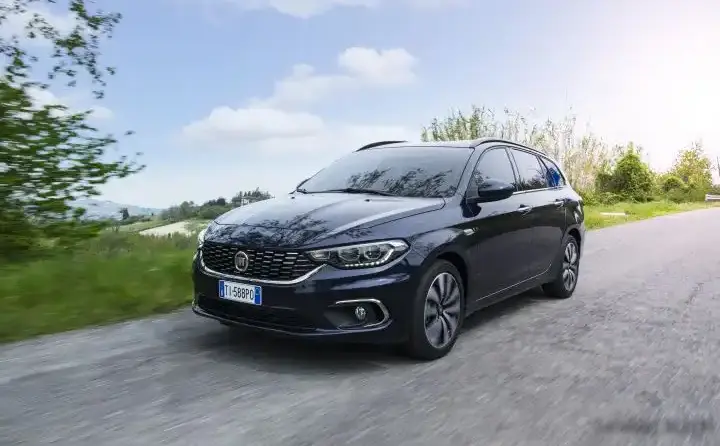
The Fiat Tipo (358) Wagon 1.6, produced from 2016 to 2018, represented a practical and fuel-efficient offering in the European compact estate market. Positioned as a mid-range trim within the Tipo Wagon lineup, it aimed to provide a balance between affordability, space, and reasonable performance. The Tipo, revived after a two-decade hiatus, was designed to appeal to families and those needing a versatile vehicle without the premium price tag of competitors. This variant specifically utilized a 1.6-liter diesel engine paired with a six-speed manual transmission, offering a blend of economy and usability. It was a key component of Fiat’s strategy to regain market share in the C-segment.
Technical Specifications
| Brand | Fiat |
| Model | Tipo |
| Generation | Tipo (358) Wagon |
| Type (Engine) | 1.6 (120 Hp) |
| Start of production | 2016 |
| End of production | 2018 |
| Powertrain Architecture | Internal Combustion engine |
| Body type | Station wagon (estate) |
| Seats | 5 |
| Doors | 5 |
| Fuel consumption (urban) | 4.4 l/100 km (63.6 US mpg) |
| Fuel consumption (extra urban) | 3.3 l/100 km (71.3 US mpg) |
| Fuel consumption (combined) | 3.7 l/100 km (63.6 US mpg) |
| CO2 emissions | 98 g/km |
| Fuel Type | Diesel |
| Acceleration 0 – 100 km/h | 10.1 sec |
| Acceleration 0 – 62 mph | 10.1 sec |
| Acceleration 0 – 60 mph | 9.6 sec |
| Maximum speed | 200 km/h (124.27 mph) |
| Emission standard | Euro 6 |
| Weight-to-power ratio | 11.6 kg/Hp |
| Weight-to-torque ratio | 4.4 kg/Nm |
| Power | 120 Hp @ 3750 rpm |
| Torque | 320 Nm @ 1750 rpm (236.02 lb.-ft. @ 1750 rpm) |
| Engine layout | Front, Transverse |
| Engine Model/Code | 55260384 |
| Engine displacement | 1598 cm3 (97.52 cu. in.) |
| Number of cylinders | 4 |
| Engine configuration | Inline |
| Cylinder Bore | 79.5 mm (3.13 in.) |
| Piston Stroke | 80.5 mm (3.17 in.) |
| Compression ratio | 16.5:1 |
| Number of valves per cylinder | 4 |
| Fuel injection system | Diesel Commonrail |
| Engine aspiration | Turbocharger, Intercooler |
| Engine oil capacity | 4.8 l (5.07 US qt | 4.22 UK qt) |
| Coolant capacity | 6.1 l (6.45 US qt | 5.37 UK qt) |
| Kerb Weight | 1395 kg (3075.45 lbs.) |
| Max. weight | 1895 kg (4177.76 lbs.) |
| Max load | 500 kg (1102.31 lbs.) |
| Trunk (boot) space – minimum | 550 l (19.42 cu. ft.) |
| Fuel tank capacity | 50 l (13.21 US gal | 11 UK gal) |
| Permitted trailer load with brakes (12%) | 1200 kg (2645.55 lbs.) |
| Length | 4571 mm (179.96 in.) |
| Width | 1792 mm (70.55 in.) |
| Height | 1514 mm (59.61 in.) |
| Wheelbase | 2638 mm (103.86 in.) |
| Front track | 1542 mm (60.71 in.) |
| Rear track | 1543 mm (60.75 in.) |
| Front overhang | 893 mm (35.16 in.) |
| Rear overhang | 1040 mm (40.94 in.) |
| Minimum turning circle | 10.93 m (35.86 ft.) |
| Drivetrain Architecture | Front wheel drive |
| Number of gears | 6 |
| Gearbox type | Manual transmission |
| Front suspension | Independent type McPherson |
| Rear suspension | Semi-independent, coil spring |
| Front brakes | Disc |
| Rear brakes | Disc |
| Assisting systems | ABS (Anti-lock braking system) |
| Steering type | Steering rack and pinion |
| Power steering | Electric |
Powertrain & Engine Architecture
The heart of the Tipo Wagon 1.6 was the Fiat-sourced 1.6-liter Multijet II diesel engine, bearing the code 55260384. This engine was a member of the second generation of Fiat’s common rail direct injection diesel engines, known for their improved efficiency and reduced noise compared to earlier iterations. It featured a turbocharger with an intercooler to boost power output and a sophisticated common rail fuel injection system capable of multiple injections per combustion cycle. This allowed for precise fuel delivery, optimizing combustion and minimizing emissions. The engine utilized a four-valve-per-cylinder configuration and a compression ratio of 16.5:1, contributing to its efficiency. The six-speed manual transmission was chosen for its balance of fuel economy and driver engagement. Gear ratios were tuned for maximizing fuel efficiency during highway cruising while still providing adequate acceleration in urban environments.
Driving Characteristics
The 120 horsepower and 320 Nm (236 lb-ft) of torque delivered by the 1.6 Multijet II provided adequate, though not exhilarating, performance. Acceleration from 0 to 60 mph took around 9.6 seconds, and top speed was approximately 124 mph. The engine’s torque peak at 1750 rpm meant that it felt responsive in everyday driving situations, offering good pulling power for overtaking and carrying a full load. Compared to the higher-output 1.4 T-Jet petrol engine available in the Tipo range, the 1.6 diesel prioritized fuel economy over outright speed. The manual transmission offered a more engaging driving experience than the optional automatic, allowing drivers to better control the engine’s power delivery. However, the gear ratios were somewhat long, prioritizing fuel efficiency over rapid acceleration.
Equipment & Trim Levels
The 1.6-liter diesel Tipo Wagon typically came equipped with a reasonable level of standard features. These included air conditioning, electric front windows, a basic audio system with USB connectivity, and stability control. Higher trim levels offered upgrades such as alloy wheels, a touchscreen infotainment system with navigation, rear parking sensors, and cruise control. Interior upholstery was typically cloth, with a functional and durable design. Optional extras included a panoramic sunroof, leather upholstery, and advanced driver-assistance systems like automatic emergency braking.
Chassis & Braking
The Tipo Wagon utilized a McPherson strut front suspension and a semi-independent coil spring rear suspension. This setup provided a comfortable ride quality, suitable for long journeys. The front brakes were ventilated discs, while the rear brakes were solid discs. ABS (Anti-lock Braking System) was standard, enhancing safety during emergency braking. The steering was electrically assisted, providing light and precise control. Stabilizer bars were fitted to both the front and rear axles to reduce body roll during cornering.
Market Reception & Comparison
The Fiat Tipo Wagon 1.6 received generally positive reviews for its practicality, fuel efficiency, and competitive pricing. Critics praised its spacious interior and large boot capacity. However, some reviewers noted that the interior materials felt somewhat low-rent compared to rivals like the Volkswagen Golf Estate or Skoda Octavia Estate. The 1.6 diesel engine was lauded for its economy, but some found it to be somewhat noisy and lacking in refinement. Compared to the petrol-powered Tipo variants, the 1.6 diesel offered significantly better fuel economy, making it a popular choice for high-mileage drivers. The manual transmission was generally preferred over the optional automatic due to its smoother operation and improved fuel efficiency.
Legacy
The Fiat Tipo Wagon 1.6 has proven to be a relatively reliable vehicle in the used car market. The 1.6 Multijet II engine is known for its durability, provided it is properly maintained. Common issues include diesel particulate filter (DPF) problems, particularly on vehicles that have primarily been used for short journeys. Regular servicing and the use of high-quality diesel fuel are essential for maintaining the engine’s health. Today, the Tipo Wagon 1.6 represents a cost-effective option for those seeking a practical and fuel-efficient estate car. Its spacious interior and reasonable running costs continue to make it an appealing choice for families and budget-conscious buyers.