
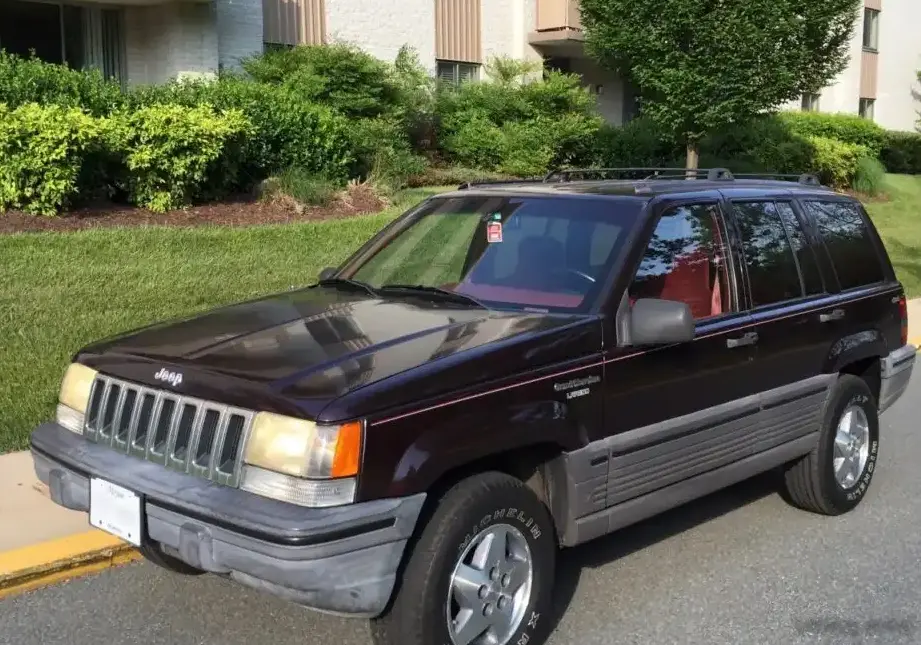
The Jeep Grand Cherokee (ZJ) 4.0i, produced from 1994 to 1995, represented a significant step forward for the Jeep brand, blending off-road capability with on-road comfort. This variant, equipped with the 4.0-liter inline-six engine and a four-speed automatic transmission, occupied a middle ground in the ZJ lineup, offering a balance between affordability and performance. It was positioned above the base 4.0-liter manual transmission models and below the more powerful and luxurious 5.2L V8 versions. The ZJ generation, launched in 1993, was a crucial model for Jeep, replacing the aging Cherokee and Wagoneer, and establishing the Grand Cherokee as a premium SUV contender in the North American market.
Technical Specifications
| Brand | Jeep |
| Model | Grand Cherokee |
| Generation | Grand Cherokee I (ZJ) |
| Type (Engine) | 4.0i (188 Hp) 4×4 Automatic |
| Start of production | 1994 |
| End of production | 1995 |
| Powertrain Architecture | Internal Combustion engine |
| Body type | SUV |
| Seats | 5 |
| Doors | 5 |
| Fuel consumption (urban) | 15.7 l/100 km (15 US mpg, 18 UK mpg, 6.4 km/l) |
| Fuel consumption (extra urban) | 11.8 l/100 km (19.9 US mpg, 23.9 UK mpg, 8.5 km/l) |
| Fuel consumption (combined) | 13.8 l/100 km (17 US mpg, 20.5 UK mpg, 7.2 km/l) |
| Fuel Type | Petrol (Gasoline) |
| Weight-to-power ratio | 9 kg/Hp, 111.2 Hp/tonne |
| Weight-to-torque ratio | 5.7 kg/Nm, 176.3 Nm/tonne |
| Power | 188 Hp @ 4600 rpm |
| Power per litre | 47.5 Hp/l |
| Torque | 298 Nm @ 2400 rpm (219.79 lb.-ft. @ 2400 rpm) |
| Engine layout | Front, Longitudinal |
| Engine Model/Code | ERH |
| Engine displacement | 3956 cm3 (241.41 cu. in.) |
| Number of cylinders | 6 |
| Engine configuration | Inline |
| Cylinder Bore | 98.4 mm (3.87 in.) |
| Piston Stroke | 86.7 mm (3.41 in.) |
| Compression ratio | 8.8:1 |
| Number of valves per cylinder | 2 |
| Fuel injection system | Multi-port manifold injection |
| Engine aspiration | Naturally aspirated engine |
| Valvetrain | OHV |
| Engine oil capacity | 5.7 l (6.02 US qt | 5.02 UK qt) |
| Coolant capacity | 11.4 l (12.05 US qt | 10.03 UK qt) |
| Kerb Weight | 1690 kg (3725.81 lbs.) |
| Fuel tank capacity | 87 l (22.98 US gal | 19.14 UK gal) |
| Length | 4489 mm (176.73 in.) |
| Width | 1758 mm (69.21 in.) |
| Height | 1648 mm (64.88 in.) |
| Wheelbase | 2690 mm (105.91 in.) |
| Front track | 1473 mm (57.99 in.) |
| Rear track | 1473 mm (57.99 in.) |
| Ride height (ground clearance) | 202 mm (7.95 in.) |
| Drag coefficient (Cd) | 0.45 |
| Minimum turning circle | 11.7 m (38.39 ft.) |
| Drive wheel | All wheel drive (4×4) |
| Number of gears | 4 |
| Gearbox type | automatic transmission |
| Front brakes | Ventilated discs |
| Rear brakes | Ventilated discs |
| Assisting systems | ABS (Anti-lock braking system) |
| Steering type | Steering rack and pinion |
| Power steering | Hydraulic Steering |
| Tires size | 215/75 R15 |
| Wheel rims size | 15 |
Powertrain & Engine Architecture
The heart of the ZJ 4.0i is the 4.0-liter (3956 cc) inline-six cylinder engine, designated the ERH code. This engine, a mainstay of Jeep vehicles for decades, is known for its durability and relatively simple design. It features a cast iron block and cylinder head, with a two-valve-per-cylinder overhead valve (OHV) configuration. Fuel delivery is managed by a multi-port fuel injection system, providing a balance between efficiency and power. The engine produces 188 horsepower at 4,600 rpm and 298 Nm (219.79 lb-ft) of torque at 2400 rpm. The four-speed automatic transmission (typically the 42RE) was chosen for its reliability and ease of use, making it a popular choice for drivers prioritizing convenience over outright performance. This transmission featured a torque converter for smooth engagement and a relatively conservative gear ratio spread, optimized for towing and off-road driving.
Driving Characteristics
The 4.0i automatic Grand Cherokee offered a comfortable and capable driving experience, though it wasn’t particularly quick. Acceleration was adequate for everyday driving, but the 188 horsepower and the weight of the vehicle (approximately 3726 lbs) meant that passing maneuvers required planning. The automatic transmission, while smooth, lacked the responsiveness of a manual gearbox. The gear ratios were geared towards low-end torque, making it well-suited for climbing hills and navigating challenging terrain. Compared to the 5.2L V8 models, the 4.0i offered significantly better fuel economy, but at the expense of outright power. The 4.0i was also noticeably more nimble than the V8 versions due to its lighter engine.
Equipment & Trim Levels
The 4.0i Grand Cherokee typically came standard with features such as air conditioning, power windows and locks, and an AM/FM stereo. Higher trim levels, like the Limited, added features such as leather upholstery, upgraded sound systems, and alloy wheels. Optional extras included a sunroof, a tow package, and a premium sound system. Interior upholstery was typically cloth, though leather was available on higher trims. The dashboard layout was functional and straightforward, with easy-to-read gauges and well-placed controls.
Chassis & Braking
The ZJ Grand Cherokee utilized a body-on-frame construction, providing a robust and durable platform. The suspension consisted of a traditional setup with coil springs and shock absorbers. Front suspension was independent, while the rear featured a solid axle with coil springs. Braking duties were handled by ventilated discs on all four wheels, supplemented by an Anti-lock Braking System (ABS). The braking system was adequate for the vehicle’s weight and performance, but lacked the stopping power of more modern SUVs. Stabilizer bars were fitted to both the front and rear axles to reduce body roll during cornering.
Market Reception & Comparison
The Jeep Grand Cherokee ZJ 4.0i was generally well-received by critics and consumers alike. It was praised for its comfortable ride, off-road capability, and relatively affordable price. However, some reviewers noted its lackluster acceleration and somewhat dated interior design. Compared to other SUVs of the time, such as the Ford Explorer and Chevrolet Blazer, the Grand Cherokee offered a more refined driving experience and superior off-road performance. Fuel economy was competitive for its class, though not exceptional. The 4.0i proved to be a popular choice for buyers who wanted a capable and reliable SUV without the expense of the V8 models.
Legacy
The 4.0-liter inline-six engine paired with the 42RE automatic transmission proved to be a remarkably durable combination. Many ZJ Grand Cherokees equipped with this powertrain are still on the road today, a testament to their reliability. While maintenance costs can increase with age, parts availability remains good. The ZJ Grand Cherokee, and particularly the 4.0i variant, has gained a loyal following among off-road enthusiasts and classic SUV collectors. It represents a pivotal moment in Jeep’s history, bridging the gap between traditional ruggedness and modern comfort and establishing the Grand Cherokee as a leading SUV in the American market.
