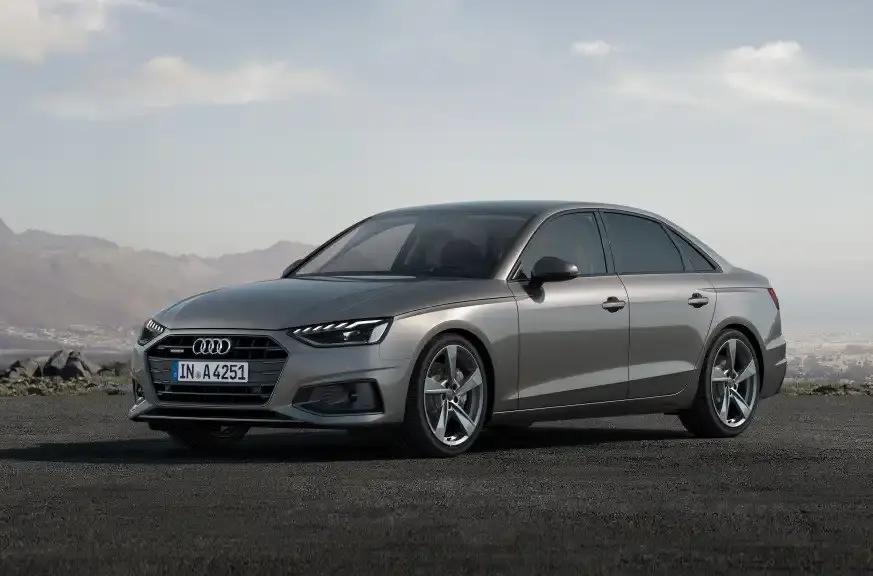
The Audi A4 (B9 8W) 30 TDI, produced from October 2019 to June 2020, represents a key variant within the facelifted B9 generation of Audi’s popular compact executive car. Positioned as an entry-level diesel option, it aimed to deliver a balance of fuel efficiency and reasonable performance for the European market. This model utilized a 2.0-liter turbocharged diesel engine producing 122 horsepower, paired with a six-speed manual transmission. It served as a more economical alternative to the higher-powered TDI variants and the petrol-fueled A4 models, targeting buyers prioritizing running costs and everyday usability.
Technical Specifications
| Brand | Audi |
| Model | A4 |
| Generation | A4 (B9 8W, facelift 2019) |
| Type (Engine) | 30 TDI (122 Hp) |
| Start of production | October, 2019 |
| End of production | June, 2020 |
| Powertrain Architecture | Internal Combustion engine |
| Body type | Sedan |
| Seats | 5 |
| Doors | 4 |
| Fuel consumption (urban) | 4.8-5.0 l/100 km (49 – 47 US mpg, 58.9 – 56.5 UK mpg, 20.8 – 20 km/l) |
| Fuel consumption (extra urban) | 3.6-3.9 l/100 km (65.3 – 60.3 US mpg, 78.5 – 72.4 UK mpg, 27.8 – 25.6 km/l) |
| Fuel consumption (combined) | 4.0-4.3 l/100 km (58.8 – 54.7 US mpg, 70.6 – 65.7 UK mpg, 25 – 23.3 km/l) |
| CO2 emissions | 106-114 g/km |
| Fuel Type | Diesel |
| Acceleration 0 – 100 km/h | 10.9 sec |
| Acceleration 0 – 62 mph | 10.9 sec |
| Acceleration 0 – 60 mph | 10.4 sec |
| Maximum speed | 205 km/h (127.38 mph) |
| Emission standard | Euro 6d – TEMP – EVAP – ISC |
| Weight-to-power ratio | 11.7 kg/Hp, 85.3 Hp/tonne |
| Weight-to-torque ratio | 5.3 kg/Nm, 188.8 Nm/tonne |
| Power | 122 Hp @ 3500-4000 rpm |
| Power per litre | 62 Hp/l |
| Torque | 270 Nm @ 1500-3000 rpm (199.14 lb.-ft. @ 1500-3000 rpm) |
| Engine layout | Front, Longitudinal |
| Engine Model/Code | DEUC |
| Engine displacement | 1968 cm3 (120.09 cu. in.) |
| Number of cylinders | 4 |
| Engine configuration | Inline |
| Fuel injection system | Diesel Commonrail |
| Engine aspiration | Turbocharger, Intercooler |
| Engine oil capacity | 4.7 l (4.97 US qt | 4.14 UK qt) |
| Kerb Weight | 1430 kg (3152.61 lbs.) |
| Max. weight | 2060 kg (4541.52 lbs.) |
| Max load | 630 kg (1388.91 lbs.) |
| Trunk (boot) space – minimum | 460 l (16.24 cu. ft.) |
| Fuel tank capacity | 40 l (10.57 US gal | 8.8 UK gal) |
| Max. roof load | 90 kg (198.42 lbs.) |
| Permitted trailer load with brakes (8%) | 1500 kg (3306.93 lbs.) |
| Permitted trailer load with brakes (12%) | 1300 kg (2866.01 lbs.) |
| Permitted trailer load without brakes | 750 kg (1653.47 lbs.) |
| Permitted towbar download | 80 kg (176.37 lbs.) |
| Length | 4762 mm (187.48 in.) |
| Width | 1847 mm (72.72 in.) |
| Width including mirrors | 2022 mm (79.61 in.) |
| Height | 1428 mm (56.22 in.) |
| Wheelbase | 2820 mm (111.02 in.) |
| Front track | 1572 mm (61.89 in.) |
| Rear (Back) track | 1555 mm (61.22 in.) |
| Front overhang | 899 mm (35.39 in.) |
| Rear overhang | 1043 mm (41.06 in.) |
| Minimum turning circle | 11.6 m (38.06 ft.) |
| Drivetrain Architecture | Front wheel drive |
| Number of gears and type of gearbox | 6 gears, manual transmission |
| Front suspension | Independent multi-link suspension |
| Rear suspension | Independent multi-link suspension |
| Front brakes | Ventilated discs |
| Rear brakes | Disc |
| Assisting systems | ABS (Anti-lock braking system) |
| Steering type | Steering rack and pinion |
| Power steering | Electric Steering |
| Tires size | 205/60 R16 |
| Wheel rims size | 7 J x 16 |
Powertrain & Engine Architecture
The heart of the A4 30 TDI is the Volkswagen Group’s DEUC engine, a 2.0-liter inline-four cylinder diesel. This engine is part of the modular engine family, known for its compact dimensions and efficiency. It utilizes a common rail direct injection system, delivering fuel at extremely high pressures for optimized combustion. A turbocharger with an intercooler is employed to boost power output and improve torque across a wide rev range. The engine also incorporates a diesel particulate filter (DPF) to meet stringent Euro 6d emission standards. The six-speed manual transmission provides precise gear changes and contributes to the car’s fuel efficiency. The engine’s longitudinal mounting allows for front-wheel drive configuration, common in European A4 models.
Driving Characteristics
The 122 horsepower and 270 Nm (199 lb-ft) of torque offered by the 30 TDI powertrain provide adequate, though not exhilarating, performance. Acceleration from 0-100 km/h (0-62 mph) takes around 10.9 seconds. The engine delivers its peak torque between 1500 and 3000 rpm, making it responsive in everyday driving situations. Compared to the more powerful TDI variants (like the 40 TDI), the 30 TDI feels less urgent, particularly during overtaking maneuvers. The manual transmission allows for greater driver control, but the gear ratios are tuned for economy rather than outright speed. The overall driving experience is comfortable and refined, typical of the A4, but lacks the dynamic punch of higher-performance models.
Equipment & Trim Levels
The A4 30 TDI typically came equipped with a respectable level of standard features. These included Audi’s MMI radio plus infotainment system with a 7-inch display, Bluetooth connectivity, and a leather-wrapped multi-function steering wheel. Cloth upholstery was standard, with leather options available at extra cost. Safety features such as ABS, electronic stability control, and multiple airbags were also standard. Optional extras included features like Audi’s Virtual Cockpit digital instrument cluster, navigation system, advanced driver assistance systems (adaptive cruise control, lane keep assist), and upgraded sound systems. Trim levels varied by market, but generally offered progressively more luxurious appointments and technology as you moved up the range.
Chassis & Braking
The A4 30 TDI utilizes a sophisticated chassis design featuring independent multi-link suspension at both the front and rear. This setup provides a comfortable ride and good handling characteristics. The front suspension incorporates ventilated disc brakes, while the rear brakes are solid discs. ABS (Anti-lock Braking System) is standard, ensuring safe and controlled braking in various conditions. The steering is electrically assisted, providing a light and precise feel. The suspension tuning is geared towards comfort, but the A4 still offers a reasonably engaging driving experience.
Market Reception & Comparison
The A4 30 TDI was generally well-received by automotive critics as a sensible and economical choice within the A4 lineup. It was praised for its fuel efficiency, comfortable ride, and refined interior. However, some reviewers noted that the engine lacked the punch of more powerful alternatives. Compared to the A4 40 TDI, the 30 TDI offered lower running costs but sacrificed performance. Against competitors like the BMW 320d and Mercedes-Benz C200d, the A4 30 TDI held its own in terms of fuel economy and interior quality, but often lagged slightly in terms of driving dynamics.
Legacy
The DEUC engine, found in the A4 30 TDI, has proven to be a relatively reliable powertrain when properly maintained. The diesel particulate filter (DPF) can be a potential point of failure if the vehicle is primarily used for short journeys, as it requires regular regeneration. However, with regular servicing and careful driving, these engines can cover high mileages without major issues. On the used car market, the A4 30 TDI represents a good value proposition for buyers seeking a comfortable, fuel-efficient, and well-equipped compact executive car. Its lower purchase price compared to higher-powered variants makes it an attractive option for those prioritizing practicality and running costs.