
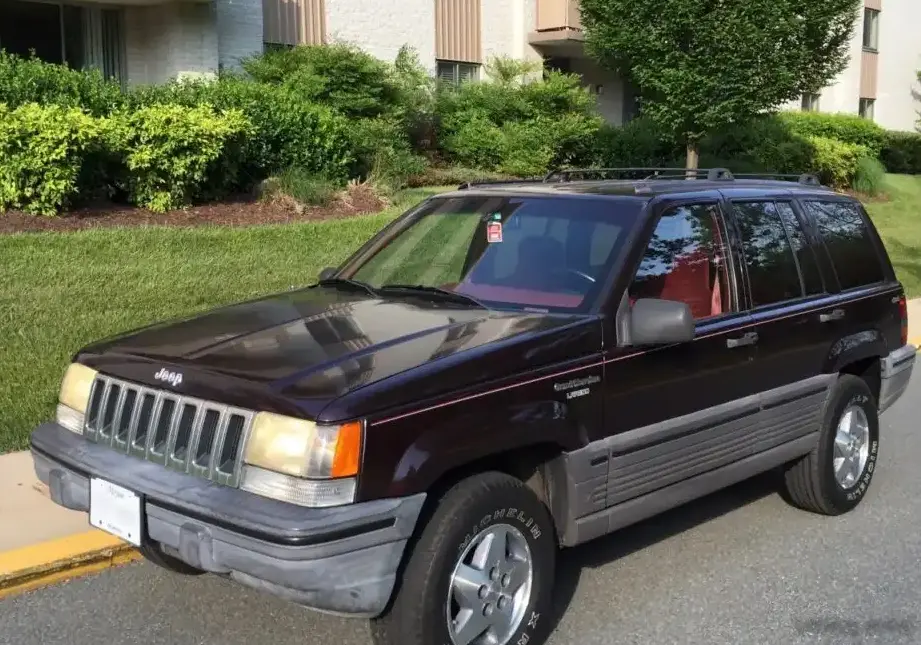
The Jeep Grand Cherokee (ZJ) 4.0i 4×4, produced from 1993 to 1994, represented a significant step forward for the Jeep brand, blending off-road capability with on-road comfort. This variant, equipped with the 4.0-liter inline-six engine and a five-speed manual transmission, occupied a middle ground in the ZJ lineup, offering a balance between affordability and performance. It was positioned above the base 2.5L models and below the more powerful and luxurious 5.2L V8 versions. The ZJ generation was the first to fully embrace the Grand Cherokee name, moving away from the earlier Cherokee models and establishing a new standard for Jeep’s full-size SUV offerings.
Technical Specifications
| Brand | Jeep |
| Model | Grand Cherokee |
| Generation | Grand Cherokee I (ZJ) |
| Type (Engine) | 4.0i (192 Hp) 4×4 |
| Start of production | 1993 |
| End of production | 1994 |
| Powertrain Architecture | Internal Combustion engine |
| Body type | SUV |
| Seats | 5 |
| Doors | 5 |
| Fuel consumption (urban) | 14.7 l/100 km (16 US mpg, 19.2 UK mpg, 6.8 km/l) |
| Fuel consumption (extra urban) | 11.8 l/100 km (19.9 US mpg, 23.9 UK mpg, 8.5 km/l) |
| Fuel consumption (combined) | 13.8 l/100 km (17 US mpg, 20.5 UK mpg, 7.2 km/l) |
| Fuel Type | Petrol (Gasoline) |
| Acceleration 0 – 100 km/h | 9.6 sec |
| Acceleration 0 – 62 mph | 9.6 sec |
| Acceleration 0 – 60 mph | 9.1 sec |
| Weight-to-power ratio | 8.7 kg/Hp, 115.2 Hp/tonne |
| Weight-to-torque ratio | 5.5 kg/Nm, 183 Nm/tonne |
| Power | 192 Hp @ 4750 rpm |
| Power per litre | 48.5 Hp/l |
| Torque | 305 Nm @ 4000 rpm (224.96 lb.-ft. @ 4000 rpm) |
| Engine layout | Front, Longitudinal |
| Engine Model/Code | ERH |
| Engine displacement | 3956 cm3 (241.41 cu. in.) |
| Number of cylinders | 6 |
| Engine configuration | Inline |
| Cylinder Bore | 98.4 mm (3.87 in.) |
| Piston Stroke | 86.7 mm (3.41 in.) |
| Compression ratio | 8.8:1 |
| Number of valves per cylinder | 2 |
| Fuel injection system | Multi-port manifold injection |
| Engine aspiration | Naturally aspirated engine |
| Valvetrain | OHV |
| Engine oil capacity | 5.7 l (6.02 US qt | 5.02 UK qt) |
| Coolant capacity | 11.4 l (12.05 US qt | 10.03 UK qt) |
| Kerb Weight | 1667 kg (3675.11 lbs.) |
| Fuel tank capacity | 87 l (22.98 US gal | 19.14 UK gal) |
| Length | 4489 mm (176.73 in.) |
| Width | 1758 mm (69.21 in.) |
| Height | 1648 mm (64.88 in.) |
| Wheelbase | 2690 mm (105.91 in.) |
| Front track | 1473 mm (57.99 in.) |
| Rear track | 1473 mm (57.99 in.) |
| Ride height (ground clearance) | 202 mm (7.95 in.) |
| Drag coefficient (Cd) | 0.45 |
| Minimum turning circle | 11.7 m (38.39 ft.) |
| Drive wheel | All wheel drive (4×4) |
| Number of gears | 5 gears, manual transmission |
| Front brakes | Ventilated discs |
| Rear brakes | Ventilated discs |
| Assisting systems | ABS (Anti-lock braking system) |
| Steering type | Steering rack and pinion |
| Power steering | Hydraulic Steering |
| Tires size | 215/75 R15 |
| Wheel rims size | 15 |
Powertrain & Engine Architecture
The heart of the Grand Cherokee 4.0i was the 4.0-liter (3956 cc) inline-six cylinder engine, designated the ERH code. This engine was a mainstay of the Jeep lineup for many years, known for its durability and relatively smooth operation. It featured a cast iron block and cylinder head, with a two-valve-per-cylinder overhead valve (OHV) configuration. Fuel delivery was handled by a multi-port fuel injection system, contributing to improved efficiency and drivability compared to earlier carbureted engines. The engine produced 192 horsepower at 4750 rpm and 225 lb-ft of torque at 4000 rpm. The five-speed manual transmission provided a more engaging driving experience than the available automatic, offering better control and fuel economy. The transmission’s gear ratios were tuned for a balance of acceleration and highway cruising, though it wasn’t particularly sporty.
Driving Characteristics
The 4.0i with the manual transmission offered a reasonably responsive driving experience. While not a performance machine, the engine provided adequate power for everyday driving and moderate off-road excursions. Acceleration from 0-60 mph took around 9.1 seconds, which was competitive for an SUV of its size and era. The manual transmission allowed drivers to keep the engine in its optimal power band, making it feel more lively than the automatic versions. However, the ZJ’s substantial weight (approximately 3675 lbs) was always noticeable, especially during spirited driving or when towing. The 4×4 system, featuring a part-time transfer case, provided excellent traction in challenging conditions, making it a capable off-road vehicle.
Equipment & Trim Levels
The Grand Cherokee 4.0i 4×4 typically came standard with features like air conditioning, power windows and locks, and an AM/FM stereo. Upholstery was usually cloth, though leather was available as an option. The base trim level was fairly spartan, but buyers could add options such as a sunroof, upgraded sound system, and cruise control. The interior design was functional and straightforward, prioritizing practicality over luxury. The dashboard layout was typical of early 1990s American vehicles, with large, easy-to-read gauges and clearly labeled controls.
Chassis & Braking
The ZJ Grand Cherokee utilized a body-on-frame construction, providing a robust and durable platform. The suspension consisted of a solid front axle with coil springs and a multi-link rear suspension with coil springs. This setup offered a good balance of ride comfort and off-road capability. Braking duties were handled by ventilated discs on all four wheels, along with an anti-lock braking system (ABS) as standard equipment. The ABS helped to maintain steering control during hard braking, enhancing safety. The steering was a hydraulic power rack-and-pinion system, providing relatively light and precise steering feel.
Market Reception & Comparison
The Grand Cherokee 4.0i 4×4 was generally well-received by automotive critics. It was praised for its comfortable ride, spacious interior, and capable 4×4 system. However, some reviewers noted that the 4.0-liter engine could feel underpowered when fully loaded or tackling steep inclines. Compared to the 5.2L V8 models, the 4.0i offered better fuel economy (around 17 mpg combined) but significantly less power. The 4.0i was also more affordable than the V8, making it an attractive option for budget-conscious buyers. Against competitors like the Ford Explorer and Chevrolet Blazer, the Grand Cherokee offered a more refined interior and a more sophisticated 4×4 system.
Legacy
The Jeep Grand Cherokee ZJ 4.0i 4×4 has proven to be a remarkably durable and reliable vehicle. The 4.0-liter inline-six engine is known for its longevity, and many examples are still on the road today. While maintenance costs can increase with age, parts availability remains good. In the used car market, these Grand Cherokees are often sought after by enthusiasts and those looking for a capable and affordable SUV. The ZJ generation laid the foundation for the modern Grand Cherokee, establishing it as a benchmark in the mid-size SUV segment. The combination of a robust powertrain, comfortable interior, and capable 4×4 system continues to make the ZJ a popular choice among Jeep fans.
