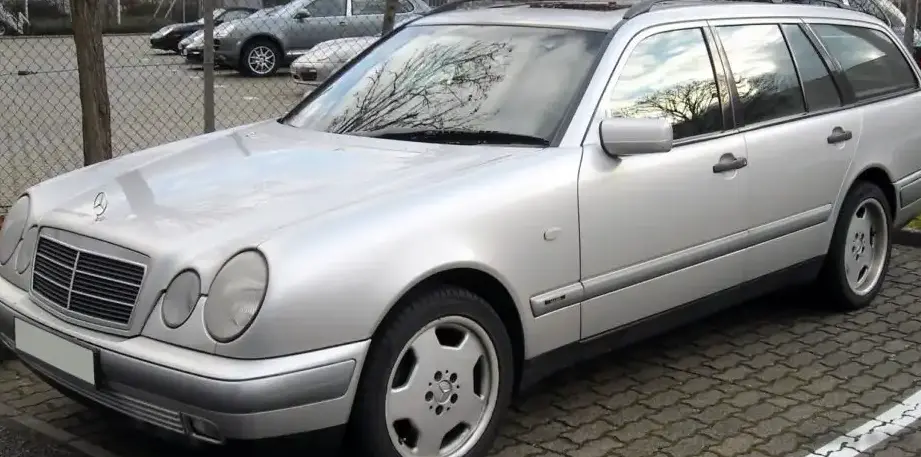
The Mercedes-Benz E 240 T-modell (S210), produced from October 1996 to July 1999, represented a compelling blend of practicality and luxury within the W210 E-Class range. As a station wagon (estate) variant, it catered to buyers seeking the refinement of an E-Class with enhanced cargo capacity. This particular configuration, featuring a 2.4-liter inline-six engine producing 170 horsepower paired with a five-speed automatic transmission, occupied a middle ground in the lineup, offering a balance between performance, fuel economy, and affordability. It served as a popular alternative to the more powerful E 320 and the diesel-powered E 300 Turbodiesel.
Technical Specifications
| Brand | Mercedes-Benz |
| Model | E-class |
| Generation | E-class T-modell (S210) |
| Type (Engine) | E 240 (170 Hp) Automatic |
| Start of production | October, 1996 |
| End of production | July, 1999 |
| Powertrain Architecture | Internal Combustion engine |
| Body type | Station wagon (estate) |
| Seats | 5 |
| Doors | 5 |
| Fuel consumption (urban) | 15.2 l/100 km (15.5 US mpg, 18.6 UK mpg, 6.6 km/l) |
| Fuel consumption (extra urban) | 8.7 l/100 km (27 US mpg, 32.5 UK mpg, 11.5 km/l) |
| Fuel consumption (combined) | 10.1 l/100 km (23.3 US mpg, 28 UK mpg, 9.9 km/l) |
| Fuel Type | Petrol (Gasoline) |
| Acceleration 0 – 100 km/h | 11.1 sec |
| Acceleration 0 – 62 mph | 11.1 sec |
| Acceleration 0 – 60 mph | 10.5 sec |
| Maximum speed | 215 km/h (133.59 mph) |
| Weight-to-power ratio | 9.4 kg/Hp, 106.9 Hp/tonne |
| Weight-to-torque ratio | 7.1 kg/Nm, 141.5 Nm/tonne |
| Power | 170 Hp @ 5900 rpm |
| Power per litre | 70.9 Hp/l |
| Torque | 225 Nm @ 3000 rpm (165.95 lb.-ft. @ 3000 rpm) |
| Engine layout | Front, Longitudinal |
| Engine Model/Code | M 112 E 24 / 112.911 |
| Engine displacement | 2397 cm3 (146.27 cu. in.) |
| Number of cylinders | 6 |
| Engine configuration | V-engine |
| Cylinder Bore | 83.2 mm (3.28 in.) |
| Piston Stroke | 73.5 mm (2.89 in.) |
| Compression ratio | 10:1 |
| Number of valves per cylinder | 3 |
| Fuel injection system | Multi-port manifold injection |
| Engine aspiration | Naturally aspirated engine |
| Valvetrain | SOHC |
| Engine oil capacity | 8 l (8.45 US qt | 7.04 UK qt) |
| Coolant | 10 l (10.57 US qt | 8.8 UK qt) |
| Kerb Weight | 1590 kg (3505.35 lbs.) |
| Max. weight | 2170 kg (4784.03 lbs.) |
| Max load | 580 kg (1278.68 lbs.) |
| Trunk (boot) space – minimum | 600 l (21.19 cu. ft.) |
| Trunk (boot) space – maximum | 1975 l (69.75 cu. ft.) |
| Fuel tank capacity | 70 l (18.49 US gal | 15.4 UK gal) |
| Length | 4816 mm (189.61 in.) |
| Width | 1799 mm (70.83 in.) |
| Height | 1505 mm (59.25 in.) |
| Wheelbase | 2833 mm (111.54 in.) |
| Front track | 1542 mm (60.71 in.) |
| Rear (Back) track | 1546 mm (60.87 in.) |
| Drivetrain Architecture | Rear wheel drive |
| Drive wheel | Rear wheel drive |
| Number of gears and type of gearbox | 5 gears, automatic transmission |
| Front suspension | Double wishbone |
| Rear suspension | Hydro-pneumatic element, Independent multi-link suspension |
| Front brakes | Ventilated discs |
| Rear brakes | Disc |
| Assisting systems | ABS (Anti-lock braking system) |
| Steering type | Steering rack and pinion |
| Power steering | Hydraulic Steering |
| Tires size | 205/65 R15 |
| Wheel rims size | 7J x 15 |
INTRODUCTION
The S210 E-Class T-modell, introduced in 1996, marked Mercedes-Benz’s continued commitment to offering practical and luxurious station wagons. Building upon the success of the W124-series estate, the S210 aimed to provide a more modern and refined experience. The E 240 T-modell, with its 2.4-liter engine and automatic transmission, was positioned as a sensible choice for families and individuals needing ample space without sacrificing the Mercedes-Benz driving experience. It was a key model in the lineup, bridging the gap between the more affordable E 220 and the higher-performance E 320.
Powertrain & Engine Architecture
The heart of the E 240 T-modell is the M112 E 24 engine, a 2.4-liter (2397 cc) naturally aspirated V6. This engine, part of Mercedes-Benz’s new generation of V-engines, featured all-aluminum construction, three valves per cylinder, and a single overhead camshaft (SOHC). Fuel delivery was handled by a multi-port fuel injection system, ensuring smooth and efficient combustion. The engine produced 170 horsepower at 5900 rpm and 225 Nm (165.95 lb-ft) of torque at 3000 rpm. Paired with this engine was a five-speed automatic transmission (typically the 5G-Tronic), designed for smooth and comfortable gear changes. This transmission was known for its adaptability and contributed to the car’s relaxed driving character.
Driving Characteristics
The E 240 T-modell Automatic offered a comfortable and refined driving experience. While not overtly sporty, the engine provided adequate power for everyday driving and highway cruising. Acceleration from 0 to 60 mph took around 10.5 seconds, and the top speed was electronically limited to 215 km/h (133.59 mph). The automatic transmission, while smooth, did result in some power loss compared to the available manual transmission. Gear ratios were optimized for fuel efficiency and comfortable cruising, rather than outright performance. The car felt stable and well-planted on the road, thanks to its well-tuned suspension and rear-wheel-drive configuration.
Equipment & Trim Levels
The E 240 T-modell came standard with a generous array of features, reflecting Mercedes-Benz’s commitment to luxury. Standard equipment typically included automatic climate control, power windows and locks, a multi-function steering wheel, and a high-quality audio system. Interior upholstery was typically cloth, with leather options available as an upgrade. Optional extras included a sunroof, heated seats, a navigation system, and upgraded audio systems. Trim levels were relatively simple, with most options being added individually rather than packaged into distinct tiers.
Chassis & Braking
The S210 E-Class featured a robust chassis with a double wishbone front suspension and an independent multi-link rear suspension, often incorporating a hydro-pneumatic element for enhanced ride comfort. This suspension setup provided a good balance between handling and ride quality. Braking duties were handled by ventilated discs at the front and solid discs at the rear, assisted by an Anti-lock Braking System (ABS). The steering was a rack-and-pinion system with hydraulic power assistance, providing precise and responsive steering feel.
Market Reception & Comparison
The E 240 T-modell was generally well-received by automotive critics. It was praised for its spacious interior, comfortable ride, and refined driving experience. However, some critics noted that the 2.4-liter engine could feel somewhat underpowered when fully loaded or tackling steep hills. Compared to the E 320, the E 240 offered a more affordable entry point into the E-Class range, but at the expense of performance. The E 300 Turbodiesel provided superior fuel economy but lacked the smoothness and refinement of the E 240. Fuel economy figures were respectable for the time, averaging around 23.3 US mpg in combined driving.
Legacy
The M112 engine family, including the 2.4-liter variant found in the E 240, proved to be remarkably reliable. While maintenance costs for a Mercedes-Benz are generally higher than for more mainstream brands, the M112 engine is known for its durability and longevity. Today, well-maintained E 240 T-modells are sought after by enthusiasts who appreciate their classic Mercedes-Benz styling, comfortable ride, and practical versatility. Common issues include age-related wear and tear on suspension components and potential leaks from cooling system hoses. However, parts availability remains good, and the car’s robust construction ensures that it can provide many more years of reliable service.