Technical Specifications
| Brand | Citroen |
| Model | Jumpy |
| Generation | Jumpy I |
| Type (Engine) | 2.0 HDi (109 Hp) |
| Start of production | 2001 year |
| End of production | 2003 year |
| Powertrain Architecture | Internal Combustion engine |
| Body type | Minivan |
| Seats | 2 |
| Doors | 4 |
| Fuel consumption (urban) | 8.6 l/100 km (27.4 US mpg, 32.8 UK mpg, 11.6 km/l) |
| Fuel consumption (extra urban) | 5.6 l/100 km (42 US mpg, 50.4 UK mpg, 17.9 km/l) |
| Fuel consumption (combined) | 6.7 l/100 km (35.1 US mpg, 42.2 UK mpg, 14.9 km/l) |
| Fuel Type | Diesel |
| Acceleration 0 – 100 km/h | 15 sec |
| Acceleration 0 – 62 mph | 15 sec |
| Acceleration 0 – 60 mph | 14.3 sec |
| Maximum speed | 165 km/h (102.53 mph) |
| Emission standard | Euro 3 |
| Weight-to-power ratio | 13 kg/Hp, 77 Hp/tonne |
| Weight-to-torque ratio | 5.7 kg/Nm, 176.7 Nm/tonne |
| Power | 109 Hp @ 4000 rpm |
| Power per litre | 54.6 Hp/l |
| Torque | 250 Nm @ 1750 rpm (184.39 lb.-ft. @ 1750 rpm) |
| Engine layout | Front, Transverse |
| Engine Model/Code | DW10ATED |
| Engine displacement | 1997 cm3 (121.86 cu. in.) |
| Number of cylinders | 4 |
| Engine configuration | Inline |
| Cylinder Bore | 85 mm (3.35 in.) |
| Piston Stroke | 88 mm (3.46 in.) |
| Number of valves per cylinder | 2 |
| Fuel injection system | Diesel Commonrail |
| Engine aspiration | Turbocharger, Intercooler |
| Valvetrain | SOHC |
| Engine oil capacity | 4.5 l (4.76 US qt | 3.96 UK qt) |
| Coolant | 8.5 l (8.98 US qt | 7.48 UK qt) |
| Kerb Weight | 1415 kg (3119.54 lbs.) |
| Max. weight | 2315 kg (5103.7 lbs.) |
| Max load | 900 kg (1984.16 lbs.) |
| Trunk (boot) space – maximum | 4000 l (141.26 cu. ft.) |
| Fuel tank capacity | 80 l (21.13 US gal | 17.6 UK gal) |
| Max. roof load | 100 kg (220.46 lbs.) |
| Permitted trailer load with brakes (8%) | 1800 kg (3968.32 lbs.) |
| Permitted trailer load with brakes (12%) | 1300 kg (2866.01 lbs.) |
| Permitted trailer load without brakes | 745 kg (1642.44 lbs.) |
| Permitted towbar download | 60 kg (132.28 lbs.) |
| Length | 4440 mm (174.8 in.) |
| Width | 1810 mm (71.26 in.) |
| Width including mirrors | 2134 mm (84.02 in.) |
| Height | 1927 mm (75.87 in.) |
| Wheelbase | 2824 mm (111.18 in.) |
| Front track | 1540 mm (60.63 in.) |
| Rear (Back) track | 1540 mm (60.63 in.) |
| Front overhang | 846 mm (33.31 in.) |
| Rear overhang | 770 mm (30.31 in.) |
| Minimum turning circle | 12.35 m (40.52 ft.) |
| Drivetrain Architecture | The Internal combustion engine (ICE) drives the front wheels of the vehicle. |
| Drive wheel | Front wheel drive |
| Number of gears and type of gearbox | 5 gears, manual transmission |
| Front suspension | Independent, type McPherson with coil spring and anti-roll bar |
| Rear suspension | Semi-dependent beam with stabilizer lateral stability |
| Front brakes | Ventilated discs |
| Rear brakes | Drum |
| Assisting systems | ABS (Anti-lock braking system) |
| Steering type | Steering rack and pinion |
| Power steering | Hydraulic Steering |
| Tires size | 205/65 R15 |
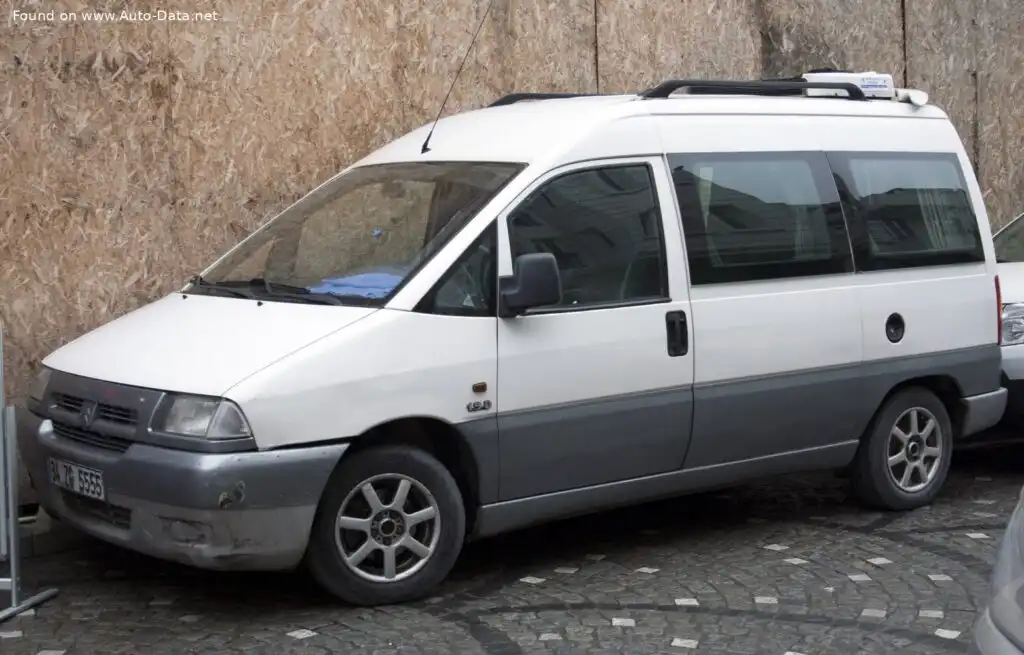
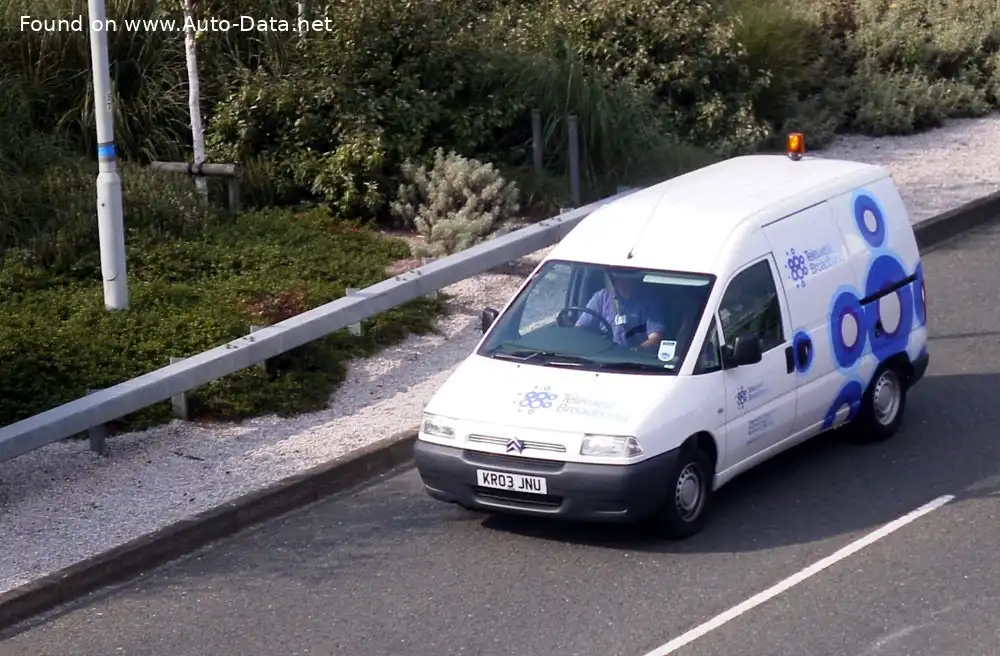
The Citroen Jumpy I 2.0 HDi (109 Hp) was produced between 2001 and 2003 as part of the first generation of the Jumpy model line. This generation, designated 1HX0, was a collaborative project with Peugeot and Fiat, resulting in the Peugeot Expert and Fiat Scudo respectively. The Jumpy aimed to provide a practical and versatile vehicle for both commercial and passenger use, offering a range of body styles and engine options. The 2.0 HDi 109 hp variant was positioned as a mainstream offering, appealing to buyers seeking a balance between performance, fuel economy, and cost. It served as a workhorse for businesses and a spacious family vehicle, particularly in European markets.
Powertrain & Engine Architecture
At the heart of the Jumpy I 2.0 HDi (109 Hp) lies the DW10ATED engine, a 1.997-liter inline-four cylinder diesel engine. This engine utilizes a turbocharger with an intercooler to boost power and efficiency. The DW10ATED is a common rail direct injection (CRDI) diesel, meaning fuel is delivered directly into the combustion chamber at extremely high pressure via a common rail system. This system allows for precise control of fuel injection timing and quantity, optimizing combustion and reducing emissions. The engine features a single overhead camshaft (SOHC) valvetrain with two valves per cylinder. The 109 horsepower output is achieved at 4000 rpm, while peak torque of 250 Nm (184.39 lb.-ft.) is delivered at 1750 rpm. The engine is transversely mounted in the front of the vehicle. The transmission is a 5-speed manual gearbox, chosen for its durability and efficiency.
Driving Characteristics
The 2.0 HDi 109 hp engine in the Jumpy I provides adequate, though not exhilarating, performance. Acceleration from 0 to 100 km/h (0-62 mph) takes around 15 seconds. The engine’s torque characteristics make it well-suited for carrying loads, providing sufficient pulling power for commercial applications. The 5-speed manual transmission is geared to prioritize fuel efficiency, with taller gear ratios in the upper gears. Compared to higher-output versions of the Jumpy, such as those with more powerful HDi engines, this variant feels less responsive, particularly when fully loaded. However, the lower power output contributes to improved fuel economy. The driving experience is generally comfortable, with the Jumpy’s suspension absorbing bumps and imperfections in the road reasonably well.
Equipment & Trim Levels
The Citroen Jumpy I 2.0 HDi (109 Hp) typically came with a relatively basic level of equipment, reflecting its positioning as a practical work vehicle. Standard features generally included power steering, a driver’s airbag, and ABS brakes. Interior upholstery was typically durable cloth. Trim levels varied depending on the market, but generally offered options such as air conditioning, electric windows, and a radio/CD player. Higher trim levels might include features like central locking, upgraded upholstery, and alloy wheels. The Jumpy’s interior is functional and spacious, with a focus on practicality rather than luxury.
Chassis & Braking
The Jumpy I utilizes a front-wheel-drive layout. The front suspension consists of independent McPherson struts with coil springs and an anti-roll bar, providing a comfortable ride and stable handling. The rear suspension employs a semi-dependent beam axle with a stabilizer bar, offering a good balance between load-carrying capacity and ride quality. Braking duties are handled by ventilated discs at the front and drum brakes at the rear. The ABS system helps to prevent wheel lockup during hard braking, enhancing safety. The steering is a rack and pinion system with hydraulic power assistance, providing precise and responsive steering feel.
Market Reception & Comparison
The Citroen Jumpy I 2.0 HDi (109 Hp) was generally well-received in the European market. Critics praised its practicality, fuel efficiency, and spacious interior. However, some noted that the engine lacked the power of some of its competitors. Compared to the higher-output HDi variants, the 109 hp version offered a more affordable entry point into the Jumpy range, but at the expense of performance. It also offered better fuel economy than the more powerful engines. Against rivals like the Volkswagen Transporter and Mercedes-Benz Vito, the Jumpy offered a competitive package in terms of price and practicality.
Legacy
The Citroen Jumpy I 2.0 HDi (109 Hp) has proven to be a relatively reliable powertrain. The DW10ATED engine is known for its durability, and with regular maintenance, can cover high mileages. Common issues include turbocharger wear and potential problems with the fuel injection system. On the used car market, these Jumpy models are often sought after for their affordability and practicality. They remain a popular choice for small businesses and tradespeople. While not the most powerful or luxurious van available, the Jumpy I 2.0 HDi (109 Hp) represents a solid and dependable workhorse that continues to serve its purpose well.