
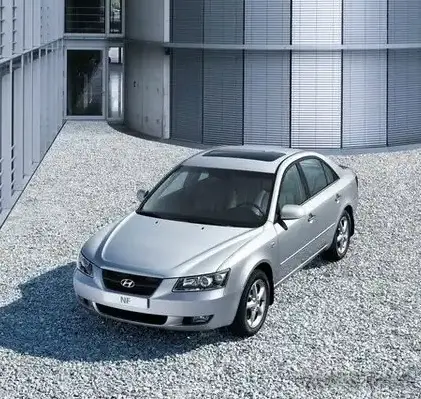
The Hyundai NF 2.4 i 16V, produced between 2004 and 2010, represents a significant step forward for Hyundai in the mid-size sedan segment. Part of the NF generation, this variant was primarily aimed at the domestic South Korean market and select export regions. It occupied a mid-range position within the NF lineup, offering a balance between performance, fuel efficiency, and affordability. The NF series, internally designated as the NF Sonata, was a crucial model for Hyundai, showcasing improved design, build quality, and technology compared to its predecessors. This 2.4-liter engine and five-speed manual transmission combination was a popular choice for buyers seeking a responsive and practical family sedan.
Technical Specifications
| Brand | Hyundai |
| Model | NF |
| Generation | NF |
| Type (Engine) | 2.4 i 16V (161 Hp) |
| Start of production | 2004 year |
| End of production | 2010 year |
| Powertrain Architecture | Internal Combustion engine |
| Body type | Sedan |
| Seats | 5 |
| Doors | 4 |
| Fuel Type | Petrol (Gasoline) |
| Acceleration 0 – 100 km/h | 8.9 sec |
| Acceleration 0 – 62 mph | 8.9 sec |
| Acceleration 0 – 60 mph | 8.5 sec |
| Maximum speed | 209 km/h (129.87 mph) |
| Weight-to-power ratio | 9.1 kg/Hp, 110 Hp/tonne |
| Weight-to-torque ratio | 6.7 kg/Nm, 149.7 Nm/tonne |
| Power | 161 Hp @ 5800 rpm |
| Power per litre | 68.2 Hp/l |
| Torque | 219 Nm @ 4250 rpm (161.53 lb.-ft. @ 4250 rpm) |
| Engine layout | Front, Transverse |
| Engine Model/Code | Theta / G4KC |
| Engine displacement | 2359 cm3 (143.96 cu. in.) |
| Number of cylinders | 4 |
| Engine configuration | Inline |
| Cylinder Bore | 88 mm (3.46 in.) |
| Piston Stroke | 97 mm (3.82 in.) |
| Compression ratio | 10.5:1 |
| Number of valves per cylinder | 4 |
| Fuel injection system | Multi-port manifold injection |
| Engine aspiration | Naturally aspirated engine |
| Valvetrain | DOHC |
| Engine oil capacity | 4.4 l (4.65 US qt | 3.87 UK qt) |
| Coolant | 6.5 l (6.87 US qt | 5.72 UK qt) |
| Kerb Weight | 1463 kg (3225.36 lbs) |
| Max. weight | 2030 kg (4475.38 lbs) |
| Max load | 567 kg (1250.02 lbs) |
| Trunk (boot) space – minimum | 523 l (18.47 cu. ft.) |
| Fuel tank capacity | 70 l (18.49 US gal | 15.4 UK gal) |
| Length | 4800 mm (188.98 in.) |
| Width | 1832 mm (72.13 in.) |
| Height | 1474 mm (58.03 in.) |
| Wheelbase | 2730 mm (107.48 in.) |
| Front track | 1565 mm (61.61 in.) |
| Rear (Back) track | 1550 mm (61.02 in.) |
| Drivetrain Architecture | The Internal combustion engine (ICE) drives the front wheels of the vehicle. |
| Drive wheel | Front wheel drive |
| Number of gears and type of gearbox | 5 gears, manual transmission |
| Front suspension | Double wishbone |
| Rear suspension | Transverse stabilizer |
| Front brakes | Ventilated discs |
| Rear brakes | Disc |
| Assisting systems | ABS (Anti-lock braking system) |
| Steering type | Steering rack and pinion |
| Tires size | 215/60 R16 |
| Wheel rims size | 6.5J X 16 |
Powertrain & Engine Architecture
The heart of the NF 2.4 i 16V is the Hyundai Theta engine, specifically the G4KC variant. This 2.4-liter inline-four cylinder engine utilizes a cast iron block with an aluminum cylinder head. The Theta engine family was a significant development for Hyundai, representing a move towards more modern engine designs. It features a double overhead camshaft (DOHC) valvetrain with four valves per cylinder, contributing to improved breathing and power output. Fuel delivery is managed by a multi-port fuel injection system, providing precise fuel metering for optimal combustion. The engine’s 161 horsepower at 5800 rpm and 219 Nm (161.53 lb-ft) of torque at 4250 rpm provided adequate performance for everyday driving. Paired with a five-speed manual transmission, the powertrain offered a reasonably engaging driving experience. The transmission itself was a conventional design, prioritizing durability and ease of maintenance.
Driving Characteristics
The NF 2.4 i 16V with the five-speed manual transmission offered a balanced driving experience. Acceleration to 60 mph was achieved in approximately 8.5 seconds, making it competitive within its class. The engine delivered smooth and linear power delivery, making it easy to modulate for both city and highway driving. While not a sports sedan, the manual transmission allowed drivers to take greater control over the engine’s power band. Compared to the automatic transmission option, the manual version provided slightly better fuel economy and a more connected feel. The gear ratios were well-chosen for everyday usability, with a fifth gear designed for comfortable cruising at highway speeds. Compared to higher-spec NF models equipped with larger engines, the 2.4-liter version felt less powerful, particularly during overtaking maneuvers, but it offered a more economical and accessible entry point into the NF range.
Equipment & Trim Levels
The NF 2.4 i 16V typically came equipped with a respectable level of standard features. Interior appointments generally included cloth upholstery, power windows and locks, and a basic audio system. Air conditioning was standard, as were safety features like dual front airbags and ABS (Anti-lock Braking System). Higher trim levels, often denoted by additional packages, offered upgrades such as alloy wheels, a more sophisticated audio system, and optional features like a sunroof. The dashboard layout was functional and straightforward, prioritizing ease of use. The overall interior design was typical of mid-size sedans of the era, focusing on practicality and durability rather than luxury.
Chassis & Braking
The NF 2.4 i 16V utilized a front-wheel-drive layout with a double wishbone suspension setup at the front and a transverse stabilizer at the rear. This suspension configuration provided a comfortable ride quality, absorbing bumps and imperfections in the road surface effectively. The front brakes were ventilated discs, offering good stopping power, while the rear brakes were solid discs. The steering system employed a rack and pinion setup, providing precise and responsive steering feel. The chassis was designed to provide a stable and predictable handling experience, prioritizing comfort and safety over outright sportiness. Tire size was typically 215/60 R16, offering a good balance between grip and ride comfort.
Market Reception & Comparison
The Hyundai NF 2.4 i 16V was generally well-received by critics as a solid and reliable mid-size sedan. It was praised for its spacious interior, comfortable ride, and competitive price point. However, some reviewers noted that the engine lacked the refinement and power of some of its competitors. Compared to other trims in the NF lineup, the 2.4-liter version offered a more affordable option for buyers who prioritized fuel economy and practicality over outright performance. Fuel economy figures were respectable for the time, typically ranging from 22-28 mpg in combined driving conditions. Reliability was generally good, with the Theta engine proving to be a durable and long-lasting powerplant.
Legacy
The Hyundai NF 2.4 i 16V has proven to be a relatively reliable vehicle in the used car market. The Theta engine, while not without its potential issues (such as oil consumption in some cases), is generally considered to be a robust and durable unit. Parts availability remains good, and maintenance costs are relatively low. Today, these vehicles are often sought after by budget-conscious buyers looking for a practical and dependable family sedan. The NF generation as a whole played a crucial role in establishing Hyundai as a major player in the global automotive market, demonstrating the company’s commitment to improving quality and design. The 2.4L manual variant, while not the most sought-after trim, represents a sweet spot for those prioritizing driver engagement and reasonable running costs.
