Technical Specifications
| Brand | Volkswagen |
| Model | Golf |
| Generation | Golf VII Sportsvan |
| Type (Engine) | 1.4 TSI (150 Hp) DSG |
| Start of production | April, 2014 |
| End of production | June, 2017 |
| Powertrain Architecture | Internal Combustion engine |
| Body type | Minivan |
| Seats | 5 |
| Doors | 5 |
| Fuel consumption (urban) | 6.5 l/100 km (36.2 US mpg, 43.5 UK mpg, 15.4 km/l) |
| Fuel consumption (extra urban) | 4.7-4.8 l/100 km (50 – 49 US mpg, 60.1 – 58.9 UK mpg, 21.3 – 20.8 km/l) |
| Fuel consumption (combined) | 5.4-5.5 l/100 km (43.6 – 42.8 US mpg, 52.3 – 51.4 UK mpg, 18.5 – 18.2 km/l) |
| CO2 emissions | 123-126 g/km |
| Fuel Type | Petrol (Gasoline) |
| Acceleration 0 – 100 km/h | 8.8 sec |
| Acceleration 0 – 62 mph | 8.8 sec |
| Acceleration 0 – 60 mph | 8.4 sec |
| Maximum speed | 212 km/h (131.73 mph) |
| Weight-to-power ratio | 9.4 kg/Hp, 106.5 Hp/tonne |
| Weight-to-torque ratio | 5.6 kg/Nm, 177.4 Nm/tonne |
| Power | 150 Hp @ 5000-6000 rpm |
| Power per litre | 107.5 Hp/l |
| Torque | 250 Nm @ 1500-3500 rpm (184.39 lb.-ft. @ 1500-3500 rpm) |
| Engine layout | Front, Transverse |
| Engine Model/Code | CZDA |
| Engine displacement | 1395 cm3 (85.13 cu. in.) |
| Number of cylinders | 4 |
| Engine configuration | Inline |
| Fuel injection system | Direct injection |
| Engine aspiration | Turbocharger, Intercooler |
| Valvetrain | DOHC |
| Engine oil capacity | 4 l (4.23 US qt | 3.52 UK qt) |
| Kerb Weight | 1409 kg (3106.31 lbs.) |
| Max. weight | 1900 kg (4188.78 lbs.) |
| Max load | 491 kg (1082.47 lbs.) |
| Trunk (boot) space – minimum | 500 l (17.66 cu. ft.) |
| Trunk (boot) space – maximum | 1520 l (53.68 cu. ft.) |
| Fuel tank capacity | 50 l (13.21 US gal | 11 UK gal) |
| Length | 4338 mm (170.79 in.) |
| Width | 1807 mm (71.14 in.) |
| Height | 1578 mm (62.13 in.) |
| Wheelbase | 2685 mm (105.71 in.) |
| Front track | 1543 mm (60.75 in.) |
| Rear (Back) track | 1514 mm (59.61 in.) |
| Minimum turning circle | 11.1 m (36.42 ft.) |
| Drivetrain Architecture | Front wheel drive |
| Number of gears and type of gearbox | 7 gears, automatic transmission DSG |
| Front brakes | Ventilated discs |
| Rear brakes | Disc |
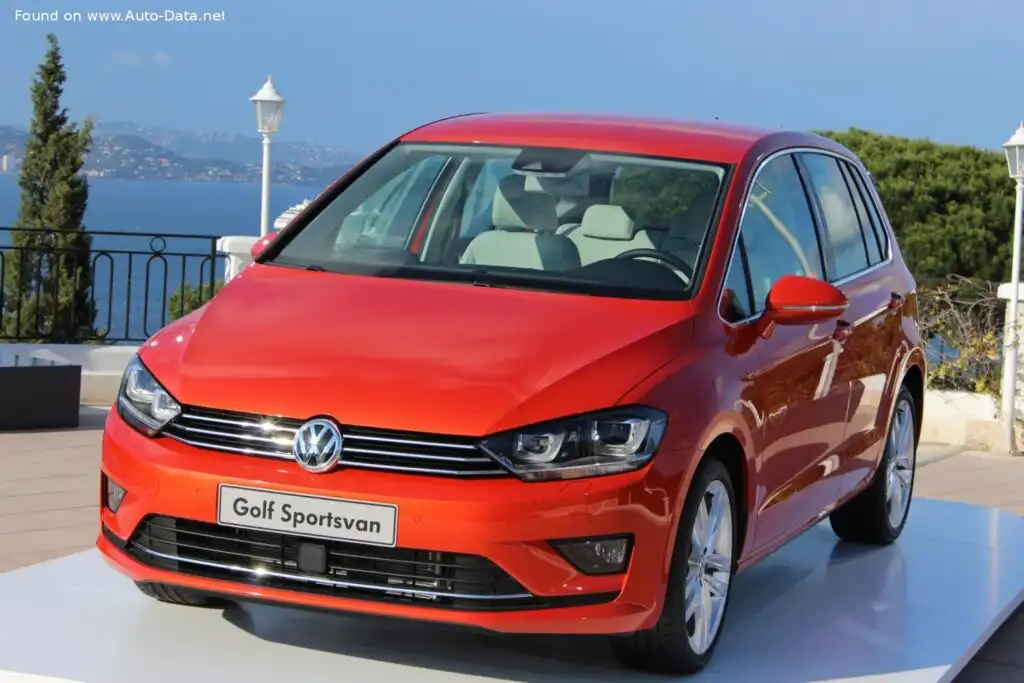
The Golf VII Sportsvan, launched in 2014, was Volkswagen’s response to the increasing popularity of compact MPVs, particularly in the European market. Built upon the versatile Volkswagen Group MQB platform – specifically the A3 variant shared with models like the Audi A3 and SEAT Leon – the Sportsvan aimed to provide a more spacious and practical alternative to the standard Golf hatchback. The 1.4 TSI (150 hp) DSG variant occupied a key position in the Sportsvan lineup, offering a compelling blend of performance, fuel efficiency, and affordability. It sat comfortably between the entry-level 1.2 TSI engine and the more potent 1.8 TSI and 2.0 TDI diesel options.
Powertrain & Engine Architecture
The Golf VII Sportsvan 1.4 TSI DSG is powered by an engine from the EA211 family. The engine code CZDA specifically identifies this version. This 1.4-liter, inline-four cylinder engine employs direct fuel injection and a turbocharger with an intercooler to generate 150 horsepower and 250 Nm (184 lb-ft) of torque. The engine boasts a dual overhead camshaft (DOHC) valvetrain, contributing to its smooth operation and responsive nature. The direct injection system is a critical component, optimizing efficiency and power output by precisely controlling the air-fuel mixture delivered to the combustion chamber.
Paired with the engine is Volkswagen’s highly regarded seven-speed dual-clutch transmission (DSG). This transmission is renowned for its rapid and seamless gear changes, enhancing both performance and fuel economy. The DSG utilizes two clutches, pre-selecting the next gear while the current one is engaged, resulting in minimal interruption to power delivery. The transmission’s programming is calibrated for a balance of comfort and efficiency, prioritizing smooth shifts during normal driving and offering more aggressive shifts when Sport mode is selected.
Driving Characteristics
The 1.4 TSI DSG Sportsvan delivers a comfortable and refined driving experience. While not designed for outright sportiness, the 150 hp engine provides sufficient power for everyday driving scenarios, including highway travel and overtaking maneuvers. Acceleration from 0 to 60 mph takes around 8.4 seconds, with a top speed of 131.73 mph. The DSG transmission contributes to a smooth and responsive feel, and the engine’s torque is readily available from low engine speeds, making it easy to navigate urban traffic. Compared to the less powerful 1.2 TSI, the 1.4 TSI offers a noticeable improvement in performance, especially when carrying passengers or luggage. However, it doesn’t quite match the acceleration of the 1.8 TSI or the robust low-end torque of the 2.0 TDI diesel models.
Equipment & Trim Levels
The Golf VII Sportsvan 1.4 TSI DSG typically came standard with a solid array of features. These generally included air conditioning, power windows, power mirrors, a touchscreen infotainment system with Bluetooth connectivity, and alloy wheels. Higher trim levels, such as Comfortline and Highline, added features like automatic climate control, parking sensors, a navigation system, and upgraded interior upholstery. A range of optional extras were also available, including a panoramic sunroof, adaptive cruise control, and a premium sound system. Interior materials were generally of good quality, consistent with Volkswagen’s reputation for build quality. The Sportsvan’s interior was thoughtfully designed with practicality in mind, offering ample storage compartments and comfortable seating for five occupants.
Chassis & Braking
The Golf VII Sportsvan features a MacPherson strut front suspension and a multi-link rear suspension, providing a comfortable and controlled ride. The suspension tuning prioritizes comfort over sporty handling, but still delivers respectable handling characteristics. The front brakes are ventilated discs, while the rear brakes are solid discs. An anti-lock braking system (ABS) is standard, enhancing braking performance and stability. The Sportsvan’s steering is precise and responsive, making it easy to maneuver in tight spaces.
Market Reception & Comparison
The Golf VII Sportsvan 1.4 TSI DSG was generally well-received by automotive reviewers. It was praised for its spacious interior, comfortable ride quality, and fuel efficiency. Some critics, however, noted that the 1.4 TSI engine could feel somewhat underpowered when the vehicle was fully loaded. Compared to the 1.8 TSI, the 1.4 TSI offered better fuel economy but less overall performance. The 2.0 TDI diesel models provided even greater fuel economy and stronger low-end torque, but came with a higher price point and potential concerns regarding diesel emissions regulations. Fuel economy averaged around 43.6 – 42.8 US mpg combined, making it a relatively economical choice for families.
Legacy
The Volkswagen Golf VII Sportsvan 1.4 TSI DSG has proven to be a reliable and durable vehicle. The EA211 engine is generally considered a robust and long-lasting unit, and the DSG transmission, with regular maintenance, is known for its smooth operation and efficiency. In the used car market, the Sportsvan 1.4 TSI DSG represents a good value proposition, offering a practical and well-equipped vehicle at a reasonable price. Consistent maintenance, including regular oil changes and DSG fluid replacements, is essential for ensuring the long-term reliability of this powertrain. The Sportsvan continues to be a popular choice for buyers seeking a versatile and economical compact MPV.