
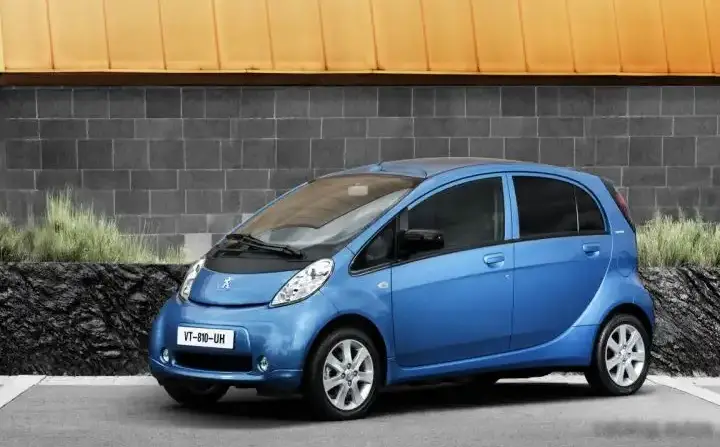
The Peugeot iOn, a fully electric city car, was produced from 2013 to 2020. It represented Peugeot’s initial foray into the burgeoning electric vehicle (EV) market, primarily aimed at European urban commuters. The iOn is essentially a rebadged Mitsubishi i-MiEV, a result of a collaborative venture between Peugeot and Mitsubishi Motors. This 14.5 kWh variant, producing 67 horsepower, served as the sole powertrain option throughout its production run, positioning it as an entry-level EV focused on efficiency and low running costs rather than outright performance. It falls within the supermini segment, competing with other early EVs and conventional small hatchbacks.
Technical Specifications
| Brand | Peugeot |
| Model | iOn |
| Generation | iOn |
| Type (Engine) | 14.5 kWh (67 Hp) |
| Start of production | 2013 |
| End of production | 2020 |
| Powertrain Architecture | BEV (Electric Vehicle) |
| Body type | Hatchback |
| Seats | 4 |
| Doors | 5 |
| Fuel Type | Electricity |
| Acceleration 0 – 100 km/h | 15.9 sec |
| Acceleration 0 – 62 mph | 15.9 sec |
| Acceleration 0 – 60 mph | 15.1 sec |
| Maximum speed | 130 km/h (80.78 mph) |
| Weight-to-power ratio | 15.9 kg/Hp, 62.9 Hp/tonne |
| Weight-to-torque ratio | 5.4 kg/Nm, 184 Nm/tonne |
| Gross battery capacity | 14.5 kWh |
| Battery technology | Lithium-ion (Li-Ion) |
| Battery weight | 221 kg (487.22 lbs) |
| Battery location | Below the floor |
| All-electric range (WLTP) | 100 km (62.14 mi) |
| All-electric range (NEDC) | 150 km (93.21 mi) |
| Average Energy consumption (WLTP) | 17 kWh/100 km (27.36 kWh/100 mi, 123 MPGe, 5.9 km/kWh, 3.7 mi/kWh) |
| Average Energy consumption (NEDC) | 12.6 kWh/100 km (20.28 kWh/100 mi, 166 MPGe, 7.9 km/kWh, 4.9 mi/kWh) |
| Electric motor power | 67 Hp @ 4000-8800 rpm |
| Electric motor Torque | 196 Nm @ 0-300 rpm (144.56 lb.-ft. @ 0-300 rpm) |
| Electric motor model/code | Y51 |
| Maximum revolutions of the electric motor | 9500 rpm |
| Electric motor location | Rear axle, Transverse |
| System power | 67 Hp @ 4000-8800 rpm |
| System torque | 196 Nm @ 0-300 rpm (144.56 lb.-ft. @ 0-300 rpm) |
| Kerb Weight | 1065 kg (2347.92 lbs) |
| Max. weight | 1450 kg (3196.7 lbs) |
| Max load | 385 kg (848.78 lbs) |
| Trunk (boot) space – minimum | 166 l (5.86 cu. ft) |
| Max. roof load | 43 kg (94.8 lbs) |
| Length | 3475 mm (136.81 in) |
| Width | 1475 mm (58.07 in) |
| Width with mirrors folded | 1594 mm (62.76 in) |
| Width including mirrors | 1792 mm (70.55 in) |
| Height | 1608 mm (63.31 in) |
| Wheelbase | 2550 mm (100.39 in) |
| Front track | 1310 mm (51.57 in) |
| Rear (Back) track | 1270 mm (50 in) |
| Front overhang | 500 mm (19.69 in) |
| Rear overhang | 425 mm (16.73 in) |
| Drag coefficient (Cd) | 0.33 |
| Minimum turning circle | 9 m (29.53 ft) |
| Drivetrain Architecture | One electric motor drives the rear wheels |
| Drive wheel | Rear wheel drive |
| Front suspension | Independent type McPherson |
| Rear suspension | Suspension De-Dion |
| Front brakes | Ventilated discs |
| Rear brakes | Drum |
| Assisting systems | ABS (Anti-lock braking system) |
| Steering type | Steering rack and pinion |
| Power steering | Electric Steering |
| Front wheel tires | 145/65 R15 |
| Rear wheel tires | 175/55 R15 |
| Front wheel rims | 4J x 15 |
| Rear wheel rims | 5J x 15 |
Powertrain & Engine Architecture
The Peugeot iOn utilizes a fully electric powertrain centered around a Y51 electric motor. This motor, producing 67 horsepower and 196 Nm (144.56 lb-ft) of torque, is mounted transversely at the rear axle, resulting in a rear-wheel-drive configuration. The motor operates at a relatively high RPM range, peaking at 9500 rpm. Power is delivered instantly, characteristic of electric motors, but limited by the modest output. The 14.5 kWh lithium-ion battery pack is located under the floor, contributing to a low center of gravity. The iOn employs a single-speed reduction gear transmission, typical of EVs, simplifying the drivetrain. The charging port location is not publicly available.
Driving Characteristics
The iOn’s driving experience is defined by its focus on urban usability. Acceleration is understandably slow, taking approximately 15.9 seconds to reach 62 mph. However, the instant torque provides adequate responsiveness for city driving. The single-speed transmission means there are no gear changes, offering a smooth, linear power delivery. The rear-wheel-drive layout provides a slightly different feel compared to front-wheel-drive competitors, but it doesn’t translate to particularly sporty handling. The limited range of around 100 km (62 miles) on the WLTP cycle necessitates careful trip planning. Compared to higher-powered EVs, the iOn prioritizes efficiency over performance.
Equipment & Trim Levels
The Peugeot iOn was relatively sparsely equipped, reflecting its position as an affordable EV. Standard features typically included air conditioning, electric windows, central locking, and an ABS braking system. Interior upholstery was basic, utilizing durable cloth materials. Dashboard design was functional rather than luxurious. Optional extras were limited, often including upgrades to the audio system or the addition of parking sensors. Trim levels were minimal, with most iOns being similarly equipped.
Chassis & Braking
The iOn’s chassis is designed for lightweight efficiency. It features an independent McPherson strut suspension at the front and a De-Dion suspension setup at the rear. The front brakes are ventilated discs, providing adequate stopping power, while the rear brakes are drums, a cost-saving measure. The electric power steering offers light and easy maneuverability, ideal for navigating tight city streets. The relatively small 15-inch wheels and tires contribute to ride comfort, but don’t offer exceptional grip.
Market Reception & Comparison
The Peugeot iOn received mixed reviews upon its release. Critics praised its affordability and environmental credentials but criticized its limited range, slow acceleration, and basic interior. Compared to other EVs available at the time, such as the Nissan Leaf or Renault Zoe, the iOn offered a shorter range and less performance. However, it was often cheaper to purchase. Its fuel economy, expressed as 123 MPGe, was competitive with other EVs, and its reliance on electricity resulted in significantly lower running costs compared to gasoline-powered vehicles.
Legacy
The Peugeot iOn, while not a groundbreaking vehicle, played a significant role in introducing electric mobility to a wider audience. Its relatively low price point made it accessible to consumers who were hesitant to invest in more expensive EVs. The powertrain proved to be reasonably reliable, with few major issues reported. On the used car market, the iOn remains an affordable option for those seeking a short-range city car. However, battery degradation is a concern, as the original 14.5 kWh battery pack may have reduced capacity over time. The iOn paved the way for Peugeot’s subsequent, more advanced electric vehicles, such as the e-208 and e-2008.
