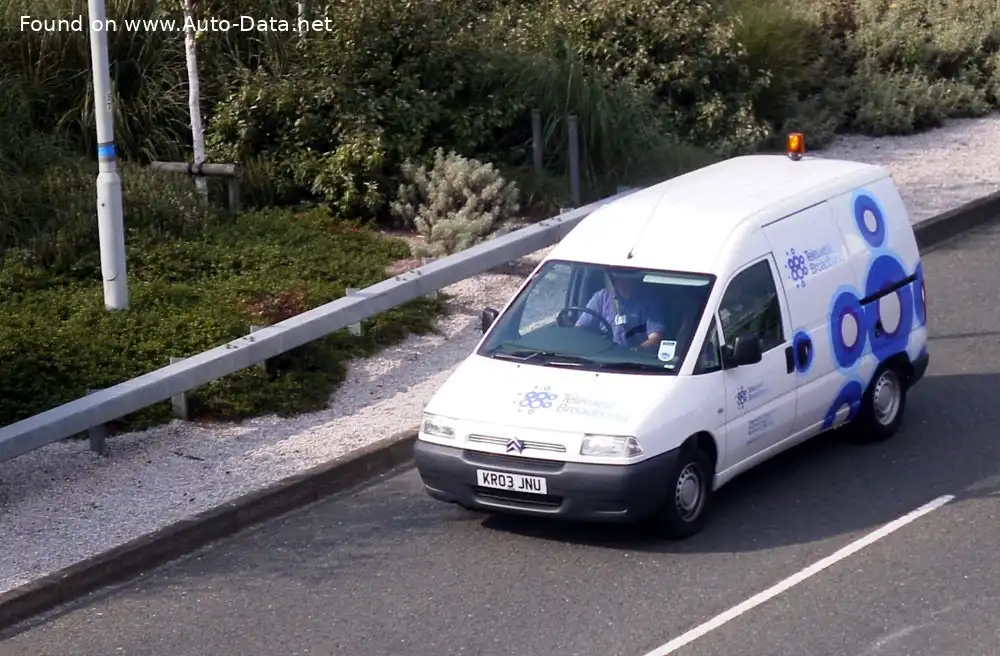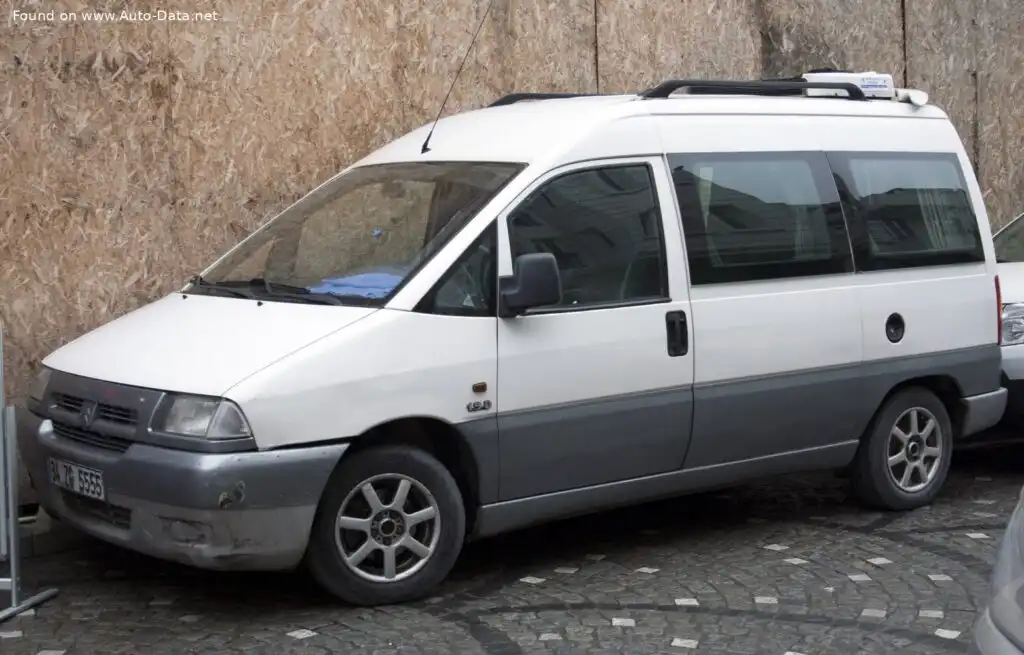
The Citroen Jumpy I, marketed in the United Kingdom as the Dispatch, was a light commercial vehicle and passenger van produced from 1996 to 2000. The 1.6i variant, powered by an 80 horsepower engine, represented the entry-level offering in the Jumpy/Dispatch range. This model aimed to provide an affordable and practical transport solution for both commercial and family use, prioritizing fuel economy and ease of maintenance over outright performance. It was a key component of Citroen’s strategy to compete in the growing European van market, alongside similar offerings from Peugeot, Fiat, and Renault.
Technical Specifications
| Brand | Citroen |
| Model | Jumpy |
| Generation | Jumpy I Dispatch |
| Type (Engine) | 1.6i (80 Hp) |
| Start of production | June, 1996 |
| End of production | May, 2000 |
| Powertrain Architecture | Internal Combustion engine |
| Body type | Minivan |
| Seats | 5-6 |
| Doors | 5 |
| Fuel consumption (urban) | 12.9 l/100 km (18.2 US mpg, 21.9 UK mpg, 7.8 km/l) |
| Fuel consumption (extra urban) | 8.6 l/100 km (27.4 US mpg, 32.8 UK mpg, 11.6 km/l) |
| Fuel consumption (combined) | 10.2 l/100 km (23.1 US mpg, 27.7 UK mpg, 9.8 km/l) |
| Fuel Type | Petrol (Gasoline) |
| Acceleration 0 – 100 km/h | 16.6 sec |
| Acceleration 0 – 62 mph | 16.6 sec |
| Acceleration 0 – 60 mph | 15.8 sec |
| Maximum speed | 148 km/h (91.96 mph) |
| Emission standard | Euro 2 |
| Weight-to-power ratio | 17.3 kg/Hp, 57.8 Hp/tonne |
| Weight-to-torque ratio | 11.1 kg/Nm, 90.3 Nm/tonne |
| Power | 80 Hp @ 5750 rpm |
| Power per litre | 50.6 Hp/l |
| Torque | 125 Nm @ 2750 rpm (92.2 lb.-ft. @ 2750 rpm) |
| Engine layout | Front, Transverse |
| Engine Model/Code | 220A2000 |
| Engine displacement | 1581 cm3 (96.48 cu. in.) |
| Number of cylinders | 4 |
| Engine configuration | Inline |
| Cylinder Bore | 86.4 mm (3.4 in.) |
| Piston Stroke | 67.4 mm (2.65 in.) |
| Compression ratio | 9.2:1 |
| Number of valves per cylinder | 2 |
| Fuel injection system | Single-point injection |
| Engine aspiration | Naturally aspirated engine |
| Valvetrain | SOHC |
| Engine oil capacity | 3.75 l (3.96 US qt | 3.3 UK qt) |
| Coolant | 8.5 l (8.98 US qt | 7.48 UK qt) |
| Kerb Weight | 1385 kg (3053.4 lbs.) |
| Max. weight | 2195 kg (4839.15 lbs.) |
| Max load | 810 kg (1785.74 lbs.) |
| Fuel tank capacity | 80 l (21.13 US gal | 17.6 UK gal) |
| Max. roof load | 150 kg (330.69 lbs.) |
| Permitted trailer load with brakes (8%) | 1600 kg (3527.4 lbs.) |
| Permitted trailer load with brakes (12%) | 1000 kg (2204.62 lbs.) |
| Permitted trailer load without brakes | 730 kg (1609.37 lbs.) |
| Permitted towbar download | 60 kg (132.28 lbs.) |
| Length | 4440 mm (174.8 in.) |
| Width | 1810 mm (71.26 in.) |
| Width including mirrors | 2134 mm (84.02 in.) |
| Height | 1927 mm (75.87 in.) |
| Wheelbase | 2824 mm (111.18 in.) |
| Front track | 1540 mm (60.63 in.) |
| Rear track | 1540 mm (60.63 in.) |
| Front overhang | 846 mm (33.31 in.) |
| Rear overhang | 770 mm (30.31 in.) |
| Minimum turning circle | 12.35 m (40.52 ft.) |
| Drivetrain Architecture | Front wheel drive |
| Number of gears | 5 gears, manual transmission |
| Front suspension | Independent, type McPherson with coil spring and anti-roll bar |
| Rear suspension | Trailing arm, Torsion |
| Front brakes | Ventilated discs |
| Rear brakes | Drum |
| Assisting systems | ABS (Anti-lock braking system) |
| Steering type | Steering rack and pinion |
| Power steering | Hydraulic Steering |
| Tires size | 195/70 R14 |
| Wheel rims size | 6J x 14 |
INTRODUCTION
The Citroen Jumpy I, and its Peugeot Partner/Expert siblings, represented Citroen’s entry into the increasingly popular compact van segment in the mid-1990s. Introduced in June 1996, the Jumpy aimed to offer a versatile and practical vehicle for both commercial and private buyers. The 1.6i 80 hp variant was positioned as the base model, offering a balance of affordability and functionality. It was designed to appeal to customers who prioritized low running costs and ease of use over high performance. The Jumpy I was built on the shared 1HX0 platform, also used by Peugeot and Fiat, allowing for economies of scale and a wider range of available configurations.
Powertrain & Engine Architecture
The heart of the Jumpy 1.6i is the 220A2000 engine, a 1.6-liter inline-four cylinder petrol engine. This engine utilizes a single-point fuel injection system, a relatively simple and cost-effective technology for the time. The engine features a single overhead camshaft (SOHC) valvetrain with two valves per cylinder. Its 9.2:1 compression ratio was typical for naturally aspirated engines of this era. The 80 horsepower output at 5750 rpm and 125 Nm (92.2 lb-ft) of torque at 2750 rpm were modest, but sufficient for everyday driving. The engine’s transverse mounting and front-wheel-drive configuration were standard for vehicles in this class. The Jumpy 1.6i was exclusively offered with a 5-speed manual transmission, designed to maximize fuel efficiency and provide adequate acceleration.
Driving Characteristics
The Jumpy 1.6i’s driving experience was characterized by its practicality rather than its excitement. With 80 horsepower propelling a relatively heavy vehicle, acceleration was slow, taking approximately 16.6 seconds to reach 62 mph (100 km/h). The 5-speed manual transmission helped to keep the engine in its optimal power band, but overtaking maneuvers required careful planning. The gear ratios were tuned for fuel economy, resulting in a somewhat sluggish feel at lower speeds. Compared to the more powerful diesel variants, the 1.6i felt significantly underpowered, especially when fully loaded. However, the light steering and relatively compact dimensions made it easy to maneuver in urban environments.
Equipment & Trim Levels
The 1.6i Jumpy typically came with a basic level of equipment, reflecting its position as the entry-level model. Standard features generally included power steering, a basic audio system, and cloth upholstery. Safety features were limited to an ABS anti-lock braking system. Optional extras included air conditioning, electric windows, and upgraded interior trim. The interior was functional and durable, designed to withstand the rigors of commercial use. The dashboard layout was simple and straightforward, with easy-to-read gauges and controls. The Jumpy offered seating for five to six passengers, depending on the configuration.
Chassis & Braking
The Jumpy 1.6i utilized a McPherson strut independent suspension system at the front, providing a reasonable level of ride comfort. The rear suspension employed a trailing arm torsion beam setup, which was cost-effective and space-efficient. The front brakes were ventilated discs, offering adequate stopping power, while the rear brakes were drums. The ABS system helped to prevent wheel lockup during hard braking. The Jumpy’s chassis was designed to prioritize load-carrying capacity and durability. The relatively narrow tires (195/70 R14) contributed to fuel efficiency but offered limited grip.
Market Reception & Comparison
The Jumpy 1.6i received mixed reviews from automotive critics. While praised for its practicality and affordability, it was often criticized for its lack of power and refinement. Compared to the diesel variants, the 1.6i offered significantly lower fuel economy. However, it was generally considered more reliable and less prone to expensive repairs than the diesel models. The petrol engine was also quieter and smoother than the diesel alternatives. The Jumpy 1.6i competed with other compact vans such as the Renault Kangoo, Peugeot Partner, and Fiat Doblo.
Legacy
The Citroen Jumpy I 1.6i, while not the most powerful or refined van in its class, remains a popular choice among budget-conscious buyers in the used car market. The 220A2000 engine is known for its relative reliability, provided it is properly maintained. Common issues include corrosion, particularly in areas exposed to salt, and wear and tear on suspension components. The Jumpy’s simple design and readily available parts make it relatively easy and inexpensive to repair. Today, these vans are often found being used as work vehicles, camper conversions, or affordable family transport.