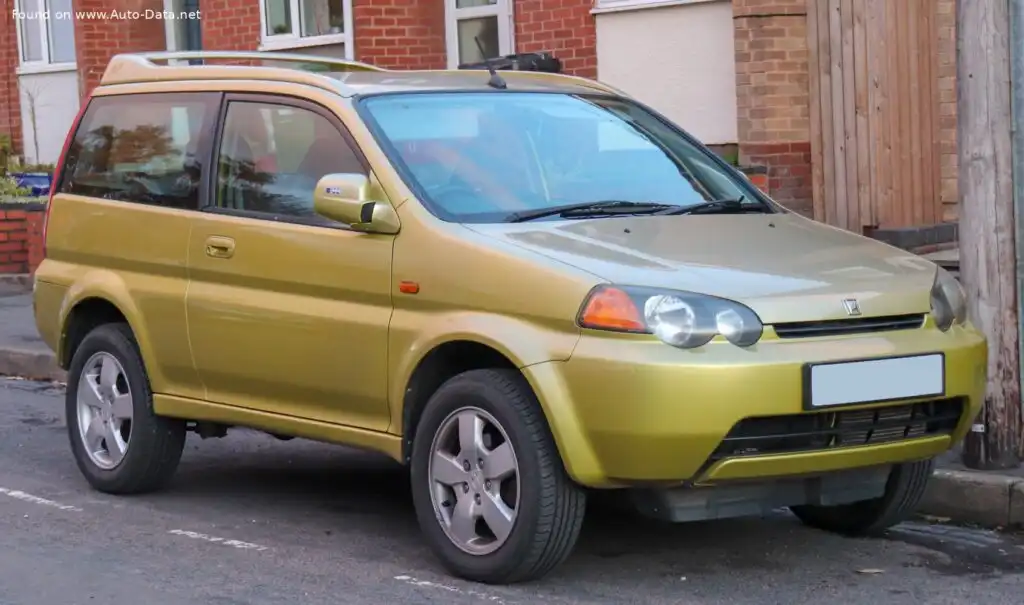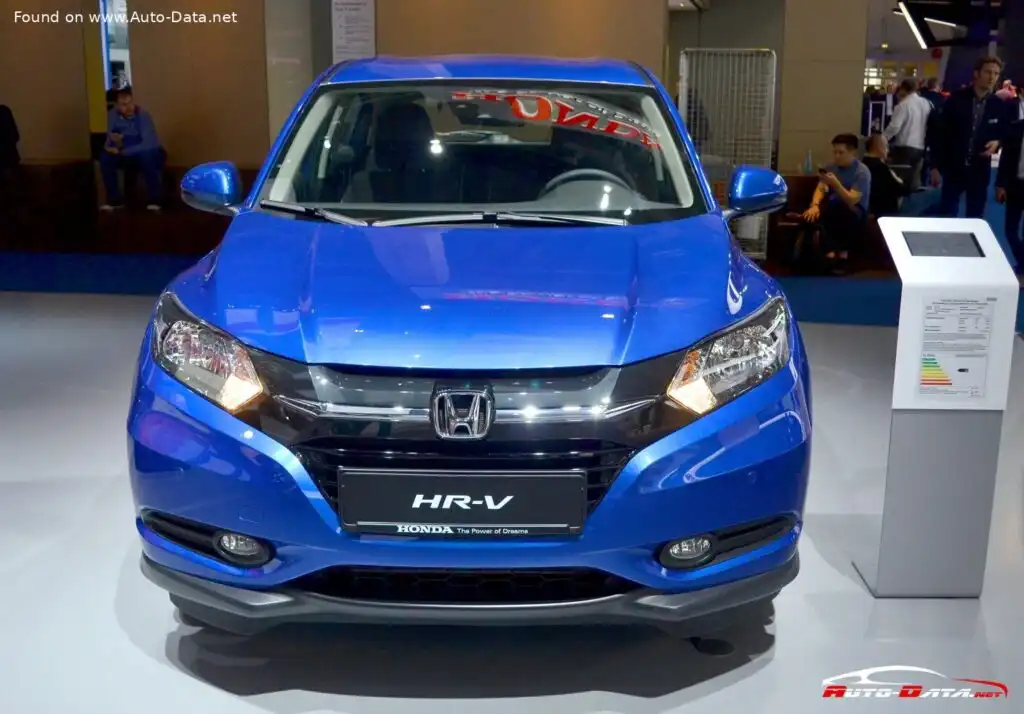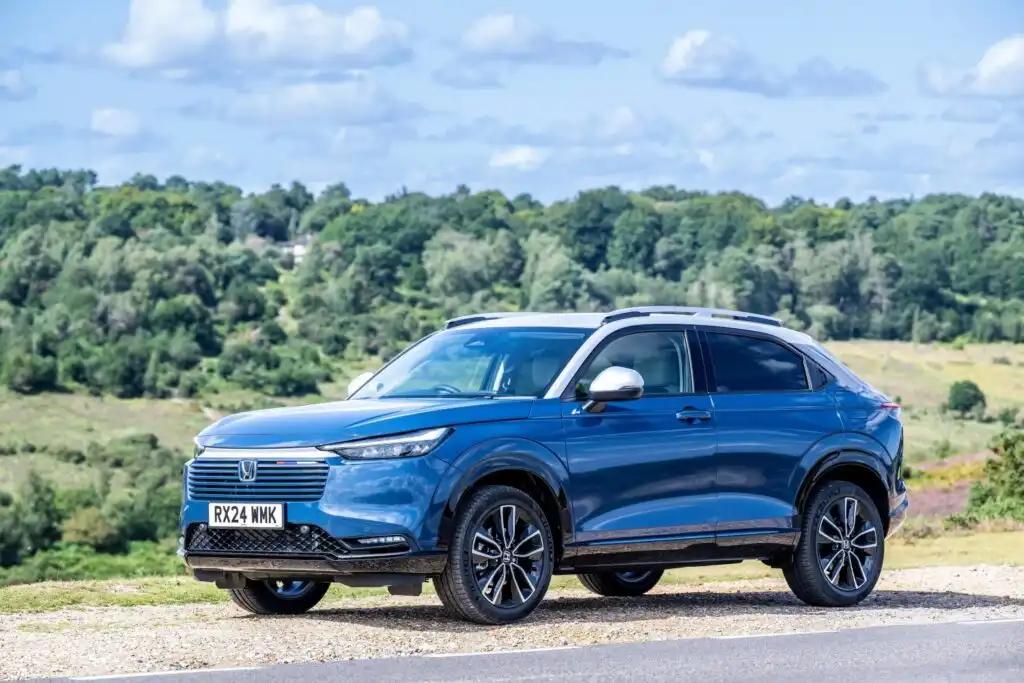
The Honda HR-V III, specifically the 1.5 i-MMD (131 Hp) e:HEV e-CVT variant introduced with the 2024 facelift, represents Honda’s continued commitment to fuel efficiency and hybrid technology within the subcompact crossover segment. Production began in 2024, and this model year marked a significant refresh for the third-generation HR-V (RU series), aligning it more closely with the globally sold model. This particular configuration is positioned as a mid-range offering, balancing performance with Honda’s renowned fuel economy and practicality. It’s primarily targeted towards buyers seeking a versatile, efficient, and technologically advanced small SUV for urban and suburban driving.
Technical Specifications
| Brand | Honda |
| Model | HR-V |
| Generation | HR-V III (facelift 2024) |
| Type (Engine) | 1.5 i-MMD (131 Hp) e:HEV e-CVT |
| Start of production | 2024 |
| Powertrain Architecture | FHEV (Full Hybrid Electric Vehicle) |
| Body type | SUV, Crossover |
| Seats | 5 |
| Doors | 5 |
| Fuel consumption at Low speed (WLTP) | 4.6 l/100 km (51.1 US mpg, 61.4 UK mpg, 21.7 km/l) |
| Fuel consumption at Medium speed (WLTP) | 4.1 l/100 km (57.4 US mpg, 68.9 UK mpg, 24.4 km/l) |
| Fuel consumption at high speed (WLTP) | 4.6 l/100 km (51.1 US mpg, 61.4 UK mpg, 21.7 km/l) |
| Fuel consumption at very high speed (WLTP) | 7.1 l/100 km (33.1 US mpg, 39.8 UK mpg, 14.1 km/l) |
| Combined fuel consumption (WLTP) | 5.4 l/100 km (43.6 US mpg, 52.3 UK mpg, 18.5 km/l) |
| CO2 emissions (WLTP) | 122 g/km |
| Fuel Type | Petrol (Gasoline) |
| Acceleration 0 – 100 km/h | 10.6 sec |
| Acceleration 0 – 62 mph | 10.6 sec |
| Acceleration 0 – 60 mph | 10.1 sec |
| Maximum speed | 170 km/h (105.63 mph) |
| Emission standard | Euro 6e |
| Weight-to-power ratio | 10.5 kg/Hp, 94.9 Hp/tonne |
| Weight-to-torque ratio | 10.5 kg/Nm, 94.9 Nm/tonne |
| Battery technology | Lithium-ion (Li-Ion) |
| Battery location | Under the trunk |
| Electric motor power | 131 Hp |
| Electric motor Torque | 253 Nm (186.6 lb.-ft.) |
| Electric motor location | Integrated into the transmission |
| System power | 131 Hp |
| Power | 107 Hp @ 6000-6400 rpm (71.4 Hp/l) |
| Torque | 131 Nm @ 4500-5000 rpm (96.62 lb.-ft. @ 4500-5000 rpm) |
| Engine layout | Front, Transverse |
| Engine displacement | 1498 cm3 (91.41 cu. in.) |
| Number of cylinders | 4 |
| Engine configuration | Inline |
| Cylinder Bore | 73 mm (2.87 in.) |
| Piston Stroke | 89.5 mm (3.52 in.) |
| Compression ratio | 13.5:1 |
| Number of valves per cylinder | 4 |
| Fuel injection system | Multi-port manifold injection |
| Engine aspiration | Naturally aspirated engine |
| Valvetrain | DOHC, i-VTEC |
| Kerb Weight | 1380-1415 kg (3042.38 – 3119.54 lbs.) |
| Max. weight | 1870 kg (4122.64 lbs.) |
| Max load | 455-490 kg (1003.1 – 1080.27 lbs.) |
| Trunk (boot) space – minimum | 304 l (10.74 cu. ft.) |
| Trunk (boot) space – maximum | 1305 l (46.09 cu. ft.) |
| Fuel tank capacity | 40 l (10.57 US gal | 8.8 UK gal) |
| Max. roof load | 50 kg (110.23 lbs.) |
| Length | 4355 mm (171.46 in.) |
| Width | 1790 mm (70.47 in.) |
| Width with mirrors folded | 1866 mm (73.46 in.) |
| Width including mirrors | 2028 mm (79.84 in.) |
| Height | 1582 mm (62.28 in.) |
| Wheelbase | 2610 mm (102.76 in.) |
| Front track | 1535 mm (60.43 in.) |
| Rear (Back) track | 1540 mm (60.63 in.) |
| Ride height (ground clearance) | 188 mm (7.4 in.) |
| Minimum turning circle (turning diameter) | 11.3 m (37.07 ft.) |
| Drivetrain Architecture | The Internal combustion engine (ICE) and electric motor drive the front wheels of the car with the ability to work in full electric or mixed mode. |
| Drive wheel | Front wheel drive |
| Number of gears and type of gearbox | automatic transmission e-CVT |
| Front suspension | Independent, type McPherson with coil spring and anti-roll bar |
| Rear suspension | Semi-independent, coil spring |
| Front brakes | Ventilated discs |
| Rear brakes | Disc |
| Assisting systems | ABS (Anti-lock braking system) |
| Steering type | Steering rack and pinion |
| Power steering | Electric Steering |
| Tires size | 225/50 R18 |
| Wheel rims size | 7.5J x 18 |
Powertrain & Engine Architecture
The heart of the HR-V 1.5 i-MMD e:HEV is Honda’s 1.5-liter inline-four cylinder engine, designated as part of the i-MMD (Intelligent Multi-Mode Drive) hybrid system. This engine, producing 107 horsepower at 6000-6400 rpm and 131 Nm (96.62 lb-ft) of torque, is coupled with an electric motor that contributes an additional 131 horsepower and 253 Nm (186.6 lb-ft) of torque. The i-MMD system is a series-parallel hybrid, meaning it can operate in EV mode, hybrid mode, or engine drive mode, seamlessly switching between them for optimal efficiency. The engine utilizes multi-point fuel injection and a DOHC i-VTEC valvetrain for improved combustion efficiency and power delivery. The e-CVT (electronic continuously variable transmission) isn’t a traditional CVT with belts and pulleys; instead, it’s a single-speed gearbox with a planetary gearset that allows the electric motor to act as a generator and provide seamless power transitions.
Driving Characteristics
The 1.5 i-MMD e-CVT HR-V offers a distinctly different driving experience compared to versions equipped with a traditional automatic transmission or higher-output engines. Acceleration from 0-60 mph takes approximately 10.1 seconds, and 0-100 km/h in 10.6 seconds. While not particularly sporty, the instant torque from the electric motor provides brisk acceleration from a standstill and during overtaking maneuvers. The e-CVT provides a smooth, linear power delivery, lacking the stepped gear changes of a conventional automatic. The system prioritizes fuel efficiency, and the engine often operates at optimal RPMs, sometimes sounding and feeling disconnected from the vehicle’s speed. The focus is on refinement and ease of driving, making it well-suited for city commuting and highway cruising.
Equipment & Trim Levels
The 1.5 i-MMD e:HEV trim typically includes standard features such as Honda Sensing suite of safety and driver-assistance technologies (including adaptive cruise control, lane keeping assist, and collision mitigation braking system), a 7-inch touchscreen infotainment system with Apple CarPlay and Android Auto compatibility, automatic climate control, and LED headlights. Interior upholstery is generally cloth, with options for leather upgrades. Higher trim levels within the e:HEV range may add features like a larger touchscreen, premium audio system, heated front seats, and a power tailgate.
Chassis & Braking
The HR-V utilizes a front-wheel-drive configuration with an independent McPherson strut suspension in the front and a semi-independent torsion beam suspension in the rear. The front suspension incorporates a stabilizer bar to reduce body roll. Braking duties are handled by ventilated discs at the front and solid discs at the rear. ABS (Anti-lock Braking System) is standard. The suspension tuning is geared towards comfort and ride quality, prioritizing a smooth and controlled driving experience over sporty handling.
Market Reception & Comparison
The 2024 HR-V 1.5 i-MMD e:HEV was generally well-received by automotive critics for its fuel efficiency, comfortable ride, and advanced technology. However, some reviewers noted the lack of outright performance and the somewhat disconnected feel of the e-CVT. Compared to other trims in the HR-V lineup, the e:HEV offers superior fuel economy but slightly less spirited acceleration. Against competitors like the Toyota Corolla Cross Hybrid and Kia Niro, the HR-V e:HEV holds its own in terms of fuel efficiency and features, offering a compelling value proposition.
Legacy
Honda’s i-MMD hybrid system has proven to be relatively reliable, with few widespread issues reported. The 1.5-liter engine is known for its durability and longevity. On the used car market, the HR-V 1.5 i-MMD e:HEV is expected to hold its value well due to its fuel efficiency and the growing demand for hybrid vehicles. Regular maintenance, including oil changes and hybrid system checks, will be crucial for ensuring the long-term reliability of this powertrain.