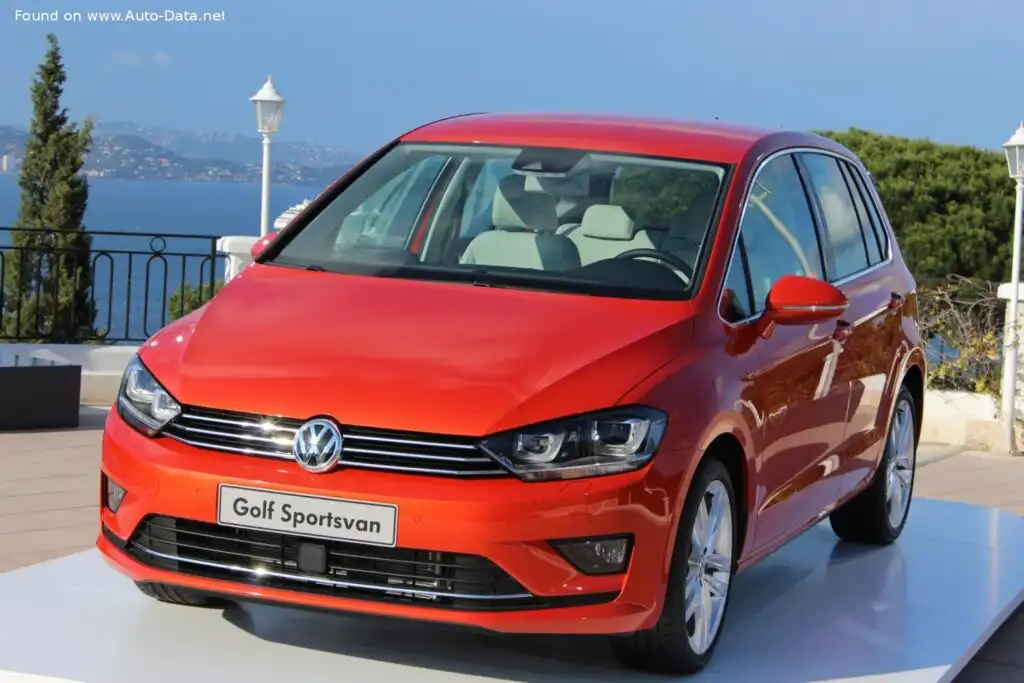
The Volkswagen Golf VII Sportsvan 2.0 TDI, producing 150 horsepower, was a key variant within the broader Golf VII Sportsvan lineup, manufactured between April 2014 and 2017. Positioned as a mid-range offering, it aimed to balance fuel efficiency with respectable performance in the compact MPV (Multi-Purpose Vehicle) segment. The Sportsvan, essentially a Golf-based minivan, was primarily marketed in Europe as a practical and versatile family vehicle, offering increased interior space compared to the standard Golf hatchback while maintaining a relatively compact footprint. This particular 2.0 TDI engine represented a step up in power and torque from the lower-displacement diesel options available, targeting buyers who frequently carried passengers or cargo and occasionally undertook longer journeys.
Technical Specifications
| Brand | Volkswagen |
| Model | Golf |
| Generation | Golf VII Sportsvan |
| Type (Engine) | 2.0 TDI (150 Hp) |
| Start of production | April, 2014 |
| End of production | 2017 |
| Powertrain Architecture | Internal Combustion engine |
| Body type | Minivan |
| Seats | 5 |
| Doors | 5 |
| Fuel consumption (urban) | 5.1 l/100 km (46.1 US mpg) |
| Fuel consumption (extra urban) | 3.9-4.0 l/100 km (60.3 – 58.8 US mpg) |
| Fuel consumption (combined) | 4.3-4.4 l/100 km (54.7 – 53.5 US mpg) |
| CO2 emissions | 112-115 g/km |
| Fuel Type | Diesel |
| Acceleration 0 – 100 km/h | 9.2 sec |
| Acceleration 0 – 62 mph | 9.2 sec |
| Acceleration 0 – 60 mph | 8.7 sec |
| Maximum speed | 212 km/h (131.73 mph) |
| Weight-to-power ratio | 9.8 kg/Hp |
| Weight-to-torque ratio | 4.3 kg/Nm |
| Power | 150 Hp @ 3500-4000 rpm |
| Torque | 340 Nm @ 1750-3000 rpm (250.77 lb.-ft.) |
| Engine layout | Front, Transverse |
| Engine Model/Code | CRLB, DCYA, DFGA |
| Engine displacement | 1968 cm3 (120.09 cu. in.) |
| Number of cylinders | 4 |
| Engine configuration | Inline |
| Fuel injection system | Diesel Commonrail |
| Engine aspiration | Turbocharger, Intercooler |
| Valvetrain | DOHC |
| Engine oil capacity | 4.7 l (4.97 US qt | 4.14 UK qt) |
| Kerb Weight | 1474 kg (3249.61 lbs.) |
| Max. weight | 1970 kg (4343.11 lbs.) |
| Max load | 496 kg (1093.49 lbs.) |
| Trunk (boot) space – minimum | 500 l (17.66 cu. ft.) |
| Trunk (boot) space – maximum | 1520 l (53.68 cu. ft.) |
| Fuel tank capacity | 50 l (13.21 US gal | 11 UK gal) |
| Length | 4338 mm (170.79 in.) |
| Width | 1807 mm (71.14 in.) |
| Height | 1578 mm (62.13 in.) |
| Wheelbase | 2685 mm (105.71 in.) |
| Front track | 1543 mm (60.75 in.) |
| Rear (Back) track | 1514 mm (59.61 in.) |
| Minimum turning circle | 11.1 m (36.42 ft.) |
| Drivetrain Architecture | Front wheel drive |
| Number of gears | 6 gears, manual transmission |
| Front brakes | Ventilated discs |
| Rear brakes | Disc |
| Assisting systems | ABS (Anti-lock braking system) |
| Steering type | Steering rack and pinion |
Powertrain & Engine Architecture
The heart of the Golf VII Sportsvan 2.0 TDI was the Volkswagen Group’s EA188 series of diesel engines. Specifically, this variant utilized engine codes CRLB, DCYA, or DFGA, depending on the exact production year and market. These engines were common across various Volkswagen, Audi, SEAT, and Skoda models. The 2.0-liter inline-four cylinder engine featured a cast iron block and aluminum cylinder head, employing a common rail direct injection system. This system, operating at extremely high pressures, allowed for precise fuel delivery and optimized combustion. The engine also incorporated a turbocharger with an intercooler to increase air density and boost power output. The valvetrain was a dual overhead camshaft (DOHC) design with four valves per cylinder, contributing to efficient gas exchange. The six-speed manual transmission was the standard offering, providing a balance between fuel economy and driver engagement. While a dual-clutch transmission (DSG) was available as an option, the manual was more common in this trim level.
Driving Characteristics
The 150 hp 2.0 TDI engine in the Golf Sportsvan delivered a noticeable improvement in performance compared to the smaller 1.6 TDI engine. While not a sports car, it provided ample power for everyday driving, including highway overtaking and carrying a full load of passengers and luggage. The maximum torque of 340 Nm (250.77 lb-ft) available from 1750-3000 rpm meant that strong acceleration was readily accessible without needing to rev the engine excessively. The six-speed manual transmission was well-matched to the engine’s characteristics, offering smooth gear changes and a reasonable spread of ratios. Compared to the higher-output 2.0 TDI variants (often exceeding 180 hp), this version prioritized fuel economy and refinement over outright performance. The manual transmission also offered a more engaging driving experience than the optional DSG, although it required more driver involvement.
Equipment & Trim Levels
The Golf VII Sportsvan 2.0 TDI typically came equipped with a respectable level of standard features. These included air conditioning, power windows, power mirrors, a multi-function steering wheel, and an infotainment system with a touchscreen display. Safety features such as ABS, electronic stability control, and multiple airbags were also standard. Interior upholstery was typically cloth, although leather options were available. Higher trim levels offered additional features such as automatic climate control, parking sensors, a navigation system, and upgraded audio systems. Optional extras included panoramic sunroof, adaptive cruise control, and various driver assistance systems.
Chassis & Braking
The Golf Sportsvan utilized a MacPherson strut front suspension and a multi-link rear suspension, providing a comfortable and controlled ride. The suspension was tuned to prioritize comfort and stability, rather than outright sportiness. The braking system consisted of ventilated discs on the front wheels and solid discs on the rear. ABS (Anti-lock Braking System) was standard, enhancing braking performance and safety. Stabilizer bars were fitted to both the front and rear axles to reduce body roll during cornering. The chassis was reinforced to accommodate the increased weight and dimensions of the Sportsvan compared to the standard Golf hatchback.
Market Reception & Comparison
The Golf VII Sportsvan 2.0 TDI was generally well-received by automotive critics. It was praised for its practicality, fuel efficiency, and comfortable ride. However, some reviewers noted that the interior, while functional, lacked the premium feel of some competitors. Compared to other compact MPVs, the Golf Sportsvan offered a more engaging driving experience and a higher level of build quality. In terms of fuel economy, the 2.0 TDI variant offered a good balance between performance and efficiency, typically achieving combined fuel consumption figures of around 4.3-4.4 l/100 km (54.7 – 53.5 US mpg). Compared to the 1.6 TDI version, the 2.0 TDI offered significantly more power and torque, but at the expense of slightly higher fuel consumption.
Legacy
The Volkswagen Golf VII Sportsvan 2.0 TDI has proven to be a relatively reliable vehicle in the used car market. The EA188 diesel engine, while subject to some controversy regarding emissions, is generally robust and capable of high mileage with proper maintenance. Common issues include turbocharger wear, injector problems, and occasional issues with the dual-mass flywheel. However, these issues are typically addressable with routine servicing and preventative maintenance. Today, the Golf Sportsvan 2.0 TDI remains a popular choice for buyers seeking a practical, fuel-efficient, and well-built compact MPV.