
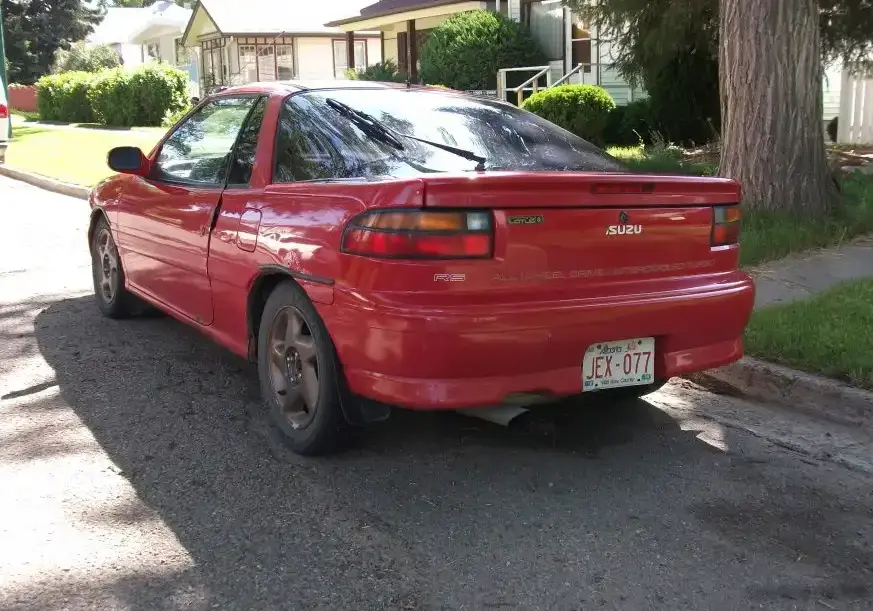
The Isuzu Impulse Coupe 1.6i Automatic, produced between 1990 and 1995, represented a foray into the sporty coupe market for the Japanese automaker. Positioned as an entry-level offering within the second-generation Impulse range (known internally as the FJ series), this variant aimed to provide affordable style and reasonable performance. It was primarily sold in North America and Japan, where Isuzu sought to establish a stronger presence with vehicles that appealed to a younger demographic. The 1.6i Automatic occupied the lower end of the Impulse lineup, below the more powerful and technologically advanced turbocharged models, and served as a more accessible alternative to competitors like the Honda Civic Coupe and Toyota Celica.
Technical Specifications
| Brand | Isuzu |
| Model | Impulse |
| Generation | Impulse Coupe |
| Type (Engine) | 1.6 i (130 Hp) Automatic |
| Start of production | 1990 |
| End of production | 1995 |
| Powertrain Architecture | Internal Combustion engine |
| Body type | Coupe |
| Seats | 4 |
| Doors | 2 |
| Fuel consumption (urban) | 13 l/100 km (18.1 US mpg, 21.7 UK mpg) |
| Fuel consumption (extra urban) | 8 l/100 km (29.4 US mpg, 35.3 UK mpg) |
| Fuel Type | Petrol (Gasoline) |
| Maximum speed | 200 km/h (124.27 mph) |
| Weight-to-power ratio | 7.8 kg/Hp |
| Weight-to-torque ratio | 7.3 kg/Nm |
| Power | 130 Hp @ 7000 rpm |
| Power per litre | 81.9 Hp/l |
| Torque | 138 Nm @ 5800 rpm (101.78 lb.-ft. @ 5800 rpm) |
| Engine layout | Front, Transverse |
| Engine displacement | 1588 cm3 (96.91 cu. in.) |
| Number of cylinders | 4 |
| Engine configuration | Inline |
| Cylinder Bore | 80 mm (3.15 in.) |
| Piston Stroke | 79 mm (3.11 in.) |
| Compression ratio | 9.8:1 |
| Number of valves per cylinder | 4 |
| Fuel injection system | Multi-port manifold injection |
| Engine aspiration | Naturally aspirated |
| Kerb Weight | 1010 kg (2226.67 lbs.) |
| Trunk (boot) space – minimum | 310 l (10.95 cu. ft.) |
| Trunk (boot) space – maximum | 620 l (21.9 cu. ft.) |
| Fuel tank capacity | 47 l (12.42 US gal | 10.34 UK gal) |
| Length | 4150 mm (163.39 in.) |
| Width | 1695 mm (66.73 in.) |
| Height | 1300 mm (51.18 in.) |
| Wheelbase | 2450 mm (96.46 in.) |
| Front track | 1430 mm (56.3 in.) |
| Rear track | 1405 mm (55.31 in.) |
| Drivetrain Architecture | Front wheel drive |
| Number of gears | 4 |
| Gearbox type | Automatic transmission |
| Front suspension | Coil spring |
| Rear suspension | Coil spring |
| Front brakes | Ventilated discs |
| Rear brakes | Drum |
| Assisting systems | ABS (Anti-lock braking system) |
| Steering type | Steering rack and pinion |
| Power steering | Hydraulic |
| Tires size | 205/50 VR15 |
| Wheel rims size | 15 |
Powertrain & Engine Architecture
The heart of the Impulse 1.6i Automatic was the 4G62 engine, a 1.6-liter inline-four cylinder powerplant. This engine utilized a multi-port fuel injection system, which improved fuel efficiency and throttle response compared to earlier carbureted designs. The engine featured a single overhead camshaft (SOHC) valvetrain with four valves per cylinder, contributing to its respectable power output for its displacement. The 4G62 produced 130 horsepower at 7000 rpm and 138 Nm (101.78 lb-ft) of torque at 5800 rpm. The engine’s relatively high compression ratio of 9.8:1 helped maximize efficiency. Paired with the engine was a four-speed automatic transmission, designed for smooth and convenient operation. This transmission wasn’t known for its sportiness, prioritizing comfort and ease of use over aggressive shifting.
Driving Characteristics
The 1.6i Automatic offered a comfortable, but not particularly exhilarating, driving experience. The automatic transmission, while smooth, resulted in noticeable power loss compared to the available five-speed manual transmission. Acceleration was adequate for everyday driving, but overtaking maneuvers required careful planning. The gear ratios were tuned for fuel economy rather than performance, meaning the engine often felt strained when pushed hard. The front-wheel-drive configuration provided predictable handling, but lacked the dynamic capabilities of the turbocharged and all-wheel-drive Impulse variants. Compared to the more potent 1.8L or turbocharged models, the 1.6i Automatic felt noticeably slower and less responsive.
Equipment & Trim Levels
The 1.6i Automatic typically came with a fairly basic level of equipment. Standard features generally included power steering, air conditioning, and an AM/FM stereo. Interior upholstery was typically cloth, and the dashboard featured a simple, functional design. Optional extras included power windows, power locks, and a sunroof. The trim level was generally considered the base model, offering a no-frills approach to coupe ownership. The focus was on providing an affordable and reliable vehicle, rather than a luxurious one.
Chassis & Braking
The Impulse Coupe utilized a relatively simple chassis design. Front suspension consisted of coil springs and MacPherson struts, while the rear featured a coil spring and torsion beam setup. Braking duties were handled by ventilated discs at the front and drum brakes at the rear. An Anti-lock Braking System (ABS) was included as standard equipment, enhancing safety. The suspension was tuned for comfort, providing a relatively soft ride quality. Stabilizer bars were present, but were relatively thin compared to those found on the higher-performance models.
Market Reception & Comparison
The Isuzu Impulse 1.6i Automatic received mixed reviews from automotive critics. While praised for its styling and affordability, it was often criticized for its lack of performance and the somewhat unrefined nature of the automatic transmission. Fuel economy was considered average for the time. Compared to the more powerful Impulse variants, the 1.6i Automatic offered significantly less excitement, but at a lower price point. The 1.8L manual transmission version offered a better balance of performance and price, making it a more popular choice among enthusiasts. Reliability was generally good, although the automatic transmission could be prone to issues if not properly maintained.
Legacy
Today, the Isuzu Impulse Coupe 1.6i Automatic is a relatively rare sight on the roads. While not highly sought after by collectors, well-maintained examples are gaining a following among enthusiasts who appreciate their affordability and retro styling. The 4G62 engine is known for its durability, and with proper maintenance, can provide many years of reliable service. Parts availability can be a challenge, but many components are interchangeable with other Mitsubishi and Isuzu models. The 1.6i Automatic represents a unique chapter in Isuzu’s history, showcasing the brand’s attempt to capture a share of the competitive coupe market.
