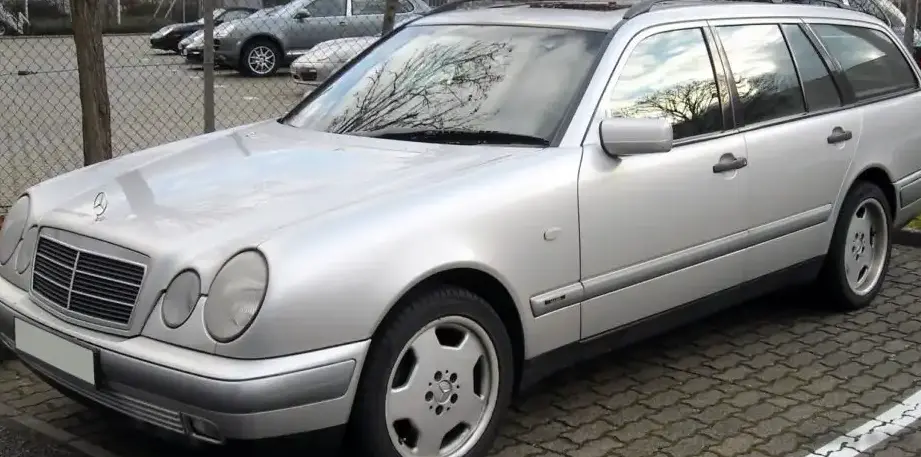
The Mercedes-Benz E-Class T-modell (S210) E 290 Turbodiesel, produced from December 1995 to July 1999, represented a compelling blend of practicality and performance within the mid-size executive wagon segment. Positioned as a more economical and torque-rich alternative to the gasoline-powered E-Class variants, the E 290 Turbodiesel catered to buyers prioritizing fuel efficiency and long-distance cruising capability. It was a key offering in the S210 series, which marked Mercedes-Benz’s continued commitment to the station wagon body style, offering a premium alternative to SUVs gaining popularity at the time. This model occupied a middle ground in the E-Class T-modell lineup, offering a step up in performance and refinement from the base diesel models while remaining more accessible than the higher-specification E 320 or E 420.
Technical Specifications
| Brand | Mercedes-Benz |
| Model | E-class |
| Generation | E-class T-modell (S210) |
| Type (Engine) | E 290 Turbodiesel (129 Hp) |
| Start of production | December, 1995 |
| End of production | July, 1999 |
| Powertrain Architecture | Internal Combustion engine |
| Body type | Station wagon (estate) |
| Seats | 5 |
| Doors | 5 |
| Fuel consumption (urban) | 7.4 l/100 km (31.8 US mpg) |
| Fuel consumption (extra urban) | 5 l/100 km (47 US mpg) |
| Fuel Type | Diesel |
| Acceleration 0 – 100 km/h | 12.2 sec |
| Acceleration 0 – 62 mph | 12.2 sec |
| Acceleration 0 – 60 mph | 11.6 sec |
| Maximum speed | 190 km/h (118.06 mph) |
| Weight-to-power ratio | 12.8 kg/Hp |
| Weight-to-torque ratio | 5.5 kg/Nm |
| Power | 129 Hp @ 4000 rpm |
| Power per litre | 44.9 Hp/l |
| Torque | 300 Nm @ 1800 rpm (221.27 lb.-ft. @ 1800 rpm) |
| Engine layout | Front, Longitudinal |
| Engine Model/Code | OM 602 DE 29 LA / 602.982 |
| Engine displacement | 2874 cm3 (175.38 cu. in.) |
| Number of cylinders | 5 |
| Engine configuration | Inline |
| Cylinder Bore | 89 mm (3.5 in.) |
| Piston Stroke | 92.4 mm (3.64 in.) |
| Compression ratio | 22:1 |
| Number of valves per cylinder | 2 |
| Fuel injection system | Precombustion chamber injection |
| Engine aspiration | Turbocharger, Intercooler |
| Valvetrain | SOHC |
| Engine oil capacity | 7 l (7.4 US qt | 6.16 UK qt) |
| Coolant | 9.5 l (10.04 US qt | 8.36 UK qt) |
| Kerb Weight | 1650 kg (3637.63 lbs.) |
| Max. weight | 2230 kg (4916.31 lbs.) |
| Max load | 580 kg (1278.68 lbs.) |
| Trunk (boot) space – minimum | 600 l (21.19 cu. ft.) |
| Trunk (boot) space – maximum | 1975 l (69.75 cu. ft.) |
| Fuel tank capacity | 70 l (18.49 US gal | 15.4 UK gal) |
| Length | 4816 mm (189.61 in.) |
| Width | 1799 mm (70.83 in.) |
| Height | 1505 mm (59.25 in.) |
| Wheelbase | 2833 mm (111.54 in.) |
| Front track | 1542 mm (60.71 in.) |
| Rear (Back) track | 1546 mm (60.87 in.) |
| Drivetrain Architecture | Rear wheel drive |
| Number of gears | 5 |
| Type of gearbox | Manual transmission |
| Front suspension | Double wishbone |
| Rear suspension | Hydro-pneumatic element, Independent multi-link suspension |
| Front brakes | Ventilated discs |
| Rear brakes | Disc |
| Assisting systems | ABS (Anti-lock braking system) |
| Steering type | Steering rack and pinion |
| Power steering | Hydraulic Steering |
| Tires size | 205/60 R15 |
| Wheel rims size | 7J x 15 |
Powertrain & Engine Architecture
The heart of the E 290 Turbodiesel was the OM 602 DE 29 LA engine, a 2.9-liter inline-five cylinder diesel. This engine utilized precombustion chamber injection, a system common in Mercedes-Benz diesels of the era, known for its relatively quiet operation and good combustion efficiency. A turbocharger with an intercooler was employed to boost power output to 129 horsepower at 4000 rpm and 300 Nm (221 lb-ft) of torque at a low 1800 rpm. This torque peak, delivered early in the rev range, was a defining characteristic of the engine. The engine featured a single overhead camshaft (SOHC) valvetrain with two valves per cylinder. The five-speed manual transmission was the standard offering, providing a good balance between fuel economy and drivability. While an automatic transmission was available, it was less common and often perceived as diminishing the engine’s responsiveness.
Driving Characteristics
The E 290 Turbodiesel offered a distinctly different driving experience compared to its gasoline counterparts. Acceleration was respectable, with a 0-60 mph time of around 11.6 seconds, but the focus was on effortless cruising and strong mid-range pull. The high torque output meant that overtaking maneuvers were easily accomplished without needing to downshift. The manual transmission, while not sporty, was precise and well-matched to the engine’s characteristics. Compared to the more powerful E 320 or E 420 models, the E 290 Turbodiesel felt less urgent, but it offered significantly better fuel economy. The ride quality, typical of Mercedes-Benz, was comfortable and composed, even on less-than-perfect road surfaces.
Equipment & Trim Levels
The E 290 Turbodiesel T-modell typically came equipped with a solid base level of features, reflecting its position as a premium vehicle. Standard equipment included power windows, central locking, air conditioning, and an AM/FM radio. Interior upholstery was typically cloth, although leather was available as an option. Optional extras included a sunroof, upgraded audio systems, and automatic climate control. The dashboard layout was typical of the S210 series, characterized by a functional and understated design. Wood trim was often included to enhance the interior ambiance.
Chassis & Braking
The S210 E-Class featured a robust chassis with double wishbone suspension at the front and an independent multi-link hydro-pneumatic suspension at the rear. This suspension setup provided a comfortable ride and good handling characteristics. Brakes were ventilated discs at the front and solid discs at the rear, with ABS (Anti-lock Braking System) as standard. The steering was a rack and pinion system with hydraulic power assistance, offering precise and responsive control. The E 290 Turbodiesel’s weight of approximately 1650 kg (3637 lbs) was relatively moderate for a wagon of its size, contributing to its balanced handling.
Market Reception & Comparison
The E 290 Turbodiesel T-modell was generally well-received by automotive critics. It was praised for its fuel efficiency, comfortable ride, and spacious interior. However, some reviewers noted that the engine could be somewhat noisy compared to gasoline engines, and the acceleration was not particularly brisk. Compared to other diesel wagons of the time, the E 290 Turbodiesel offered a more refined and luxurious experience. Against its gasoline siblings, it represented a more economical choice, albeit with a trade-off in performance. Its fuel economy, averaging around 32-47 mpg, was a significant selling point for buyers covering long distances.
Legacy
The OM 602 engine family, including the 2.9-liter variant found in the E 290 Turbodiesel, is known for its durability and longevity. With proper maintenance, these engines can reliably exceed 200,000 miles. Today, the E 290 Turbodiesel T-modell is a sought-after classic among Mercedes-Benz enthusiasts, particularly those who appreciate the combination of practicality, fuel efficiency, and robust engineering. While finding well-maintained examples can be challenging, the E 290 Turbodiesel remains a testament to Mercedes-Benz’s commitment to building high-quality, long-lasting vehicles. Parts availability is generally good, although some specific components may be becoming increasingly scarce.