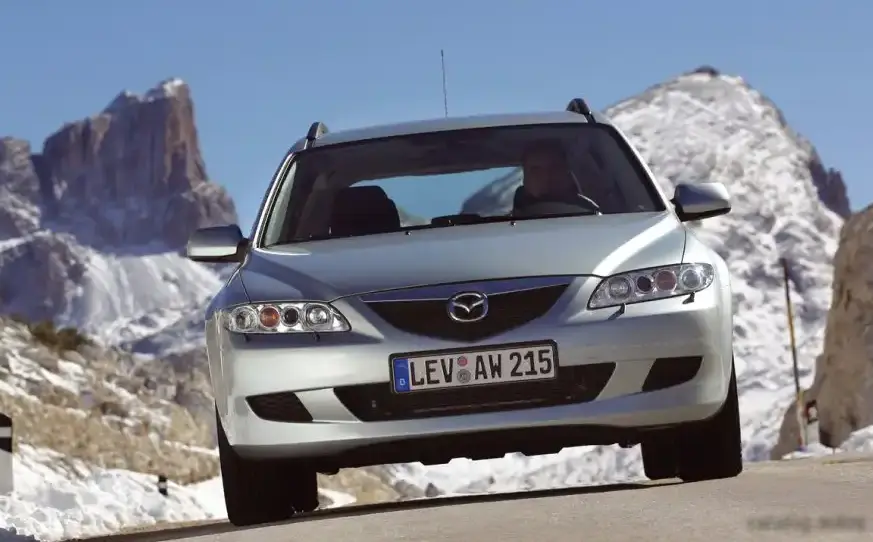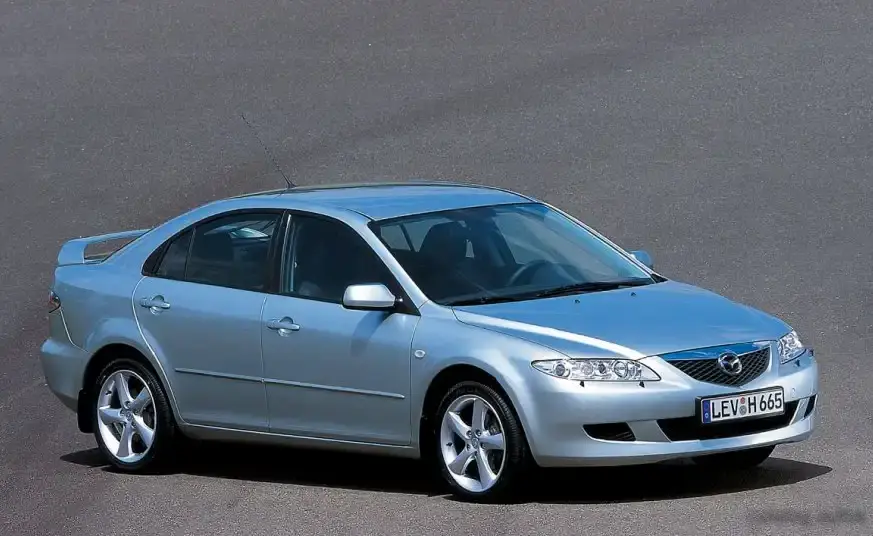
The Mazda 6 first generation (GG/GY/GG1) 3.0 V6 hatchback, produced from February 2004 to September 2005, represented a significant step upmarket for Mazda. Positioned as the flagship trim level for the hatchback body style, it aimed to offer a more premium and sporty alternative to traditional family cars. This variant was primarily sold in the European and Australian markets, where the hatchback configuration was more popular. It was a key part of Mazda’s effort to establish itself as a brand offering both style and driving dynamics. The 3.0 V6 was the top-tier engine option for the first-generation Mazda 6, offering a substantial performance increase over the four-cylinder models.
Technical Specifications
| Brand | Mazda |
| Model | 6 |
| Generation | 6 I Hatchback (Typ GG/GY/GG1) |
| Type (Engine) | 3.0 V6 (220 Hp) |
| Start of production | February, 2004 |
| End of production | September, 2005 |
| Powertrain Architecture | Internal Combustion engine |
| Body type | Hatchback |
| Seats | 5 |
| Doors | 5 |
| Fuel consumption (urban) | 12.4 l/100 km (19 US mpg) |
| Fuel consumption (extra urban) | 8.7 l/100 km (27 US mpg) |
| Fuel Type | Petrol (Gasoline) |
| Weight-to-power ratio | 7 kg/Hp |
| Weight-to-torque ratio | 5.9 kg/Nm |
| Power | 220 Hp @ 6300 rpm |
| Power per litre | 74.1 Hp/l |
| Torque | 260 Nm @ 5000 rpm (191.77 lb.-ft. @ 5000 rpm) |
| Maximum engine speed | 6500 rpm |
| Engine layout | Front, Transverse |
| Engine Model/Code | AJ0N |
| Engine displacement | 2967 cm3 (181.06 cu. in.) |
| Number of cylinders | 6 |
| Engine configuration | V-engine |
| Cylinder Bore | 89 mm (3.5 in.) |
| Piston Stroke | 79.5 mm (3.13 in.) |
| Compression ratio | 10:1 |
| Number of valves per cylinder | 4 |
| Fuel injection system | Multi-port manifold injection |
| Engine aspiration | Naturally aspirated engine |
| Valvetrain | DOHC, VVT |
| Engine oil capacity | 5.2 l (5.49 US qt | 4.58 UK qt) |
| Coolant capacity | 10.2 l (10.78 US qt | 8.97 UK qt) |
| Kerb Weight | 1540 kg (3395.12 lbs.) |
| Max. weight | 2037 kg (4490.82 lbs.) |
| Max load | 497 kg (1095.7 lbs.) |
| Trunk (boot) space – minimum | 623 l (22 cu. ft.) |
| Trunk (boot) space – maximum | 1662 l (58.69 cu. ft.) |
| Fuel tank capacity | 68 l (17.96 US gal | 14.96 UK gal) |
| Length | 4745 mm (186.81 in.) |
| Width | 1780 mm (70.08 in.) |
| Height | 1440 mm (56.69 in.) |
| Wheelbase | 2675 mm (105.31 in.) |
| Front track | 1530 mm (60.24 in.) |
| Rear track | 1530 mm (60.24 in.) |
| Ride height (ground clearance) | 130 mm (5.12 in.) |
| Minimum turning circle | 11.8 m (38.71 ft.) |
| Drivetrain Architecture | Front wheel drive |
| Number of gears | 5 |
| Gearbox type | Manual transmission |
| Front suspension | Double wishbone, Transverse stabilizer |
| Rear suspension | Independent multi-link spring suspension with stabilizer |
| Front brakes | Ventilated discs, 282×25 mm |
| Rear brakes | Disc, 280×10 mm |
| Assisting systems | ABS (Anti-lock braking system) |
| Steering type | Steering rack and pinion |
| Power steering | Hydraulic Steering |
| Tires size | 215/50 R17 |
| Wheel rims size | 7J x 17 |
Introduction
The Mazda 6 (GG/GY) represented a departure for Mazda, moving away from its traditionally smaller, sport-focused offerings towards a more mainstream, family-oriented vehicle. Introduced in 2002, the first generation 6 was available as a sedan, wagon, and hatchback. The 3.0 V6 hatchback, launched in 2004, was the range-topping variant, offering a significant performance boost and a more luxurious experience. It was designed to compete with vehicles like the Ford Mondeo, Vauxhall/Opel Vectra, and Volkswagen Passat, offering a more engaging driving experience than many of its rivals.
Powertrain & Engine Architecture
The heart of the 3.0 V6 Mazda 6 is the AJ0N engine, a 2.967-liter naturally aspirated V6. This engine utilizes a 60-degree V-angle, contributing to a smoother power delivery and reduced vibrations. It features multi-port fuel injection and a double overhead camshaft (DOHC) valvetrain with variable valve timing (VVT) on both intake and exhaust camshafts. This VVT system optimizes engine performance and efficiency across the rev range. The engine produces 220 horsepower at 6300 rpm and 260 Nm (191.77 lb-ft) of torque at 5000 rpm. The engine’s architecture was relatively conventional for the time, prioritizing reliability and smooth operation over outright cutting-edge technology. The 5-speed manual transmission was the only transmission option available with this engine, providing a direct connection to the engine’s power.
Driving Characteristics
The 3.0 V6 Mazda 6 hatchback offered a noticeably more spirited driving experience than its four-cylinder counterparts. The V6 engine provided ample power for confident overtaking and effortless cruising. The manual transmission allowed for precise control, and the relatively short gear ratios helped to keep the engine in its powerband. While not a sports car, the 3.0 V6 offered a level of responsiveness and engagement that was uncommon in the family car segment. The front-wheel-drive layout, combined with the engine’s torque output, could result in some torque steer under hard acceleration. The suspension, tuned for comfort and handling, provided a good balance between ride quality and body control.
Equipment & Trim Levels
The 3.0 V6 hatchback typically came with a high level of standard equipment. This included features such as air conditioning, power windows and mirrors, a CD stereo system, and alloy wheels. Higher trim levels added features like leather upholstery, a sunroof, and upgraded audio systems. Optional extras included navigation systems and heated front seats. The interior design was generally well-regarded for its quality and ergonomics, offering a comfortable and spacious cabin for both driver and passengers.
Chassis & Braking
The Mazda 6 utilized a front-engine, front-wheel-drive layout. The suspension consisted of a double wishbone setup at the front and an independent multi-link system at the rear, both incorporating a transverse stabilizer bar to reduce body roll. Braking duties were handled by ventilated discs at the front and solid discs at the rear. The braking system was equipped with ABS (Anti-lock Braking System) as standard, enhancing safety and control. The chassis was designed to provide a good balance between ride comfort and handling precision.
Market Reception & Comparison
The 3.0 V6 Mazda 6 hatchback was generally well-received by automotive critics. It was praised for its smooth and powerful engine, engaging driving dynamics, and well-equipped interior. However, some critics noted that the fuel economy was relatively poor compared to the four-cylinder models. Compared to the 2.0-liter four-cylinder variants, the V6 offered a significant performance advantage but came at the cost of increased fuel consumption and a higher purchase price. The V6 was also more complex and potentially more expensive to maintain than the simpler four-cylinder engines.
Legacy
The Mazda 6 3.0 V6 hatchback, while not a high-volume seller, remains a desirable vehicle among enthusiasts. The AJ0N V6 engine is known for its reliability and smooth operation, although regular maintenance is essential. Today, well-maintained examples are becoming increasingly rare and are sought after by those looking for a unique and engaging driving experience. The 3.0 V6 variant helped to establish Mazda as a brand capable of producing stylish, well-engineered, and enjoyable-to-drive vehicles, paving the way for future generations of Mazda 6.