
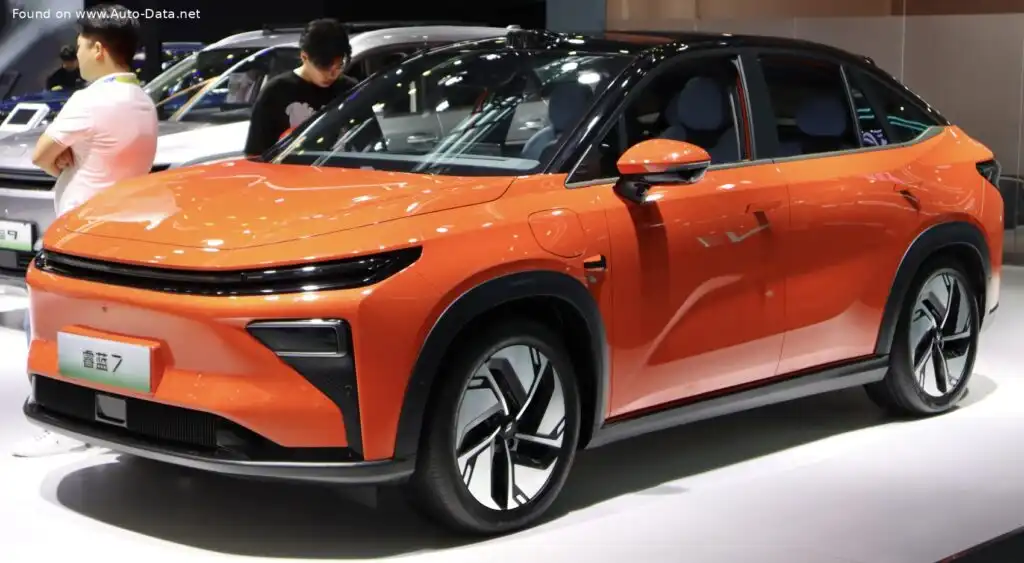
The Livan 7 68.03 kWh (163 Hp) Electric is a battery electric vehicle (BEV) introduced in 2023 by the Chinese automaker Livan. Positioned as a compact SUV or coupe-style crossover, the Livan 7 represents Livan’s entry into the rapidly expanding electric vehicle market. It is built upon a dedicated electric vehicle platform and aims to provide a balance of range, practicality, and affordability. The vehicle is primarily targeted at the Chinese domestic market, where demand for EVs is particularly strong, but export plans have been discussed. The 68.03 kWh variant is one of the initial configurations offered, providing a competitive range and performance profile within its segment.
Technical Specifications
| Brand | Livan |
| Model | 7 |
| Generation | 7 |
| Type (Engine) | 68.03 kWh (163 Hp) Electric |
| Start of production | 2023 |
| Powertrain Architecture | BEV (Electric Vehicle) |
| Body type | Coupe, SUV |
| Seats | 5 |
| Doors | 5 |
| Fuel Type | Electricity |
| Maximum speed | 150 km/h (93.21 mph) |
| Gross battery capacity | 68.03 kWh |
| Battery technology | Lithium nickel manganese cobalt oxides (Li-NMC) |
| Battery location | Below the floor |
| All-electric range (CLTC) | 605 km (375.93 mi) |
| Electric motor power | 163 Hp |
| Electric motor Torque | 240 Nm (177.01 lb.-ft.) |
| Electric motor location | Front axle, Transverse |
| Electric motor type | Synchronous |
| System power | 163 Hp |
| System torque | 240 Nm (177.01 lb.-ft.) |
| Trunk (boot) space – minimum | 402 l (14.2 cu. ft.) |
| Length | 4690 mm (184.65 in.) |
| Width | 1892 mm (74.49 in.) |
| Height | 1650 mm (64.96 in.) |
| Wheelbase | 2775 mm (109.25 in.) |
| Drag coefficient (Cd) | 0.238 |
| Minimum turning circle (turning diameter) | 10.8 m (35.43 ft.) |
| Drivetrain Architecture | One electric motor drives the front wheels. |
| Drive wheel | Front wheel drive |
| Number of gears and type of gearbox | 1 gears, automatic transmission |
| Front suspension | Independent type McPherson |
| Rear suspension | Torsion |
| Assisting systems | ABS (Anti-lock braking system) |
| Steering type | Steering rack and pinion |
| Power steering | Electric Steering |
| Tires size | 215/60 R17; 215/55 R18 |
| Wheel rims size | 17; 18 |
Powertrain & Engine Architecture
The Livan 7 68.03 kWh utilizes a front-wheel-drive configuration powered by a single synchronous electric motor. This motor delivers a peak output of 163 horsepower and 240 Nm (177.01 lb.-ft.) of torque. The powertrain is centered around a 68.03 kWh lithium nickel manganese cobalt oxide (Li-NMC) battery pack, positioned under the vehicle floor to optimize weight distribution and passenger space. The battery supports fast charging capabilities, though specific charging times vary depending on the charging infrastructure used. The vehicle employs a single-speed automatic transmission, typical of most electric vehicles, providing seamless acceleration. The motor’s transverse mounting contributes to efficient packaging within the front-wheel-drive layout.
Driving Characteristics
The Livan 7 68.03 kWh offers a driving experience characteristic of modern electric vehicles – instant torque delivery and smooth, quiet operation. While not designed for outright performance, the 163 hp motor provides adequate acceleration for everyday driving situations. The single-speed transmission ensures a linear power delivery, without the gear changes associated with internal combustion engines. The front-wheel-drive configuration provides predictable handling, although it may exhibit some torque steer under hard acceleration. The relatively low center of gravity, thanks to the underfloor battery pack, contributes to stable cornering. The vehicle’s regenerative braking system allows for one-pedal driving in certain conditions, enhancing efficiency and driver convenience.
Equipment & Trim Levels
The Livan 7 68.03 kWh is generally well-equipped for its price point. Standard features typically include air conditioning, power windows and locks, a touchscreen infotainment system, and basic safety features like ABS. Higher trim levels add features such as a larger touchscreen, navigation, a panoramic sunroof, and advanced driver-assistance systems (ADAS) like adaptive cruise control and lane-keeping assist. Interior upholstery is typically cloth in the base models, with leatherette or genuine leather options available on higher trims. The dashboard layout is modern and minimalist, with a focus on the central touchscreen display. Optional extras may include upgraded sound systems and exterior styling enhancements.
Chassis & Braking
The Livan 7 utilizes an independent McPherson strut suspension system at the front, providing a comfortable ride and responsive handling. The rear suspension employs a torsion beam setup, which is a cost-effective solution for compact SUVs. The braking system consists of disc brakes at the front and drum brakes at the rear, with ABS (Anti-lock Braking System) as standard. The electric steering system provides light and precise steering feel. Tire sizes vary depending on the trim level, with 17-inch and 18-inch alloy wheels being common options. The vehicle’s relatively low weight, due to the absence of a heavy internal combustion engine, contributes to its agility and braking performance.
Market Reception & Comparison
The Livan 7 has been generally well-received in the Chinese market, particularly for its competitive pricing and decent range. Critics have praised its spacious interior and comfortable ride. However, some have noted that its styling is somewhat conservative compared to other EVs. Compared to other electric SUVs in its class, the Livan 7 offers a good balance of range and affordability. Its CLTC range of 605 km (375.93 mi) is competitive, although real-world range may vary depending on driving conditions and usage. The vehicle’s fuel economy (measured in kWh per 100 km) is comparable to other EVs with similar battery capacities. Reliability data is still emerging, as the vehicle is relatively new to the market.
Legacy
As a relatively recent entrant to the EV market, the long-term legacy of the Livan 7 remains to be seen. However, it represents a significant step for Livan as a brand, demonstrating its commitment to electric mobility. The 68.03 kWh variant is likely to remain a popular choice for buyers seeking a balance of range and affordability. The vehicle’s powertrain technology, while not groundbreaking, is proven and reliable. Its success will depend on Livan’s ability to continue innovating and improving its products, as well as expanding its presence in international markets. The Livan 7’s impact on the used car market will become clearer over time, as more vehicles enter the secondary market.
