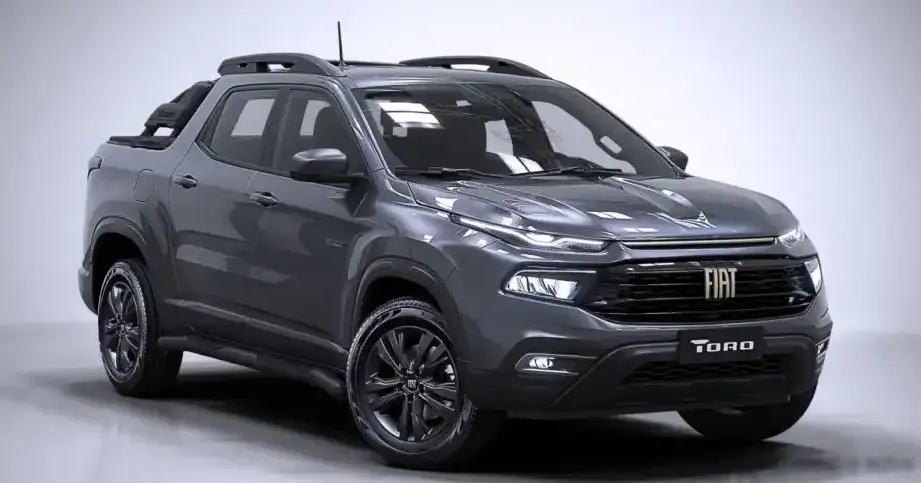
The Fiat Toro 1.8 E-Torq (135 hp) Automatic, produced from 2016 to 2021, represents a significant entry point into the Fiat Toro compact pickup truck range. Introduced as part of the Toro’s initial launch, this variant aimed to provide a balance of affordability, practicality, and reasonable performance for the South American market, particularly Brazil where the Toro was initially developed and sold. It occupied the lower-mid range of the Toro lineup, positioned below the more powerful diesel and higher-specification gasoline options. The Toro itself was a novel vehicle, attempting to bridge the gap between traditional compact pickups and more car-like crossover SUVs.
Technical Specifications
| Brand | Fiat |
| Model | Toro |
| Type (Engine) | 1.8 E-Torq (135 Hp) Automatic |
| Start of production | 2016 |
| End of production | 2021 |
| Powertrain Architecture | Internal Combustion engine |
| Body type | Pick-up |
| Seats | 5 |
| Doors | 4 |
| Fuel Type | Petrol (Gasoline) |
| Maximum speed | 171 km/h (106.25 mph) |
| Emission standard | Euro 5 |
| Weight-to-power ratio | 12.2 kg/Hp, 81.8 Hp/tonne |
| Weight-to-torque ratio | 9 kg/Nm, 111.4 Nm/tonne |
| Power | 135 Hp @ 5750 rpm |
| Power per litre | 77.3 Hp/l |
| Torque | 184 Nm @ 3750 rpm (135.71 lb.-ft. @ 3750 rpm) |
| Engine layout | Front, Transverse |
| Engine Model/Code | 370 A0.011 |
| Engine displacement | 1747 cm3 (106.61 cu. in.) |
| Number of cylinders | 4 |
| Engine configuration | Inline |
| Cylinder Bore | 80.5 mm (3.17 in.) |
| Piston Stroke | 85.8 mm (3.38 in.) |
| Compression ratio | 12.5:1 |
| Number of valves per cylinder | 4 |
| Fuel injection system | Multi-port manifold injection |
| Engine aspiration | Turbocharger, Intercooler |
| Engine oil capacity | 4.3 l (4.54 US qt | 3.78 UK qt) |
| Coolant | 5.6 l (5.92 US qt | 4.93 UK qt) |
| Kerb Weight | 1651 kg (3639.83 lbs.) |
| Trunk (boot) space – minimum | 820 l (28.96 cu. ft.) |
| Fuel tank capacity | 60 l (15.85 US gal | 13.2 UK gal) |
| Permitted trailer load with brakes (12%) | 650 kg (1433 lbs.) |
| Permitted trailer load without brakes | 400 kg (881.85 lbs.) |
| Length | 4915 mm (193.5 in.) |
| Width | 1844 mm (72.6 in.) |
| Width including mirrors | 2033 mm (80.04 in.) |
| Height | 1735 mm (68.31 in.) |
| Wheelbase | 2990 mm (117.72 in.) |
| Front track | 1547 mm (60.91 in.) |
| Rear (Back) track | 1575 mm (62.01 in.) |
| Front overhang | 920 mm (36.22 in.) |
| Rear overhang | 1005 mm (39.57 in.) |
| Ride height (ground clearance) | 224 mm (8.82 in.) |
| Minimum turning circle (turning diameter) | 12.2 m (40.03 ft.) |
| Drivetrain Architecture | The Internal combustion engine (ICE) drives the front wheels of the vehicle. |
| Drive wheel | Front wheel drive |
| Number of gears and type of gearbox | 6 gears, automatic transmission |
| Front suspension | Independent, type McPherson with coil spring and anti-roll bar |
| Rear suspension | Independent multi-link spring suspension with stabilizer |
| Front brakes | Ventilated discs |
| Rear brakes | Drum |
| Assisting systems | ABS (Anti-lock braking system) |
| Steering type | Steering rack and pinion |
| Power steering | Electric Steering |
| Tires size | 215/65 R16 |
| Wheel rims size | 6.5J x 16 |
Powertrain & Engine Architecture
The heart of the Toro 1.8 E-Torq Automatic is the 370 A0.011 engine, a 1.8-liter inline-four cylinder gasoline engine. This engine is a product of Fiat’s E.Torq family, known for its relatively simple design and focus on fuel efficiency. It features a multi-point fuel injection system and a single overhead camshaft (SOHC) valvetrain with four valves per cylinder. The addition of a turbocharger and intercooler significantly boosts power output compared to naturally aspirated versions of the same engine. The six-speed automatic transmission, sourced from a variety of suppliers depending on the production year, is a conventional torque-converter type, prioritizing smooth shifts over outright performance. This transmission was chosen to appeal to a broader customer base seeking ease of use, particularly in urban environments.
Driving Characteristics
The 135 hp and 184 Nm (135.71 lb-ft) of torque delivered by the 1.8 E-Torq engine, coupled with the six-speed automatic, results in adequate, but not exhilarating, performance. Acceleration is best described as leisurely, with a 0-60 mph time estimated around 11-12 seconds. The automatic transmission is tuned for economy, often upshifting quickly to maintain lower engine speeds. This can sometimes result in hesitation during overtaking maneuvers or when climbing hills. Compared to the more powerful 160 hp 1.8 E-Torq or the diesel options, the 135 hp version feels noticeably less responsive. However, the automatic transmission provides a more relaxed driving experience than the manual versions, especially in stop-and-go traffic. The front-wheel-drive configuration contributes to predictable handling, but limits off-road capability.
Equipment & Trim Levels
The 1.8 E-Torq Automatic typically came equipped with a reasonable level of standard features. These generally included air conditioning, power windows and locks, a basic audio system with USB connectivity, and ABS brakes. Higher trim levels, often denoted by additions like “Volcano” or “Freedom,” added features such as alloy wheels, fog lights, a more sophisticated infotainment system with a touchscreen display, and upgraded interior upholstery. Interior materials were generally durable and practical, reflecting the Toro’s work-oriented nature. Optional extras included a rearview camera, parking sensors, and leather seat upholstery.
Chassis & Braking
The Toro’s chassis is a monocoque construction, providing a good balance of strength and rigidity. The front suspension utilizes an independent McPherson strut setup, while the rear employs an independent multi-link suspension with a stabilizer bar. This configuration aims to provide a comfortable ride and reasonable handling characteristics. Braking duties are handled by ventilated discs at the front and drum brakes at the rear. While adequate for everyday use, the braking system isn’t particularly powerful, and the rear drum brakes can feel less responsive than disc brakes, especially under heavy load. The Toro’s relatively high ground clearance (224 mm / 8.82 in) allows it to tackle moderately rough terrain.
Market Reception & Comparison
The Fiat Toro 1.8 E-Torq Automatic was generally well-received as an affordable and practical entry point into the compact pickup segment. Critics praised its unique styling, comfortable ride, and spacious interior. However, the engine’s performance was often cited as a weakness, particularly when compared to the more powerful alternatives. Fuel economy was considered average for its class. Compared to the diesel-powered Toro models, the 1.8 E-Torq offered lower running costs in terms of fuel price, but sacrificed torque and fuel efficiency. The automatic transmission was appreciated for its convenience, but some reviewers noted its tendency to hunt for gears in certain situations.
Legacy
The Fiat Toro 1.8 E-Torq Automatic remains a relatively common sight on the used car market in South America. The 370 A0.011 engine, while not known for exceptional longevity, is generally reliable if properly maintained. Common issues include turbocharger wear and potential problems with the fuel injection system. The automatic transmission, if serviced regularly, is also generally dependable. The Toro’s unique blend of pickup truck practicality and crossover SUV comfort has ensured its continued popularity, and the 1.8 E-Torq Automatic variant represents a cost-effective option for buyers seeking a versatile and affordable vehicle.