
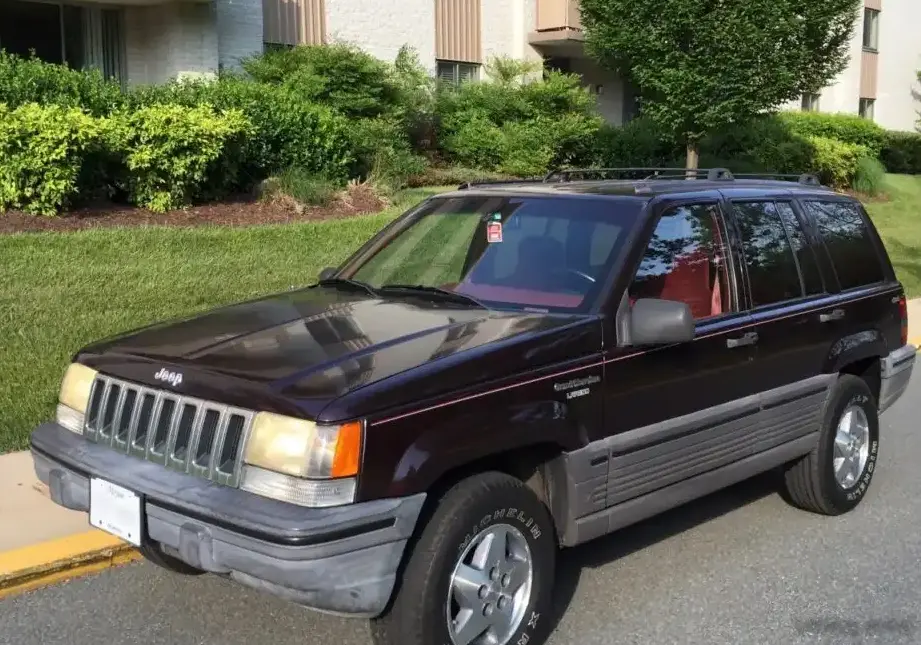
The Jeep Grand Cherokee ZJ, produced from 1993 to 1994 with the 5.2i V8 engine and four-speed automatic transmission, represented a significant step forward for the American automaker. This configuration, delivering 215 horsepower, positioned itself as a robust, capable SUV aimed at buyers prioritizing towing capacity and all-weather performance over fuel efficiency. It was a key offering within the ZJ generation (1993-1998), which marked a shift towards a more refined and luxurious SUV experience for Jeep, moving away from its more utilitarian roots. The 5.2i V8 Automatic was not the entry-level trim – that was reserved for the inline-six cylinder engine – but rather a mid-range option, offering a substantial power upgrade for those willing to accept the associated fuel consumption.
Technical Specifications
| Brand | Jeep |
| Model | Grand Cherokee |
| Generation | Grand Cherokee I (ZJ) |
| Type (Engine) | 5.2i V8 (215 Hp) 4×4 Automatic |
| Start of production | 1993 |
| End of production | 1994 |
| Powertrain Architecture | Internal Combustion engine |
| Body type | SUV |
| Seats | 5 |
| Doors | 5 |
| Fuel consumption (combined) | 15.2 l/100 km |
| Fuel consumption (US mpg) | 15.5 US mpg |
| Fuel consumption (UK mpg) | 18.6 UK mpg |
| Fuel consumption (km/l) | 6.6 km/l |
| Fuel Type | Petrol (Gasoline) |
| Acceleration 0 – 100 km/h | 9.8 sec |
| Acceleration 0 – 62 mph | 9.8 sec |
| Acceleration 0 – 60 mph | 9.3 sec |
| Maximum speed | 180 km/h (111.85 mph) |
| Weight-to-power ratio | 8.3 kg/Hp |
| Weight-to-torque ratio | 4.7 kg/Nm |
| Power | 215 Hp @ 4750 rpm |
| Power per litre | 41.3 Hp/l |
| Torque | 375 Nm @ 3050 rpm (276.59 lb.-ft. @ 3050 rpm) |
| Engine layout | Front, Longitudinal |
| Engine displacement | 5210 cm3 (317.93 cu. in.) |
| Number of cylinders | 8 |
| Engine configuration | V-engine |
| Cylinder Bore | 99.31 mm (3.91 in.) |
| Piston Stroke | 84.07 mm (3.31 in.) |
| Compression ratio | 9.1:1 |
| Number of valves per cylinder | 2 |
| Fuel injection system | Multi-port manifold injection |
| Engine aspiration | Naturally aspirated engine |
| Engine oil capacity | 4.7 l (4.97 US qt | 4.14 UK qt) |
| Coolant capacity | 14.1 l (14.9 US qt | 12.41 UK qt) |
| Kerb Weight | 1775 kg (3913.21 lbs.) |
| Max. weight | 2495 kg (5500.53 lbs.) |
| Max load | 720 kg (1587.33 lbs.) |
| Trunk (boot) space – minimum | 1136 l (40.12 cu. ft.) |
| Trunk (boot) space – maximum | 2254 l (79.6 cu. ft.) |
| Fuel tank capacity | 87 l (22.98 US gal | 19.14 UK gal) |
| Length | 4489 mm (176.73 in.) |
| Width | 1790 mm (70.47 in.) |
| Height | 1708 mm (67.24 in.) |
| Wheelbase | 2690 mm (105.91 in.) |
| Front track | 1473 mm (57.99 in.) |
| Rear (Back) track | 1473 mm (57.99 in.) |
| Ride height (ground clearance) | 202 mm (7.95 in.) |
| Drag coefficient (Cd) | 0.45 |
| Minimum turning circle | 11.7 m (38.39 ft.) |
| Drive wheel | All wheel drive (4×4) |
| Number of gears | 4 |
| Gearbox type | automatic transmission |
| Front brakes | Ventilated discs |
| Rear brakes | Disc |
| Assisting systems | ABS (Anti-lock braking system) |
| Steering type | Steering rack and pinion |
| Power steering | Hydraulic Steering |
| Tires size | 225/70 R15 |
| Wheel rims size | 15 |
Powertrain & Engine Architecture
The heart of this Grand Cherokee variant was the 5.2-liter (318 cubic inch) LA-series V8 engine. This engine, a descendant of Chrysler’s long-running small-block V8 family, was known for its durability and relatively simple design. The engine code typically associated with this output was RGA. It featured a cast iron block and cylinder heads, a two-barrel carburetor (later models transitioned to multi-port fuel injection), and a hydraulic lifter valvetrain. The multi-port fuel injection system, introduced in later years of the ZJ production, improved throttle response and fuel efficiency compared to the earlier carbureted versions. The four-speed 42RE automatic transmission was the sole transmission option for the 5.2L V8. This transmission was a robust unit designed to handle the engine’s torque and the demands of off-road driving. It featured a torque converter lockup clutch to improve fuel economy at highway speeds.
Driving Characteristics
The 5.2L V8 Automatic Grand Cherokee offered a comfortable and capable driving experience. While not particularly quick – 0-60 mph in around 9.3 seconds – it provided ample torque for towing and navigating challenging terrain. The automatic transmission, while smooth, wasn’t known for its sporty responsiveness. Gear ratios were optimized for low-end grunt rather than outright acceleration. Compared to the inline-six engine, the V8 offered significantly more power, making it a better choice for those frequently hauling trailers or driving in mountainous regions. However, it came at the cost of increased fuel consumption. Against the later 4.0L High Output inline-six, the V8 offered more peak power, but the six-cylinder was often considered more refined and fuel-efficient for everyday driving.
Equipment & Trim Levels
The 5.2i V8 Grand Cherokee typically came standard with features like air conditioning, power windows and locks, and a basic sound system. Upholstery was usually cloth, though leather was available as an option. Higher trim levels, such as the Laredo and Limited, added features like upgraded sound systems, alloy wheels, and a sunroof. Optional extras included a heavy-duty towing package, a premium sound system, and a rear entertainment system. The interior design was functional and relatively simple, reflecting the vehicle’s focus on practicality and durability.
Chassis & Braking
The ZJ Grand Cherokee utilized a body-on-frame construction, providing a robust and durable platform. The suspension consisted of a traditional coil spring setup with a solid rear axle. The 5.2L V8 models typically featured heavier-duty suspension components to handle the increased weight and torque. Braking was accomplished via ventilated discs in the front and discs in the rear. An Anti-lock Braking System (ABS) was standard equipment, enhancing safety and control, particularly on slippery surfaces. The steering was a hydraulic power-assisted rack and pinion system, providing responsive and precise handling.
Market Reception & Comparison
The 5.2L V8 Grand Cherokee was generally well-received by critics and consumers alike. It was praised for its powerful engine, comfortable ride, and capable off-road performance. However, its fuel economy was a common criticism. Compared to the inline-six models, the V8 offered a significant performance advantage but at a higher price at the pump. Reliability was generally good, although the V8 engine was more complex than the inline-six, potentially leading to higher maintenance costs over the long term. The V8 was favored by buyers who needed a vehicle capable of handling demanding tasks, such as towing boats or trailers, or navigating challenging terrain.
Legacy
The 5.2L V8 Grand Cherokee ZJ remains a popular choice among classic SUV enthusiasts. The LA-series V8 engine is known for its durability and relative simplicity, making it a relatively easy engine to maintain and repair. While fuel economy is poor by modern standards, the V8’s robust power and torque make it a capable and enjoyable vehicle to drive. Today, well-maintained examples command a reasonable price in the used car market, particularly those with low mileage and a documented service history. The ZJ Grand Cherokee, and specifically the 5.2L V8 variant, helped establish the Grand Cherokee as a benchmark for American SUVs, blending capability, comfort, and a touch of luxury.
