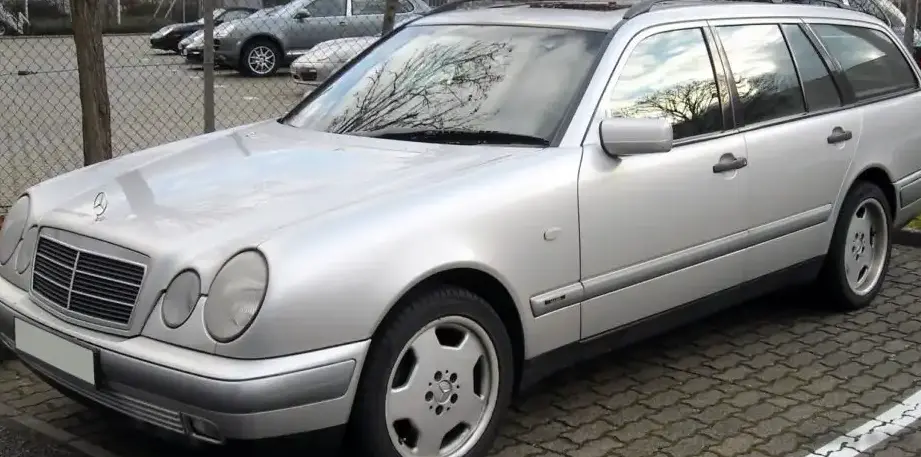
The Mercedes-Benz E 420 T-modell (S210), produced between January 1996 and September 1997, represented the pinnacle of performance and luxury within the W210 E-Class wagon range. Positioned as the flagship variant, it offered a substantial upgrade over the more common four and six-cylinder models. The S210 chassis, introduced in 1996, brought estate car practicality to the E-Class line, and the E 420 distinguished itself with its powerful V8 engine and sophisticated features. It was primarily a European market vehicle, though limited numbers were imported to North America, appealing to buyers seeking a high-performance, spacious family vehicle.
Technical Specifications
| Brand | Mercedes-Benz |
| Model | E-class |
| Generation | E-class T-modell (S210) |
| Type (Engine) | E 420 V8 (279 Hp) Automatic |
| Start of production | January, 1996 |
| End of production | September, 1997 |
| Powertrain Architecture | Internal Combustion engine |
| Body type | Station wagon (estate) |
| Seats | 5 |
| Doors | 5 |
| Fuel consumption (urban) | 14.4 l/100 km (16.3 US mpg, 19.6 UK mpg, 6.9 km/l) |
| Fuel consumption (extra urban) | 8 l/100 km (29.4 US mpg, 35.3 UK mpg, 12.5 km/l) |
| Fuel Type | Petrol (Gasoline) |
| Acceleration 0 – 100 km/h | 7.2 sec |
| Acceleration 0 – 62 mph | 7.2 sec |
| Acceleration 0 – 60 mph | 6.8 sec |
| Maximum speed | 243 km/h (150.99 mph) |
| Weight-to-power ratio | 6.2 kg/Hp, 160.3 Hp/tonne |
| Weight-to-torque ratio | 4.4 kg/Nm, 229.9 Nm/tonne |
| Power | 279 Hp @ 5700 rpm |
| Power per litre | 66.5 Hp/l |
| Torque | 400 Nm @ 3900 rpm (295.02 lb.-ft. @ 3900 rpm) |
| Engine layout | Front, Longitudinal |
| Engine Model/Code | M 119 E 42 / 119.985 |
| Engine displacement | 4196 cm3 (256.06 cu. in.) |
| Number of cylinders | 8 |
| Engine configuration | V-engine |
| Cylinder Bore | 92 mm (3.62 in.) |
| Piston Stroke | 78.9 mm (3.11 in.) |
| Compression ratio | 11:1 |
| Number of valves per cylinder | 4 |
| Fuel injection system | Multi-port manifold injection |
| Engine aspiration | Naturally aspirated engine |
| Valvetrain | DOHC |
| Engine oil capacity | 8 l (8.45 US qt | 7.04 UK qt) |
| Coolant | 11 l (11.62 US qt | 9.68 UK qt) |
| Kerb Weight | 1740 kg (3836.04 lbs.) |
| Max. weight | 2290 kg (5048.59 lbs.) |
| Max load | 550 kg (1212.54 lbs.) |
| Trunk (boot) space – minimum | 600 l (21.19 cu. ft.) |
| Trunk (boot) space – maximum | 1920 l (67.8 cu. ft.) |
| Fuel tank capacity | 70 l (18.49 US gal | 15.4 UK gal) |
| Length | 4816 mm (189.61 in.) |
| Width | 1799 mm (70.83 in.) |
| Height | 1506 mm (59.29 in.) |
| Wheelbase | 2833 mm (111.54 in.) |
| Front track | 1534 mm (60.39 in.) |
| Rear (Back) track | 1538 mm (60.55 in.) |
| Drivetrain Architecture | The Internal combustion engine (ICE) drives the rear wheels of the vehicle. |
| Drive wheel | Rear wheel drive |
| Number of gears and type of gearbox | 5 gears, automatic transmission |
| Front suspension | Double wishbone |
| Rear suspension | Hydro-pneumatic element, Independent multi-link suspension |
| Front brakes | Ventilated discs |
| Rear brakes | Disc |
| Assisting systems | ABS (Anti-lock braking system) |
| Steering type | Steering rack and pinion |
| Power steering | Hydraulic Steering |
| Tires size | 215/55 R16 |
| Wheel rims size | 7.5J x 16 |
Powertrain & Engine Architecture
The heart of the E 420 T-modell was the M119 E 42 engine, a 4.2-liter naturally aspirated V8. This engine, part of Mercedes-Benz’s renowned M119 family, was known for its smoothness and robust construction. It featured a cast-iron block and aluminum cylinder heads, incorporating a double overhead camshaft (DOHC) valvetrain with four valves per cylinder. Fuel delivery was handled by a multi-port fuel injection system, carefully calibrated for optimal performance and emissions. The engine produced 279 horsepower at 5700 rpm and 400 Nm (295 lb-ft) of torque at 3900 rpm. Paired exclusively with a five-speed automatic transmission (typically the 722.3), the powertrain delivered a balance of refinement and performance. The 722.3 transmission was electronically controlled, offering smooth shifts and adaptive shift patterns.
Driving Characteristics
The E 420 T-modell offered a distinctly different driving experience compared to its four and six-cylinder siblings. The V8 engine provided effortless acceleration, with a 0-60 mph time of around 6.8 seconds and a top speed of 151 mph. While not a sports car, the E 420 possessed ample power for confident overtaking and comfortable highway cruising. The automatic transmission, while smooth, wasn’t particularly sporty, prioritizing comfort over aggressive downshifts. The gear ratios were tuned for relaxed cruising, and the transmission didn’t offer manual shift control. Compared to the more nimble manual transmission versions of the E-Class, the E 420 felt larger and more substantial, but the V8’s torque compensated for the added weight.
Equipment & Trim Levels
The E 420 T-modell was generously equipped, reflecting its position as the range-topping wagon. Standard features typically included leather upholstery, wood trim, automatic climate control, power-adjustable front seats with memory function, and a premium sound system. Optional extras included a sunroof, navigation system, heated seats, and upgraded wheels. The interior design was typical of Mercedes-Benz at the time – luxurious and understated, with a focus on build quality and ergonomics. The wagon’s rear seats offered ample space for passengers, and the large cargo area could be expanded by folding down the rear seats.
Chassis & Braking
The S210 chassis featured a sophisticated suspension system designed to provide a comfortable ride and stable handling. The front suspension utilized double wishbones, while the rear employed an independent multi-link setup with a hydro-pneumatic element, offering self-leveling capabilities. This was particularly beneficial when carrying heavy loads. Braking duties were handled by ventilated discs at the front and solid discs at the rear, assisted by an Anti-lock Braking System (ABS). The steering was a rack-and-pinion system with hydraulic power assistance, providing precise and responsive steering feel.
Market Reception & Comparison
The E 420 T-modell was well-received by automotive critics, who praised its powerful engine, luxurious interior, and spacious cargo area. However, its high price tag limited its appeal to a relatively small segment of the market. Compared to the E 320 wagon (equipped with a six-cylinder engine), the E 420 offered significantly more performance but came at a substantial price premium. Fuel economy was also considerably lower with the V8 engine. Reliability was generally good, but the complexity of the M119 engine and its associated systems meant that maintenance costs could be higher than those of the simpler four and six-cylinder models.
Legacy
Today, the Mercedes-Benz E 420 T-modell (S210) is a sought-after classic among enthusiasts. The M119 engine is renowned for its durability and is considered one of Mercedes-Benz’s finest V8s. Well-maintained examples are becoming increasingly rare and valuable. While the cost of parts and specialized maintenance can be a concern, the E 420 offers a unique combination of performance, luxury, and practicality that continues to appeal to discerning drivers. Its status as a relatively uncommon and powerful variant within the W210 E-Class range ensures its continued desirability in the used car market.