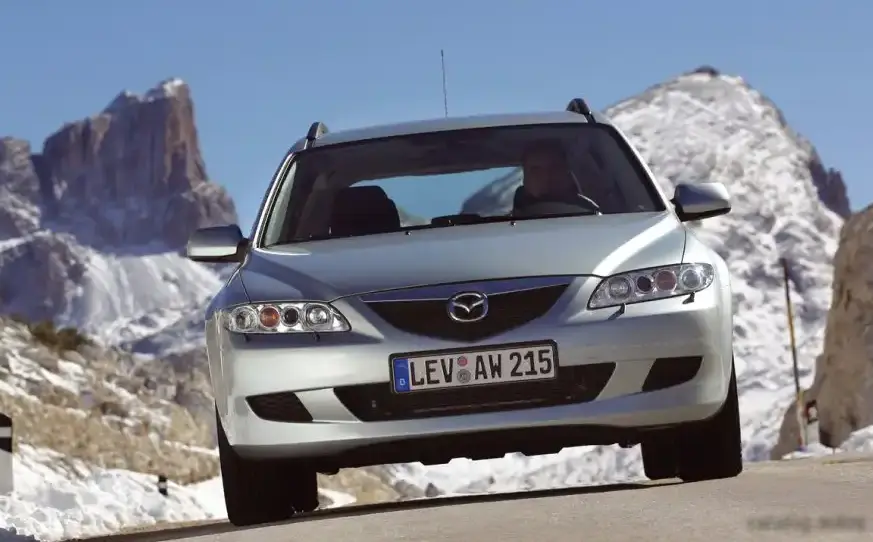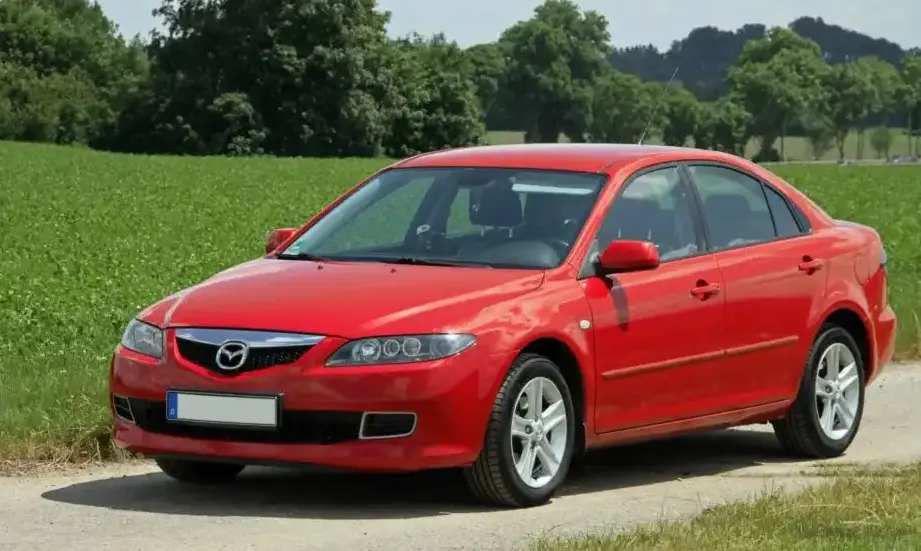
The Mazda 6 first generation (GG/GY/GG1) facelift, produced from 2005 to 2008, represented a significant step forward for Mazda in the mid-size segment. Offered in sedan, hatchback, and wagon body styles, the facelift brought revised styling, improved interior materials, and updated engine options. The 2.0 CD variant, producing 143 horsepower, was a key offering in many European markets, positioned as a fuel-efficient and practical choice for drivers seeking a balance between performance and economy. This model aimed to compete with established rivals like the Ford Mondeo, Volkswagen Passat, and Opel Vectra.
Technical Specifications
| Brand | Mazda |
| Model | 6 |
| Generation | 6 I Hatchback (Typ GG/GY/GG1 facelift 2005) |
| Type (Engine) | 2.0 CD (143 Hp) |
| Start of production | 2005 |
| End of production | 2008 |
| Powertrain Architecture | Internal Combustion engine |
| Body type | Hatchback |
| Seats | 5 |
| Doors | 5 |
| Fuel consumption (urban) | 7.5 l/100 km (31.4 US mpg, 37.7 UK mpg, 13.3 km/l) |
| Fuel consumption (extra urban) | 5.1 l/100 km (46.1 US mpg, 55.4 UK mpg, 19.6 km/l) |
| Fuel consumption (combined) | 6 l/100 km (39.2 US mpg, 47.1 UK mpg, 16.7 km/l) |
| CO2 emissions | 165 g/km |
| Fuel Type | Diesel |
| Acceleration 0 – 100 km/h | 9.5 sec |
| Acceleration 0 – 62 mph | 9.5 sec |
| Acceleration 0 – 60 mph | 9 sec |
| Maximum speed | 203 km/h (126.14 mph) |
| Emission standard | Euro 4 |
| Weight-to-power ratio | 10.4 kg/Hp, 96.3 Hp/tonne |
| Weight-to-torque ratio | 4.1 kg/Nm, 242.4 Nm/tonne |
| Power | 143 Hp @ 3500 rpm |
| Power per litre | 71.6 Hp/l |
| Torque | 360 Nm @ 2000 rpm (265.52 lb.-ft. @ 2000 rpm) |
| Engine layout | Front, Transverse |
| Engine Model/Code | RF7J |
| Engine displacement | 1998 cm3 (121.93 cu. in.) |
| Number of cylinders | 4 |
| Engine configuration | Inline |
| Cylinder Bore | 86 mm (3.39 in.) |
| Piston Stroke | 86 mm (3.39 in.) |
| Compression ratio | 16.7:1 |
| Number of valves per cylinder | 4 |
| Fuel injection system | Diesel Commonrail |
| Engine aspiration | Turbocharger, Intercooler |
| Valvetrain | SOHC |
| Engine oil capacity | 4.7 l (4.97 US qt | 4.14 UK qt) |
| Coolant | 9 l (9.51 US qt | 7.92 UK qt) |
| Kerb Weight | 1485 kg (3273.86 lbs.) |
| Max. weight | 2020 kg (4453.34 lbs.) |
| Max load | 535 kg (1179.47 lbs.) |
| Trunk (boot) space – minimum | 492 l (17.37 cu. ft.) |
| Trunk (boot) space – maximum | 1662 l (58.69 cu. ft.) |
| Fuel tank capacity | 64 l (16.91 US gal | 14.08 UK gal) |
| Permitted trailer load with brakes (12%) | 1600 kg (3527.4 lbs.) |
| Permitted trailer load without brakes | 550 kg (1212.54 lbs.) |
| Length | 4690 mm (184.65 in.) |
| Width | 1780 mm (70.08 in.) |
| Height | 1435 mm (56.5 in.) |
| Wheelbase | 2675 mm (105.31 in.) |
| Front track | 1540 mm (60.63 in.) |
| Rear (Back) track | 1540 mm (60.63 in.) |
| Ride height (ground clearance) | 130 mm (5.12 in.) |
| Drag coefficient (Cd) | 0.31 |
| Minimum turning circle (turning diameter) | 10.8 m (35.43 ft.) |
| Drivetrain Architecture | The Internal combustion engine (ICE) drives the front wheels of the vehicle. |
| Drive wheel | Front wheel drive |
| Number of gears and type of gearbox | 6 gears, manual transmission |
| Front brakes | Ventilated discs |
| Rear brakes | Disc |
| Assisting systems | ABS (Anti-lock braking system) |
| Steering type | Steering rack and pinion |
| Tires size | 205/55 R16 H |
| Wheel rims size | 16 |
Powertrain & Engine Architecture
The 2.0 CD variant of the Mazda 6 facelift utilized the RF7J engine, a 1998cc inline-four cylinder diesel engine. This engine was a common rail direct injection (CRDI) unit, benefiting from advancements in fuel delivery for improved efficiency and reduced emissions. The RF7J featured a single overhead camshaft (SOHC) valvetrain and was equipped with a turbocharger and intercooler to boost power output. The turbocharger provided increased air intake, resulting in a significant increase in torque. The engine produced 143 horsepower at 3500 rpm and a substantial 360 Nm (265.52 lb.-ft.) of torque at just 2000 rpm. This torque curve provided good low-end responsiveness, making it suitable for everyday driving. The engine’s high compression ratio of 16.7:1 was typical for diesel engines, contributing to its thermal efficiency. The engine was paired with a 6-speed manual transmission, delivering power to the front wheels.
Driving Characteristics
The 2.0 CD with the 6-speed manual transmission offered a balanced driving experience. While not a performance-oriented variant, the ample torque made it feel surprisingly capable. Acceleration from 0-100 km/h (0-62 mph) took around 9.5 seconds, which was competitive for its class. The gear ratios were well-chosen, providing good acceleration in each gear. The engine was relatively quiet for a diesel, although some engine noise was noticeable during hard acceleration. Compared to the higher-output petrol variants, the 2.0 CD prioritized fuel economy and low-speed drivability over outright speed. The manual transmission allowed for greater driver control, but the relatively long throws could feel less precise than some competitors.
Equipment & Trim Levels
The 2.0 CD trim level in the Mazda 6 facelift typically included standard features such as air conditioning, power windows, power mirrors, a CD player, and ABS brakes. Higher trim levels added features like alloy wheels, a multi-function steering wheel, cruise control, and upgraded interior upholstery. Optional extras included a sunroof, leather seats, and a premium sound system. Interior materials were generally of good quality, with a focus on practicality and durability. The hatchback body style offered increased versatility compared to the sedan, with a larger cargo area and the ability to fold down the rear seats for even more space.
Chassis & Braking
The Mazda 6 facelift featured a MacPherson strut front suspension and a multi-link rear suspension. This setup provided a good balance between ride comfort and handling. The steering was precise and well-weighted, offering good feedback to the driver. The 2.0 CD variant typically came equipped with ventilated front disc brakes and solid rear disc brakes. ABS (Anti-lock Braking System) was standard, enhancing safety during emergency braking situations. The suspension was tuned to provide a comfortable ride, but it also allowed for confident handling in corners.
Market Reception & Comparison
The Mazda 6 2.0 CD was generally well-received by automotive critics. It was praised for its fuel efficiency, comfortable ride, and spacious interior. However, some critics noted that the engine could be a bit noisy and that the handling wasn’t as sporty as some of its rivals. Compared to the petrol variants, the 2.0 CD offered significantly better fuel economy, making it a popular choice for drivers who covered long distances. Compared to other diesel options in the segment, such as the Volkswagen Passat TDI, the Mazda 6 offered a more engaging driving experience and a more stylish interior.
Legacy
The RF7J engine, while generally reliable, is known to require regular maintenance, particularly regarding the diesel particulate filter (DPF). Proper servicing and the use of high-quality diesel fuel are crucial for preventing DPF issues. Today, the Mazda 6 facelift 2.0 CD can be found on the used car market at relatively affordable prices. It remains a practical and fuel-efficient option for those seeking a mid-size hatchback. Its blend of comfort, practicality, and reasonable running costs continues to appeal to a wide range of buyers. The model represents a high point for Mazda in terms of design and engineering, establishing the brand as a serious contender in the competitive mid-size segment.