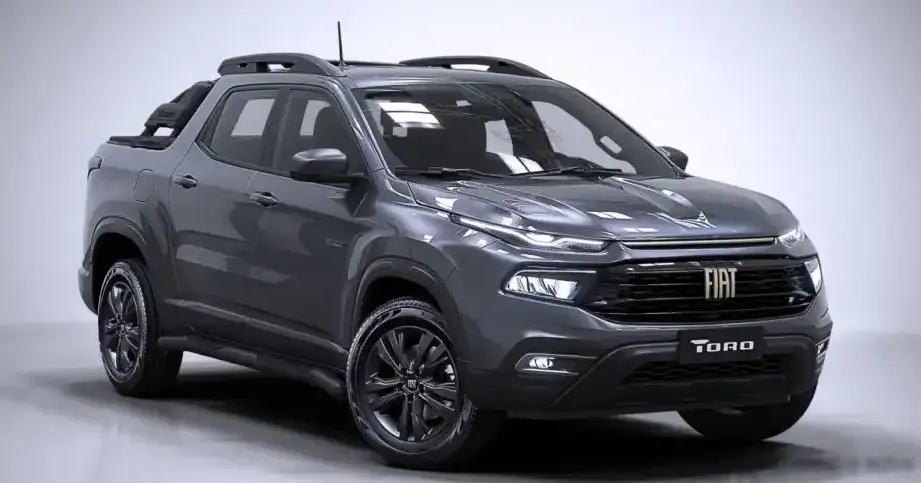
The Fiat Toro 2.4 (186 Hp) Automatic, produced from 2016 to 2021, represents a unique offering in the mid-size pickup truck segment, particularly within the South American market where it was primarily sold. Positioned as a lifestyle pickup, the Toro aimed to bridge the gap between traditional, work-oriented trucks and more comfortable, car-like SUVs. This specific 2.4-liter turbocharged engine paired with a nine-speed automatic transmission was a mid-range offering in the Toro lineup, slotting above the base engine options and below the more powerful diesel variants. It was designed to appeal to buyers seeking a balance of performance, fuel efficiency, and modern features.
Technical Specifications
| Brand | Fiat |
| Model | Toro |
| Generation | Toro |
| Type (Engine) | 2.4 (186 Hp) Automatic |
| Start of production | 2016 year |
| End of production | 2021 year |
| Powertrain Architecture | Internal Combustion engine |
| Body type | Pick-up |
| Seats | 5 |
| Doors | 4 |
| Fuel Type | Petrol / Ethanol – E85 |
| Maximum speed | 200 km/h (124.27 mph) |
| Emission standard | Euro 5 |
| Weight-to-power ratio | 9.2 kg/Hp, 109.2 Hp/tonne |
| Weight-to-torque ratio | 7 kg/Nm, 143.2 Nm/tonne |
| Power | 186 Hp @ 6250 rpm |
| Power per litre | 78.8 Hp/l |
| Torque | 244 Nm @ 4000 rpm (179.97 lb.-ft. @ 4000 rpm) |
| Engine layout | Front, Transverse |
| Engine displacement | 2360 cm3 (144.02 cu. in.) |
| Number of cylinders | 4 |
| Engine configuration | Inline |
| Cylinder Bore | 88 mm (3.46 in.) |
| Piston Stroke | 97 mm (3.82 in.) |
| Compression ratio | 11.8:1 |
| Number of valves per cylinder | 4 |
| Fuel injection system | Multi-port manifold injection |
| Engine aspiration | Turbocharger |
| Engine oil capacity | 5.2 l (5.49 US qt | 4.58 UK qt) |
| Coolant | 6.45 l (6.82 US qt | 5.68 UK qt) |
| Kerb Weight | 1704 kg (3756.68 lbs.) |
| Trunk (boot) space – minimum | 820 l (28.96 cu. ft.) |
| Fuel tank capacity | 60 l (15.85 US gal | 13.2 UK gal) |
| Permitted trailer load with brakes (12%) | 750 kg (1653.47 lbs.) |
| Permitted trailer load without brakes | 400 kg (881.85 lbs.) |
| Length | 4915 mm (193.5 in.) |
| Width | 1844 mm (72.6 in.) |
| Width including mirrors | 2033 mm (80.04 in.) |
| Height | 1737 mm (68.39 in.) |
| Wheelbase | 2990 mm (117.72 in.) |
| Front track | 1547 mm (60.91 in.) |
| Rear (Back) track | 1575 mm (62.01 in.) |
| Front overhang | 920 mm (36.22 in.) |
| Rear overhang | 1005 mm (39.57 in.) |
| Ride height (ground clearance) | 235 mm (9.25 in.) |
| Minimum turning circle (turning diameter) | 12.2 m (40.03 ft.) |
| Approach angle | 26.1-26.3° |
| Departure angle | 28.3-28.5° |
| Ramp-over (brakeover) angle | 21.2-21.4° |
| Drivetrain Architecture | The Internal combustion engine (ICE) drives the front wheels of the vehicle. |
| Drive wheel | Front wheel drive |
| Number of gears and type of gearbox | 9 gears, automatic transmission |
| Front suspension | Independent, type McPherson with coil spring and anti-roll bar |
| Rear suspension | Independent multi-link spring suspension with stabilizer |
| Front brakes | Ventilated discs |
| Rear brakes | Drum |
| Assisting systems | ABS (Anti-lock braking system) |
| Steering type | Steering rack and pinion |
| Power steering | Electric Steering |
| Tires size | 215/65 R16; 225/60 R17 |
| Wheel rims size | 6.5J x 16; 6.5J x 17 |
Powertrain & Engine Architecture
The heart of the Toro 2.4 Automatic is the Fiat Fire family 2.4-liter inline-four cylinder engine. This engine, designated as a member of the E.Torq series, utilizes a single overhead camshaft (SOHC) design with four valves per cylinder. The engine benefits from a turbocharger, which significantly boosts power output compared to naturally aspirated versions. Fuel delivery is managed by a multi-point fuel injection system. The nine-speed automatic transmission, sourced from ZF, was a key feature, offering smooth shifting and contributing to improved fuel economy. This transmission was relatively advanced for its class, providing a wide range of gear ratios to optimize engine performance in various driving conditions. The engine is designed to run on both gasoline and ethanol (E85) blends, a common feature in the Brazilian market.
Driving Characteristics
The 186 horsepower and 244 Nm (179.97 lb-ft) of torque provided by the 2.4-liter engine and nine-speed automatic offered a comfortable and capable driving experience. While not a performance-oriented pickup, it provided adequate acceleration for everyday use and highway cruising. The automatic transmission’s nine gears helped keep the engine in its optimal power band, resulting in responsive performance. Compared to the base engine options, the 2.4-liter offered a noticeable improvement in acceleration and towing capacity. However, it didn’t match the low-end torque of the diesel variants, which were favored for heavy-duty tasks. The front-wheel-drive configuration provided decent traction in normal conditions, but limited off-road capability compared to four-wheel-drive models.
Equipment & Trim Levels
The Toro 2.4 Automatic typically came standard with features such as air conditioning, power windows and locks, a basic audio system with USB connectivity, and ABS brakes. Higher trim levels added features like alloy wheels, a touchscreen infotainment system with Bluetooth, rear parking sensors, and a rearview camera. Interior upholstery was typically cloth, with leather options available on higher trims. Optional extras included a panoramic sunroof, automatic climate control, and advanced driver-assistance systems. The overall interior design was modern and functional, aiming for a more refined feel than traditional pickup trucks.
Chassis & Braking
The Toro utilized an independent McPherson strut suspension in the front and an independent multi-link suspension in the rear, providing a comfortable ride quality. Stabilizer bars were included on both axles to reduce body roll during cornering. The front brakes were ventilated discs, offering good stopping power, while the rear brakes were drums, a cost-saving measure common in this segment. The steering system was an electric power-assisted rack and pinion, providing light and precise steering feel. Ground clearance of 235 mm (9.25 inches) allowed for moderate off-road capability, although the front-wheel-drive configuration limited its performance on challenging terrain.
Market Reception & Comparison
The Fiat Toro 2.4 Automatic was generally well-received in the South American market. Critics praised its unique styling, comfortable ride, and modern features. The 2.4-liter engine was considered a good compromise between performance and fuel economy. However, some reviewers noted that the rear drum brakes were a drawback compared to disc brakes on competing models. Compared to the diesel variants, the 2.4-liter offered lower fuel economy but a quieter and smoother driving experience. Against competitors like the Chevrolet S10 and Toyota Hilux, the Toro stood out with its more car-like interior and focus on comfort.
Legacy
The Fiat Toro, including the 2.4 Automatic variant, established itself as a popular choice in the mid-size pickup segment in South America. The 2.4-liter engine, while not known for exceptional longevity, proved to be reasonably reliable with proper maintenance. In the used car market, the Toro 2.4 Automatic remains a sought-after option for buyers looking for a stylish, comfortable, and versatile pickup truck. Its unique blend of features and capabilities continues to appeal to a wide range of customers. The nine-speed automatic transmission, while complex, has generally proven durable, although regular fluid changes are essential for long-term reliability.