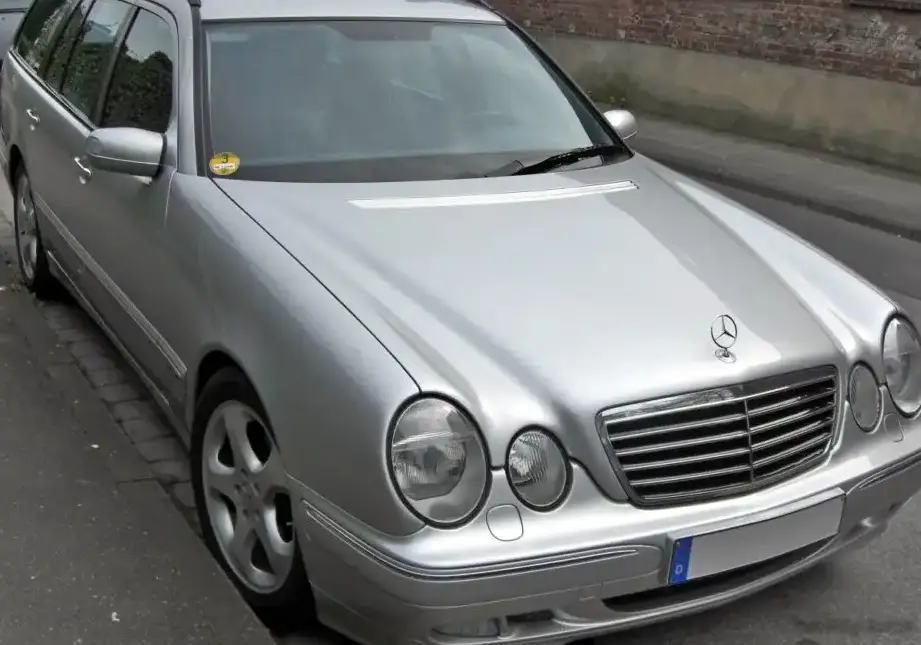
The Mercedes-Benz E 55 T-modell, part of the S210 series facelift produced from 1999 to 2002, represented the high-performance variant of the E-Class wagon. Positioned as the flagship of the E-Class estate range, it combined the practicality of a station wagon with the potent power of Mercedes-Benz’s AMG division. This model filled the niche for buyers seeking a luxurious, high-speed family vehicle, offering a compelling alternative to more conventional performance cars. It was a relatively short-lived production run, adding to its collectibility today.
Technical Specifications
| Brand | Mercedes-Benz |
| Model | E-class |
| Generation | E-class T-modell (S210, facelift 1999) |
| Type (Engine) | AMG E 55 V8 (354 Hp) Automatic |
| Start of production | July, 1999 |
| End of production | January, 2002 |
| Powertrain Architecture | Internal Combustion engine |
| Body type | Station wagon (estate) |
| Seats | 5 |
| Doors | 5 |
| Fuel consumption (economy) – urban | 18.3 l/100 km (12.9 US mpg, 15.4 UK mpg, 5.5 km/l) |
| Fuel consumption (economy) – extra urban | 9.4 l/100 km (25 US mpg, 30.1 UK mpg, 10.6 km/l) |
| Fuel consumption (economy) – combined | 12.6 l/100 km (18.7 US mpg, 22.4 UK mpg, 7.9 km/l) |
| Fuel Type | Petrol (Gasoline) |
| Acceleration 0 – 100 km/h | 5.9 sec |
| Acceleration 0 – 62 mph | 5.9 sec |
| Acceleration 0 – 60 mph | 5.6 sec |
| Maximum speed | 250 km/h (155.34 mph), Electronically limited |
| Weight-to-power ratio | 5.1 kg/Hp, 195.6 Hp/tonne |
| Weight-to-torque ratio | 3.4 kg/Nm, 292.8 Nm/tonne |
| Power | 354 Hp @ 5500 rpm |
| Power per litre | 65.1 Hp/l |
| Torque | 530 Nm @ 3000 rpm (390.91 lb.-ft. @ 3000 rpm) |
| Engine layout | Front, Longitudinal |
| Engine Model/Code | M 113 E 55 |
| Engine displacement | 5439 cm3 (331.91 cu. in.) |
| Number of cylinders | 8 |
| Engine configuration | V-engine |
| Cylinder Bore | 97 mm (3.82 in.) |
| Piston Stroke | 92 mm (3.62 in.) |
| Compression ratio | 10.5:1 |
| Number of valves per cylinder | 3 |
| Fuel injection system | Multi-port manifold injection |
| Engine aspiration | Naturally aspirated engine |
| Valvetrain | SOHC |
| Engine oil capacity | 8 l (8.45 US qt | 7.04 UK qt) |
| Coolant | 11 l (11.62 US qt | 9.68 UK qt) |
| Kerb Weight | 1810 kg (3990.37 lbs.) |
| Max. weight | 2310 kg (5092.68 lbs.) |
| Max load | 500 kg (1102.31 lbs.) |
| Trunk (boot) space – minimum | 600 l (21.19 cu. ft.) |
| Trunk (boot) space – maximum | 1920 l (67.8 cu. ft.) |
| Fuel tank capacity | 70 l (18.49 US gal | 15.4 UK gal) |
| Length | 4839 mm (190.51 in.) |
| Width | 1799 mm (70.83 in.) |
| Height | 1477 mm (58.15 in.) |
| Wheelbase | 2833 mm (111.54 in.) |
| Front track | 1560 mm (61.42 in.) |
| Rear (Back) track | 1543 mm (60.75 in.) |
| Drag coefficient (Cd) | 0.32 |
| Drivetrain Architecture | The Internal combustion engine (ICE) drives the rear wheels of the vehicle. |
| Drive wheel | Rear wheel drive |
| Number of gears and type of gearbox | 5 gears, automatic transmission |
| Front suspension | Double wishbone |
| Rear suspension | Hydro-pneumatic element, Independent multi-link suspension |
| Front brakes | Ventilated discs |
| Rear brakes | Disc |
| Assisting systems | ABS (Anti-lock braking system) |
| Steering type | Steering rack and pinion |
| Power steering | Hydraulic Steering |
| Tires size | Front wheel tires: 235/40 R18 Rear wheel tires: 265/35 R18 |
| Wheel rims size | Front wheel rims: 8J x 18 Rear wheel rims: 9J x 18 |
INTRODUCTION
The Mercedes-Benz E 55 T-modell (S210 facelift) debuted in July 1999 and continued through January 2002. It was built on the W210 platform, specifically the updated “facelift” version, which addressed many of the criticisms leveled at the initial W210 release. The S210 designation refers to the estate (wagon) body style. This variant occupied the top performance tier of the E-Class T-modell range, offering a significant upgrade over the more common four and six-cylinder engine options. It was aimed at buyers who desired a practical vehicle without sacrificing luxury or performance.
Powertrain & Engine Architecture
The heart of the E 55 T-modell is the M113 E 55 5.4-liter naturally aspirated V8 engine. This engine, a cornerstone of Mercedes-Benz’s performance offerings at the time, is a robust and over-engineered design. It features a short-stroke configuration (92mm stroke, 97mm bore) and a relatively conservative 10.5:1 compression ratio. The engine utilizes a three-valve-per-cylinder SOHC valvetrain and a multi-port fuel injection system. The M113 is known for its smooth power delivery and inherent reliability.
Power is transmitted to the rear wheels via a five-speed automatic transmission (specifically the 722.6). This transmission was a workhorse unit, known for its durability, but not particularly quick shifting by modern standards. The transmission is electronically controlled and features adaptive shift programs, attempting to tailor gear changes to the driver’s style. While not a sport-focused transmission, it was well-suited to the engine’s torque characteristics.
Driving Characteristics
The E 55 T-modell delivers a distinctly different driving experience compared to its lower-powered siblings. The 354 horsepower and 391 lb-ft of torque provide effortless acceleration. The 0-60 mph sprint takes approximately 5.6 seconds, a respectable figure even today. The automatic transmission, while not offering manual control, provides smooth and predictable shifts. The wagon’s weight (around 3,990 lbs) is noticeable, but the powerful V8 mitigates this, providing ample power for overtaking and highway cruising. The suspension, while comfortable, is firm enough to provide good body control, especially considering the vehicle’s size and weight. Compared to the E 430 wagon (with its 4.3L V8), the E 55 offers a more aggressive power delivery and a more focused driving experience.
Equipment & Trim Levels
The E 55 T-modell came standard with a comprehensive list of features befitting its flagship status. Interior appointments included leather upholstery, wood trim, and automatic climate control. Standard equipment also included power-adjustable front seats with memory function, a premium sound system, and a sunroof. Optional extras included navigation, upgraded leather, and various cosmetic enhancements. The E 55 typically featured sport seats with more aggressive bolstering than the standard E-Class models. The exterior was distinguished by AMG body styling, including unique front and rear bumpers, side skirts, and wheels.
Chassis & Braking
The E 55 T-modell utilized a double wishbone front suspension and an independent multi-link rear suspension, providing a comfortable yet controlled ride. The rear suspension incorporated a hydro-pneumatic leveling system, maintaining a consistent ride height regardless of load. Braking duties were handled by ventilated discs at all four corners, coupled with an Anti-lock Braking System (ABS). The braking system was effective, providing ample stopping power for a vehicle of this weight. The E 55 featured larger brake rotors and calipers compared to the standard E-Class models.
Market Reception & Comparison
The E 55 T-modell was generally well-received by automotive critics. It was praised for its powerful engine, luxurious interior, and practical wagon body style. However, some critics noted the relatively slow shifting of the automatic transmission and the car’s considerable weight. Compared to the E 430 T-modell, the E 55 offered a significant performance advantage, but at a higher price point. Fuel economy, unsurprisingly, was not a strong suit, with combined fuel consumption around 18.7 US mpg. Reliability was generally good, although the complexity of the engine and its associated systems meant that maintenance costs could be higher than for simpler E-Class models.
Legacy
The Mercedes-Benz E 55 T-modell has become a sought-after vehicle among enthusiasts. Its combination of performance, luxury, and practicality is rare. The M113 V8 engine is known for its durability, and well-maintained examples can still provide years of reliable service. However, as with any older luxury vehicle, preventative maintenance is crucial. Common issues include leaks from the hydraulic suspension system and wear and tear on the engine’s timing chain. Today, the E 55 T-modell represents a unique and compelling alternative to more common performance wagons, offering a blend of German engineering and understated style.