Technical Specifications
| Brand | Isuzu |
| Model | MU-X |
| Generation | MU-X II (facelift 2024) |
| Type (Engine) | 1.9 Ddi (150 Hp) Rev Tronic |
| Start of production | June, 2024 |
| Powertrain Architecture | Internal Combustion engine |
| Body type | SUV |
| Seats | 7 |
| Doors | 5 |
| Fuel consumption (urban) | 9 l/100 km (26.1 US mpg, 31.4 UK mpg, 11.1 km/l) |
| Fuel consumption (extra urban) | 6.7 l/100 km (35.1 US mpg, 42.2 UK mpg, 14.9 km/l) |
| Fuel consumption (combined) | 7.4 l/100 km (31.8 US mpg, 38.2 UK mpg, 13.5 km/l) |
| CO2 emissions | 196 g/km |
| Fuel Type | Diesel |
| Emission standard | Euro 5 |
| Weight-to-power ratio | 13 kg/Hp, 76.7 Hp/tonne |
| Weight-to-torque ratio | 5.6 kg/Nm, 179 Nm/tonne |
| Power | 150 Hp @ 3600 rpm |
| Power per litre | 79 Hp/l |
| Torque | 350 Nm @ 1800-2600 rpm (258.15 lb.-ft. @ 1800-2600 rpm) |
| Engine layout | Front, Longitudinal |
| Engine Model/Code | RZ4E-TC |
| Engine displacement | 1898 cm3 (115.82 cu. in.) |
| Number of cylinders | 4 |
| Engine configuration | Inline |
| Cylinder Bore | 80 mm (3.15 in.) |
| Piston Stroke | 94.4 mm (3.72 in.) |
| Compression ratio | 15.9:1 |
| Number of valves per cylinder | 4 |
| Fuel injection system | Diesel Commonrail |
| Engine aspiration | Turbocharger, Intercooler |
| Valvetrain | DOHC |
| Kerb Weight | 1955-2010 kg (4310.04 – 4431.29 lbs.) |
| Max. weight | 2700 kg (5952.48 lbs.) |
| Max load | 690-745 kg (1521.19 – 1642.44 lbs.) |
| Trunk (boot) space – minimum | 311 l (10.98 cu. ft.) |
| Trunk (boot) space – maximum | 2138 l (75.5 cu. ft.) |
| Fuel tank capacity | 80 l (21.13 US gal | 17.6 UK gal) |
| Permitted trailer load with brakes (12%) | 3000 kg (6613.87 lbs.) |
| Permitted trailer load without brakes | 750 kg (1653.47 lbs.) |
| Permitted towbar download | 300 kg (661.39 lbs.) |
| Length | 4860 mm (191.34 in.) |
| Width | 1870 mm (73.62 in.) |
| Height | 1815 mm (71.46 in.) |
| Wheelbase | 2855 mm (112.4 in.) |
| Front track | 1570 mm (61.81 in.) |
| Rear (Back) track | 1570 mm (61.81 in.) |
| Front overhang | 905 mm (35.63 in.) |
| Rear overhang | 1100 mm (43.31 in.) |
| Ride height (ground clearance) | 230 mm (9.06 in.) |
| Minimum turning circle (turning diameter) | 11.6 m (38.06 ft.) |
| Approach angle | 23.4° |
| Departure angle | 27.6° |
| Ramp-over (brakeover) angle | 19.1° |
| Wading depth | 800 mm (31.5 in.) |
| Drivetrain Architecture | Rear wheel drive |
| Drive wheel | Rear wheel drive |
| Number of gears and type of gearbox | 6 gears, automatic transmission Rev Tronic |
| Front suspension | Double wishbone, Independent coil spring, Transverse stabilizer |
| Rear suspension | Rigid axle suspension, Transverse stabilizer, Coil spring |
| Front brakes | Ventilated discs, 320 mm |
| Rear brakes | Ventilated discs, 318 mm |
| Assisting systems | ABS (Anti-lock braking system) |
| Steering type | Steering rack and pinion |
| Power steering | Electric Steering |
| Tires size | 255/65 R17 |
| Wheel rims size | 7J x 17 |
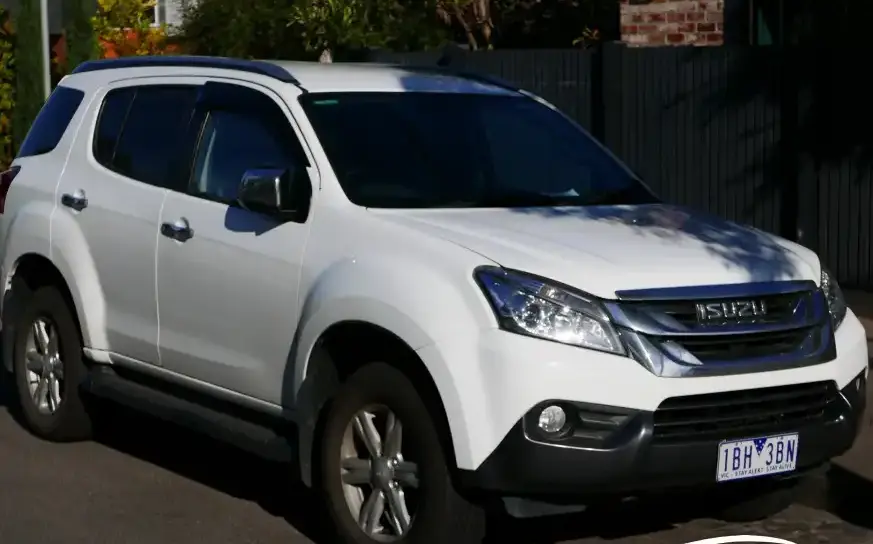
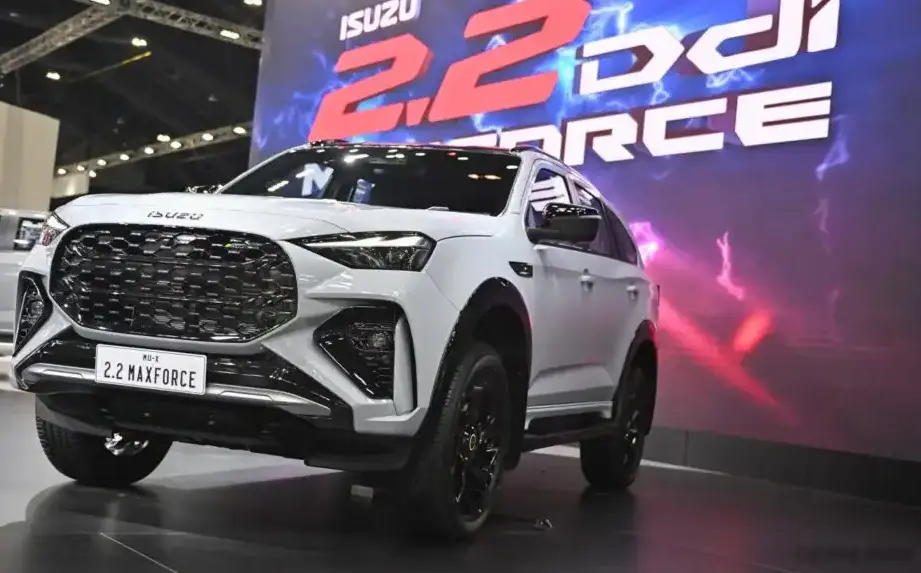
The Isuzu MU-X II, in its 1.9 Ddi (150 Hp) Rev Tronic guise introduced with the 2024 facelift, represents Isuzu’s mid-size SUV offering, primarily aimed at markets outside of North America. Production commenced in June 2024. This version builds upon the second-generation MU-X platform, striving for a balance of practicality, off-road capability, and fuel efficiency within the competitive SUV segment. The MU-X serves as Isuzu’s seven-seater SUV, positioned as a robust alternative to vehicles from Toyota, Mitsubishi, and Ford in regions like Australia, Southeast Asia, and parts of South America. This particular 1.9L diesel automatic configuration is often a mid-range offering, situated between base model variants and higher-specification trims with more powerful engines or additional features.
Powertrain & Engine Architecture
The core of this MU-X variant is the RZ4E-TC 1.9-liter four-cylinder diesel engine. This engine is a relatively recent development for Isuzu, engineered to deliver a balance of power and fuel economy. It employs a common-rail direct injection system, injecting fuel at extremely high pressure for optimized combustion. The engine also features a turbocharger with an intercooler, enhancing power output and improving torque delivery. The DOHC (Double Overhead Camshaft) valvetrain contributes to efficient engine breathing. A notable feature is the high compression ratio of 15.9:1, typical of modern diesel engines, which boosts thermal efficiency. The ‘Rev Tronic’ automatic transmission is a six-speed unit, specifically calibrated for the characteristics of the 1.9L diesel. It’s designed to provide smooth shifts and optimize fuel economy, although it might not offer the same level of responsiveness as some more advanced automatic transmissions.
Driving Characteristics
The 150 horsepower and 350 Nm (258 lb-ft) of torque generated by this engine provide sufficient performance for everyday driving and moderate towing. While not a performance-focused setup, the engine delivers a useful amount of low-end torque, making it suitable for navigating diverse terrains. The automatic transmission, while smooth, can occasionally feel hesitant during rapid acceleration or when attempting to overtake. Compared to higher-output MU-X variants (often equipped with 3.0L engines), this 1.9L automatic version prioritizes fuel economy over outright speed. The gear ratios are optimized for cruising and fuel efficiency, rather than aggressive acceleration. The rear-wheel-drive configuration contributes to a more traditional SUV feel, and while capable off-road, it lacks the all-wheel-drive capability of some competitors.
Equipment & Trim Levels
The 1.9 Ddi Rev Tronic trim typically includes standard features such as air conditioning, power windows, a basic audio system with Bluetooth connectivity, and a rearview camera. Higher trim levels add features like leather upholstery, a touchscreen infotainment system with navigation, automatic climate control, and advanced safety features like lane departure warning and automatic emergency braking. Interior upholstery is generally cloth on the base trims, with leather options available as upgrades. Dashboard configurations are functional and straightforward, prioritizing usability over elaborate design. Optional extras often include a sunroof, upgraded audio systems, and alloy wheels.
Chassis & Braking
The MU-X II utilizes a body-on-frame construction, providing a robust and durable chassis. The front suspension consists of a double wishbone setup with coil springs and a transverse stabilizer bar, while the rear suspension employs a rigid axle configuration with coil springs and a stabilizer bar. This setup is designed to provide a comfortable ride and good off-road capability. Braking is handled by ventilated discs on all four wheels, providing adequate stopping power. The inclusion of ABS (Anti-lock Braking System) is standard, enhancing safety during emergency braking situations. The relatively high ride height (230mm / 9.06 inches) contributes to good ground clearance for off-road driving.
Market Reception & Comparison
The 1.9L diesel automatic MU-X has generally been well-received in its target markets as a practical and reliable SUV. Critics have praised its fuel efficiency and comfortable ride, but some have noted the engine’s lack of outright power compared to larger-displacement alternatives. Compared to the 3.0L diesel variants, the 1.9L offers better fuel economy but sacrifices some performance. The 1.9L is often viewed as a more affordable entry point into the MU-X range, appealing to buyers who prioritize practicality and fuel savings over performance. Reliability has been a strong suit for Isuzu, and the 1.9L engine has proven to be relatively durable.
Legacy
The RZ4E-TC 1.9L diesel engine represents Isuzu’s commitment to developing efficient and reliable powertrains. While still relatively new, initial indications suggest that this engine is proving to be durable and long-lasting. In the used car market, the 1.9L automatic MU-X is likely to be a popular choice for buyers seeking a practical and affordable seven-seater SUV. Its fuel efficiency and relatively simple mechanical design should contribute to lower maintenance costs over the long term. As with any diesel engine, proper maintenance and the use of high-quality fuel and oil are crucial for ensuring its longevity.